The Invisible Variable
In the world of materials science, titanium is a paradox. It is lauded for its strength and resilience, yet during the research phase, it is one of the most temperamental subjects an engineer can handle.
In a hot compression experiment, temperature is not just a setting on a dial. It is a fundamental architect of the material's internal logic. A deviation of a few degrees isn't just a "minor error"—it is a catalyst for an entirely different physical reality.
When we fail to control the thermal environment, we aren't just getting noisy data. We are losing the truth of the material.
The Volatility of Flow Stress
Titanium alloys exhibit extreme flow stress sensitivity. In simpler terms: the material’s resistance to deformation drops off a cliff as it gets hotter.
- Thermal Softening: As the temperature rises, the energy barrier for atoms to move decreases.
- The "Flicker" Effect: If your heating system flickers even slightly, the stress-strain curve develops artificial spikes.
- Data Integrity: These spikes are often mistaken for material hardening or softening, leading to flawed mathematical models that can cause catastrophic failures when applied to real-world aerospace components.
Navigating the Alpha-Beta Threshold
Titanium exists in two primary neighborhoods: the Alpha phase and the Beta phase. The transition between these states is where the magic—and the danger—happens.
High-precision control acts as a "containment field." It keeps the specimen locked within a specific phase region, such as the alpha-plus-beta zone. Without this precision, the specimen may inadvertently drift into a different phase state, contaminating the experiment with variables that have nothing to do with the intended test.
Precision ensures that the thermal softening coefficients you calculate reflect the material’s intrinsic soul, not the inconsistencies of your lab setup.
The Romance of Dislocation Dynamics
There is a certain engineering romance in "freezing" a moment in time.
During hot compression, dislocations—microscopic defects in the crystal lattice—move and rearrange. This is the dance of deformation. High-precision isothermal maintenance allows researchers to isolate these movements.
Why Precision Enables Discovery:
- Thermal Activation: It allows us to see how thermal energy specifically triggers different deformation mechanisms.
- Dynamic Recrystallization: This is the process where new grains form during deformation. Precision ensures that grain refinement is a result of controlled strain, not localized hotspots.
- The Frozen State: When coupled with rapid quenching, a precise thermal field ensures the microstructure you see under the microscope is a faithful snapshot of the actual deformation process.
The Invisible Tax: Oxidation and Contamination
Titanium has a hungry appetite for oxygen. At elevated temperatures, this appetite becomes an obsession.
If a system lacks precision and overshoots the target temperature, even briefly, it accelerates the formation of a brittle surface layer. This "alpha case" skews compression results and ruins the specimen's integrity. Precision control isn't just about the data; it’s about protecting the specimen from its own environment.
The Engineer’s Dilemma: System vs. Outcome
In research, we often focus on the "what"—the alloy composition or the strain rate. We neglect the "how"—the system that creates the environment.
A low-precision system creates thermal gradients. One part of your specimen is soft; the other is hard. This leads to "barreling," a localized deformation that renders bulk property measurements meaningless.
As Morgan Housel might suggest, the cost of a failed experiment is rarely just the price of the titanium; it is the compounding interest of lost time and skewed conclusions. Investing in precision hardware is an insurance policy against experimental noise.
Mastering the Environment
| Factor | Behavioral Impact | Precision Benefit |
|---|---|---|
| Flow Stress | Extreme sensitivity to shifts | Measures true material resistance |
| Phase Stability | Unwanted Alpha/Beta shifts | Keeps specimen in targeted zones |
| Oxidation | Brittle surface layers | Prevents structural degradation |
| Microstructure | Static recrystallization | Captures authentic dislocation snapshots |
Engineering the Future with KINTEK
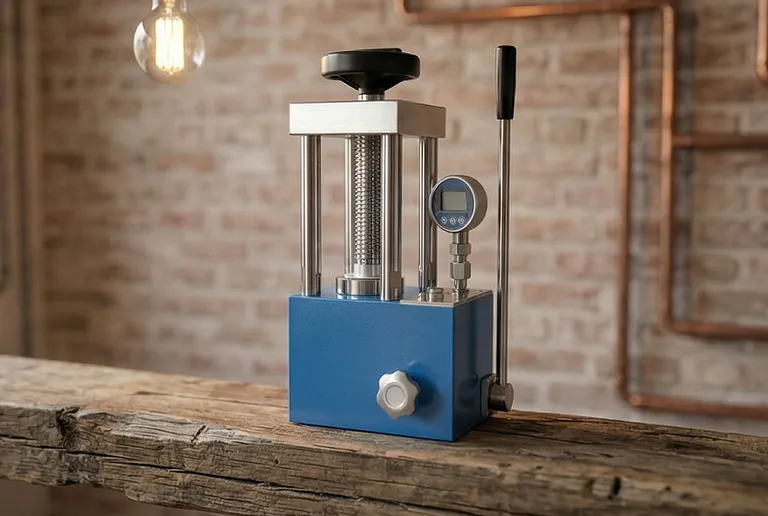
The path to breakthrough discovery in titanium research and battery technology requires total environmental mastery. KINTEK provides the hardware to turn that precision into a standard laboratory practice.
Our comprehensive range of manual, automatic, and heated presses is engineered to eliminate the "flickers" that compromise your data. For those working with sensitive materials in controlled environments, our glovebox-compatible models and isostatic presses (CIP/WIP) offer the stability required for high-fidelity research.
When the margin for error is zero, your equipment should be your greatest certainty.