
Automated Cold Isostatic Pressing (CIP) systems are specifically engineered for processing "difficult-to-process" materials, particularly powders that must be dry-pressed without additives, and for manufacturing elongated geometries like pipes that traditional methods cannot easily handle.
Core Takeaway Automated CIP systems solve the dual challenge of processing sensitive, binder-free powders and producing complex, long-form shapes. By integrating robotics, these systems not only enable the manufacture of these difficult components but also significantly reduce contamination risks and production cycles compared to manual operations.
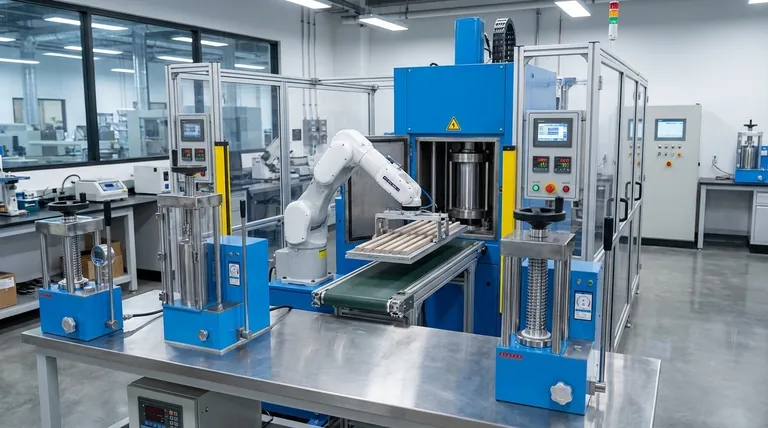
Solving Material and Geometric Challenges
Mastering Dry Pressing Applications
Automated CIP systems excel when handling powders that require dry pressing. These are specific applications where the introduction of water, lubricants, or binders is strictly prohibited or detrimental to the final product.
Because the system allows for high-pressure compaction without these additives, it is ideal for materials where chemical purity is paramount. This capability allows for the consolidation of powders that would otherwise be impossible to form using standard wet pressing techniques.
Producing Elongated Geometries
Traditional pressing methods often struggle with aspect ratios, making long, slender parts difficult to manufacture uniformly.
Automated CIP systems are particularly beneficial for producing long bars or pipes. The isostatic nature of the pressure ensures uniform density along the entire length of the component, overcoming the structural inconsistencies often found in traditional uniaxial pressing of long parts.
The Operational Advantages of Automation
Eliminating Human Variability
The integration of automated loading and unloading mechanisms directly addresses the inconsistencies of manual labor.
By removing the human element from the physical handling of the pressure vessel, the system minimizes human error. This results in a highly repeatable process where every cycle adheres to strict parameters.
Ensuring Consistency with Robotics
Systems equipped with robotic arms provide a level of precision that manual handling cannot match.
These robots precisely place and retrieve materials from the vessel. This mechanical consistency ensures that every part is subjected to the exact same handling forces and positioning, leading to superior batch-to-batch uniformity.
Reducing Contamination Risks
For high-purity applications, human contact is a primary source of contamination.
Automated robotic retrieval significantly reduces the risk of contamination. By keeping operators at a distance and utilizing clean, automated end-effectors, the purity of the dry-pressed powder is maintained throughout the cycle.
Accelerating Production Cycles
Beyond quality, automation addresses the bottleneck of speed.
Automated mechanisms significantly speed up the processing cycle. By streamlining the loading and unloading phases, the system maximizes the active pressing time and increases overall throughput.
Understanding the Context
While automated CIP systems offer distinct advantages, it is important to understand the context of their application to ensure they are the right fit.
The Necessity of Complexity
These systems are characterized by their ability to handle "difficult to process" materials.
If your materials are easily processed with standard binders or do not require high aspect ratios (like long bars), the specialized capabilities of an automated CIP system regarding "dry pressing" may exceed your requirements. The system's value is maximized when the material or geometry presents a specific manufacturing barrier.
Making the Right Choice for Your Goal
To determine if an automated CIP system is the correct solution for your facility, assess your primary manufacturing drivers:
- If your primary focus is Material Purity: The system is essential for powders that require dry pressing without binders or lubricants to prevent chemical contamination.
- If your primary focus is Component Geometry: The system is the superior choice for manufacturing long bars or pipes that are structurally compromised by traditional pressing methods.
- If your primary focus is Operational Efficiency: The integration of robotic arms and automated loading will reduce cycle times and eliminate human error.
Automated CIP represents the intersection of material science and robotics, offering a definitive solution for manufacturers who cannot compromise on purity, geometry, or consistency.
Summary Table:
| Key Benefit | Description |
|---|---|
| Material Purity | Ideal for dry pressing powders without binders or lubricants, ensuring chemical purity. |
| Complex Geometry | Superior for manufacturing long bars and pipes with uniform density via isostatic pressure. |
| Operational Efficiency | Robotic automation minimizes human error, reduces contamination, and accelerates production cycles. |
Struggling with difficult-to-process powders or complex part geometries?
KINTEK's automated CIP systems are engineered to solve these exact challenges. Our automatic lab presses and isostatic presses deliver the precision and purity your laboratory demands.
We specialize in providing solutions that:
- Maintain Material Purity: Perfect for dry pressing sensitive powders without contamination.
- Achieve Uniform Density: Produce consistent, high-integrity long-form components.
- Boost Throughput: Automate your process to reduce cycle times and human error.
Ready to enhance your lab's capabilities? Contact KINTEK today to discuss how our specialized lab press machines can meet your specific application needs.
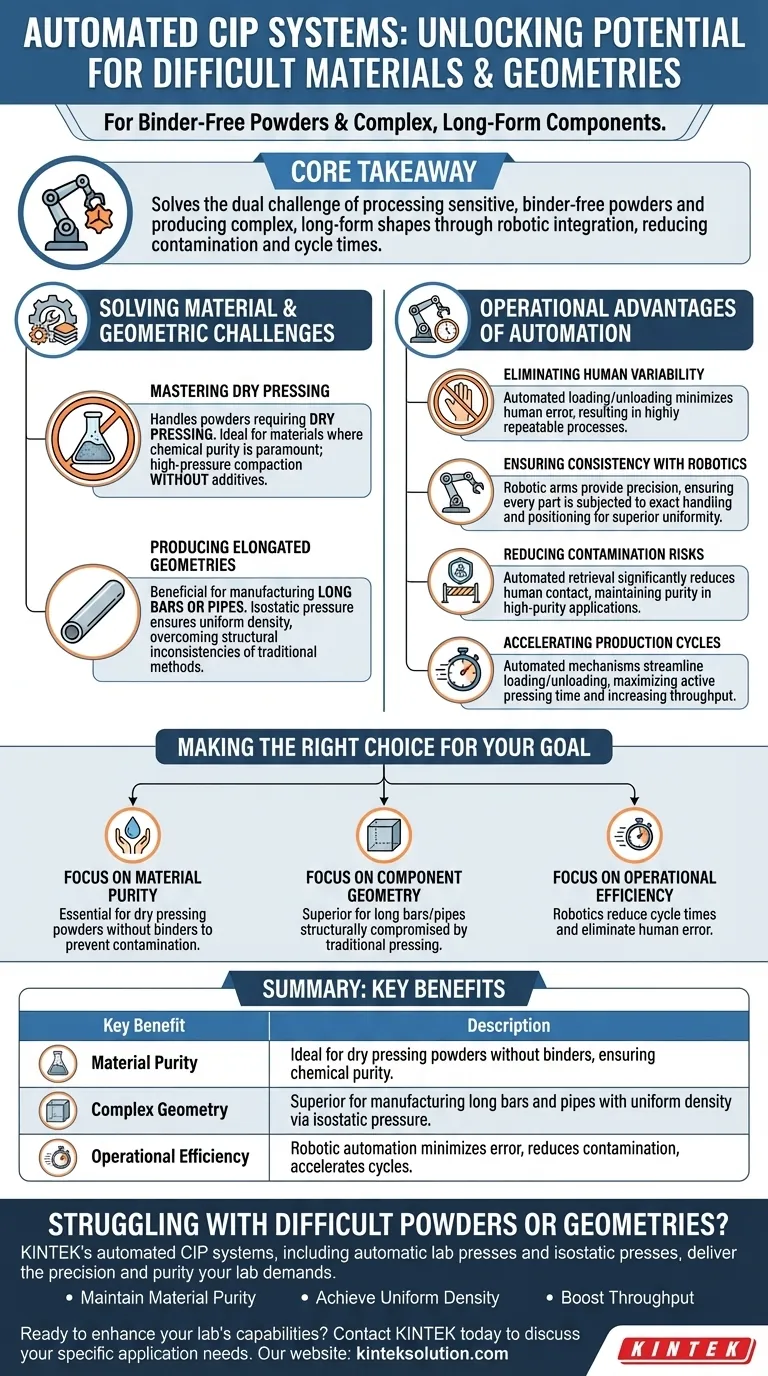
Visual Guide
Related Products
- Automatic Lab Cold Isostatic Pressing CIP Machine
- Manual Cold Isostatic Pressing CIP Machine Pellet Press
- Electric Lab Cold Isostatic Press CIP Machine
- Electric Split Lab Cold Isostatic Pressing CIP Machine
- Warm Isostatic Press for Solid State Battery Research Warm Isostatic Press
People Also Ask
- What are the key features of automated laboratory Cold Isostatic Press (CIP) systems? Achieve Precise, High-Pressure Powder Consolidation
- Why is an Isostatic Press (CIP) Necessary After Uniaxial Pressing? Achieve Transparency in Nd:Y2O3 Ceramics
- How does a Cold Isostatic Press (CIP) increase Bi-2223/Ag current density? Boost Superconductivity with Uniform Pressure
- How does a Cold Isostatic Press (CIP) facilitate the preparation of CaO-doped silicon carbide (SiC) green bodies?
- What is the primary function of a Cold Isostatic Press (CIP) in NASICON preparation? Achieve 96% Theoretical Density



















