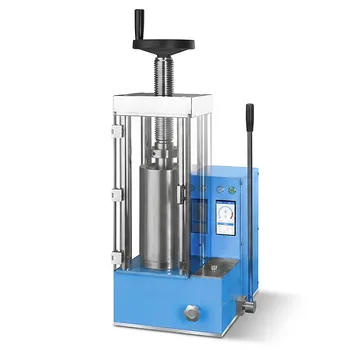
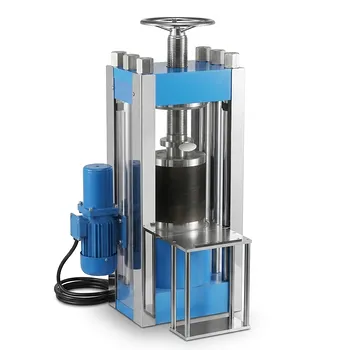
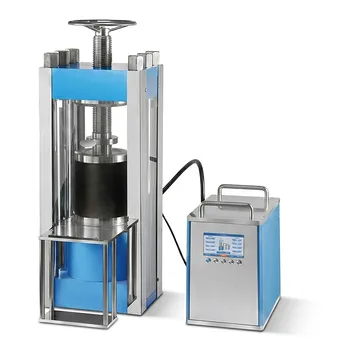
The dry bag process relies on a permanently installed flexible membrane within the pressure vessel to transmit force while isolating the workpiece from the hydraulic fluid. Instead of submerging a sealed mold into liquid, powder is loaded into a forming mold and placed inside this fixed "master" membrane. Pressure is applied to the master membrane's external surface, transferring isostatic force to the powder without the forming mold ever touching the liquid.
The core advantage of dry bag pressing is the ability to automate high-volume production. By integrating the pressure isolation membrane directly into the vessel wall, it bypasses the manual sealing and submersion steps of wet bag pressing, allowing for cycle times as fast as one minute.
The Mechanics of the Dry Bag Process
The Fixed Membrane Architecture
The defining feature of this method is the "master mold" or flexible membrane that is built into the pressure vessel itself.
This membrane creates a permanent barrier between the hydraulic fluid and the central chamber where the pressing occurs. Because the fluid never enters the forming chamber, the tooling and the powder remain "dry" throughout the entire cycle.
The Pressing Cycle
To begin the process, powder is loaded into a specific forming mold. This forming mold is then positioned inside the vessel's fixed pressurized membrane.
When the system activates, hydraulic fluid pressurizes the space behind the fixed membrane. The membrane expands inward, exerting uniform isostatic pressure on the forming mold and compacting the powder into a dense, solid mass.
Speed and Automation
Because the master mold is fixed, the system acts more like a standard production machine than a batch processing tank.
There is no need to manually seal bags or hoist heavy molds in and out of liquid tanks. This allows for continuous operation and rapid automated cycling, making it significantly faster than wet bag technologies.
Understanding the Trade-offs
Geometry and Size Limitations
While efficient, the dry bag process is rigid regarding product dimensions.
Because the pressurized master mold is a fixed component of the machine, the size and shape of the products you can produce are strictly limited by that specific vessel's geometry. You cannot simply swap in a significantly larger or oddly shaped mold as you could in a wet bag system.
Tooling Complexity vs. Flexibility
This method favors long production runs over versatility.
Changing the setup to produce a different component often requires changing the fixed membrane or using specific adapters, which can be time-consuming. It is less suited for prototyping or "high-mix, low-volume" manufacturing environments.
Making the Right Choice for Your Production
If you are deciding between isostatic pressing methods, consider your volume and geometric requirements:
- If your primary focus is high-volume mass production: Choose the dry bag process for its ability to automate cycles and produce simple shapes in as little as one minute.
- If your primary focus is large, complex, or prototype parts: Opt for the wet bag process, as it allows for varied mold sizes and shapes to be pressed simultaneously in a single vessel.
Ultimately, dry bag pressing is the superior choice when speed and consistency outweigh the need for geometric flexibility.
Summary Table:
| Feature | Dry Bag Isostatic Pressing | Wet Bag Isostatic Pressing |
|---|---|---|
| Membrane Type | Permanently fixed in vessel | Manual sealed bags |
| Cycle Speed | Fast (often < 1 minute) | Slow (batch processing) |
| Automation | High - suitable for mass production | Low - manual handling required |
| Fluid Contact | None (powder stays dry) | Mold is submerged in liquid |
| Flexibility | Limited by fixed vessel geometry | High - supports various sizes/shapes |
| Best Use Case | Continuous production of simple parts | Prototyping and large, complex parts |
Streamline Your Production with KINTEK's Isostatic Pressing Solutions
Maximize your laboratory or manufacturing throughput with KINTEK’s industry-leading cold isostatic presses. Whether you require the high-speed automation of dry bag processing for battery research or the versatile capacity of wet bag systems, our comprehensive range—including manual, automatic, and heated models—is engineered for precision and durability.
Why choose KINTEK?
- Expertise: Specialized solutions for battery research and advanced material science.
- Versatility: From glovebox-compatible units to heavy-duty isostatic presses.
- Efficiency: Reduce cycle times and improve material density with our state-of-the-art hydraulic systems.
Ready to elevate your material compaction process? Contact our technical experts today to find the perfect pressing solution tailored to your specific volume and geometry requirements.
Related Products
- Electric Lab Cold Isostatic Press CIP Machine
- Automatic Lab Cold Isostatic Pressing CIP Machine
- Electric Split Lab Cold Isostatic Pressing CIP Machine
- Manual Cold Isostatic Pressing CIP Machine Pellet Press
- Electric Isostatic Pressing Machine 40 Tons Automatic Laboratory Powder Compacting Press
People Also Ask
- What are the applications of electric lab cold isostatic presses in research settings? Advance Material R&D with High-Pressure CIPs
- What role do electric lab cold isostatic presses play in industrial contexts? Bridge R&D and Manufacturing with Precision
- How does electrical Cold Isostatic Pressing (CIP) contribute to cost savings? Unlock Efficiency and Reduce Expenses
- What are some research applications of electric lab CIPs? Unlock Uniform Powder Densification for Advanced Materials
- What are the characteristics of standard off-the-shelf electric lab CIP solutions? Achieve Immediate, Cost-Effective Processing