Battery casings require Polyether Ether Ketone (PEEK) windows because they solve the fundamental engineering conflict of Operando X-ray Absorption Spectroscopy (XAS): keeping the battery sealed while letting the X-rays in. PEEK provides a unique combination of exceptionally low X-ray attenuation and high chemical resistance to the corrosive alkaline electrolytes often used in these energy storage systems.
The Core Technical Requirement
Successful Operando XAS experiments depend on minimizing the barrier between the radiation source and the electrode. PEEK windows are essential because they allow synchrotron X-rays to penetrate the cell efficiently without compromising the structural integrity of the battery environment.
Optimizing Data Quality with Low X-ray Attenuation
Ensuring Efficient Beam Penetration
The primary obstacle in XAS experiments is the physical housing of the battery. The casing must be robust, but dense materials absorb X-rays before they reach the target.
PEEK is used specifically because it possesses a very low X-ray attenuation rate.
This property ensures that X-rays generated by synchrotron radiation sources can pass through the window with minimal energy loss.
Maintaining Fluorescence Signal Quality
Once the X-rays reach the internal electrodes, the system must collect the resulting data.
High attenuation materials would distort or block these signals. PEEK ensures that the collected fluorescence signals remain high-quality and accurate.
By minimizing absorption, PEEK windows provide a clear "optical" path for the X-rays to interact with the electrode materials, which is the core objective of the analysis.
Maintaining Cell Integrity in Harsh Environments
Resisting Alkaline Corrosion
A transparent window is useless if it dissolves during the experiment.
Battery electrolytes, particularly those involved in these studies, are often strong alkaline solutions that are highly corrosive to many standard materials.
Ensuring Long-Term Stability
PEEK offers exceptional chemical stability against these specific electrolytes.
It effectively seals the battery casing, preventing leakage or contamination of the sample environment.
This durability ensures that the window remains intact throughout the duration of the Operando experiment, preventing catastrophic failure of the cell casing.
Understanding the Trade-offs in Material Selection
The Balance of Transparency vs. Containment
When selecting a window material, you are effectively managing a trade-off between signal clarity and chemical containment.
Materials that are stronger or more chemically inert than PEEK often have higher densities, which would block the X-ray beam.
Conversely, materials that are more transparent to X-rays often lack the chemical resistance to survive contact with strong alkaline electrolytes.
PEEK is the industry standard here because it sits in the "sweet spot": it is transparent enough for the synchrotron source and chemically inert enough for the electrolyte.
Making the Right Choice for Your Experiment
When designing a cell for Operando XAS, your choice of window material dictates the limits of your experiment.
- If your primary focus is Signal Quality: Rely on PEEK to minimize attenuation and maximize the integrity of fluorescence signals from the electrode.
- If your primary focus is Chemical Safety: Use PEEK to ensure the window will not degrade or corrode when exposed to strong alkaline electrolytes.
Ultimately, PEEK is the critical enabler that allows researchers to observe the internal physics of a battery without destroying its chemical environment.
Summary Table:
| Feature | Advantage for Operando XAS | Benefit to Researchers |
|---|---|---|
| Low X-ray Attenuation | High synchrotron beam penetration | Minimal energy loss and high-quality data collection |
| Chemical Resistance | Withstands strong alkaline electrolytes | Prevents window degradation and electrolyte leakage |
| Signal Integrity | Clear path for fluorescence signals | High signal-to-noise ratio for electrode analysis |
| Material Stability | Maintains structural integrity | Ensures long-term safety throughout the experiment |
Optimize Your Battery Research with KINTEK Precision Solutions
Elevate the accuracy of your Operando XAS experiments with high-performance laboratory equipment. KINTEK specializes in comprehensive laboratory pressing solutions, offering manual, automatic, heated, multifunctional, and glovebox-compatible models, as well as cold and warm isostatic presses tailored for advanced battery research.
Whether you are developing next-generation electrodes or optimizing electrolyte compatibility, our engineering team is ready to provide the durable, high-precision tools your lab requires.
Ready to upgrade your laboratory capabilities?
Contact KINTEK Today to discover how our pressing solutions can streamline your battery research and ensure reliable, high-quality experimental data.
References
- Eric Zimmerer, Joshua W. Gallaway. Structural identification of disordered γ-MnOOH in the alkaline MnO2 discharge mechanism. DOI: 10.1557/s43579-025-00743-8
This article is also based on technical information from Kintek Solution Knowledge Base .
Related Products
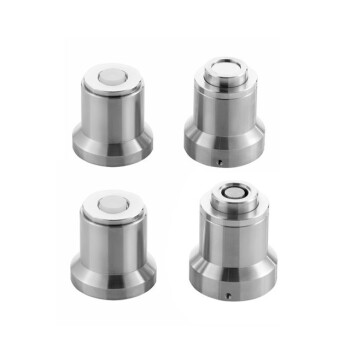
- Lab Button Battery Disassembly and Sealing Mold
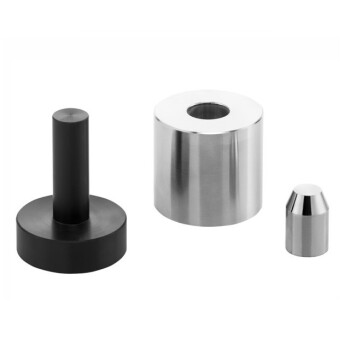
- Lab Button Battery Tablet Press Sealing Mold
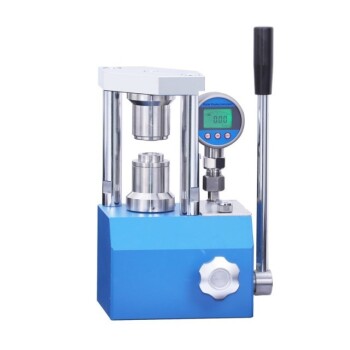
- Button Battery Sealing Press Machine for Lab
- Button Battery Sealing Machine for Button Batteries
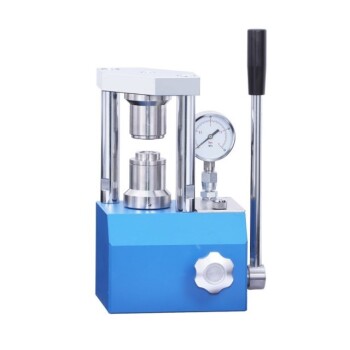
- Manual Button Battery Sealing Machine for Battery Sealing
People Also Ask
- How does a sealed battery mold facilitate the assembly and testing of asymmetric supercapacitors using VO2?
- What is the function of specialized battery molds and sealing consumables? Optimize Your In-situ XRD Testing Today
- How does the geometry of laboratory molds influence mycelium-based composites? Optimize Density and Strength
- Why are specialized battery test molds used? Ensure Peak Performance for All-Solid-State Sodium Batteries (ASSIBs)
- What role do battery testing molds play in electrolyte performance? Exploring Pressure vs. Viscoelasticity