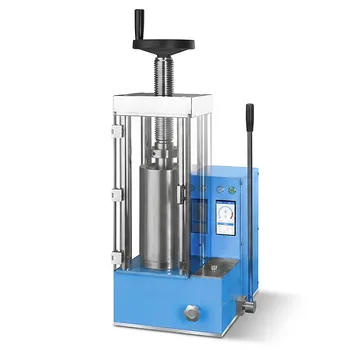
Cold Isostatic Pressing (CIP) enhances fly ash ceramic performance by applying uniform liquid pressure from all directions to eliminate internal density gradients. This process, often applied at pressures like 100 MPa, increases the packing density of the green body far beyond the capabilities of uniaxial pressing. By ensuring structural uniformity, CIP significantly reduces non-uniform shrinkage during sintering and produces ceramics with superior mechanical strength and density.
Cold Isostatic Pressing replaces directional force with isotropic pressure, transforming fly ash particles into a uniformly dense structure. This eliminates the internal stresses and density variations that typically lead to warping, cracking, and structural failure in uniaxially pressed ceramics.
Overcoming the Limitations of Uniaxial Pressing
The Problem of Friction and Gradients
In traditional uniaxial pressing, the rigid die creates wall friction that prevents pressure from distributing evenly throughout the powder. This results in density gradients, where certain areas of the fly ash component are more compacted than others, leading to inherent weak points.
The Isostatic Solution
CIP utilizes a fluid medium to transmit equal pressure to a sealed, flexible sheath containing the powder. This omnidirectional force state ensures that every cubic millimeter of the ceramic body receives identical compaction, effectively eliminating the internal pressure variations found in axial methods.
Achieving Superior Packing Density
By applying high isotropic pressure, CIP forces fly ash particles into a much tighter packing arrangement. This increases the contact points between particles and enhances adhesion, creating a more robust green body even before the firing process begins.
Impact on Sintering and Mechanical Integrity
Mitigating Non-Uniform Shrinkage
Because the density is consistent throughout the entire body, the ceramic undergoes even shrinkage during sintering. This prevents the warping and distortion that commonly occur when high-density and low-density regions shrink at different rates.
Eliminating Structural Defects
The uniform pressure of CIP is critical for preventing delamination and micro-cracks that often plague uniaxially pressed parts. This leads to high-quality components, such as ceramic pistons or frameworks, with highly uniform microstructures and zero-porosity potential.
Significant Strength Improvements
The transition to CIP can result in a dramatic increase in flexural strength, with some ceramic materials showing gains of over 35 percent. In practical terms, this can elevate the strength of a component from 367 MPa to a much more resilient 493 MPa.
Understanding the Trade-offs
Process Complexity and Speed
Compared to the high-speed, automated nature of uniaxial die pressing, CIP is generally a slower process with longer cycle times. It requires specialized fluid handling systems and the management of flexible molds, which can increase operational overhead.
Dimensional Accuracy and Tooling
While CIP is excellent for creating complex shapes, it lacks the extreme dimensional precision of rigid-die uniaxial pressing. Because the molds are flexible, the final "green" dimensions are less predictable, often requiring post-process machining to reach final tolerances.
Strategies for Optimizing Fly Ash Ceramics
How to Apply This to Your Project
To determine if Cold Isostatic Pressing is the correct choice for your fly ash ceramic application, consider your primary performance requirements:
- If your primary focus is Maximum Mechanical Strength: Utilize CIP to achieve the highest possible packing density and a 35%+ increase in flexural strength compared to axial methods.
- If your primary focus is Complex Geometry: Choose CIP for its ability to apply uniform pressure to intricate shapes that cannot be effectively compacted in a rigid, two-part die.
- If your primary focus is High-Volume Production of Simple Shapes: Stick with uniaxial pressing to benefit from faster cycle times and lower costs, provided the resulting density gradients are acceptable for the end-use.
- If your primary focus is Eliminating Sintering Defects: Implement a secondary CIP treatment (post-uniaxial) to "heal" internal density variations and ensure even shrinkage during firing.
By adopting Cold Isostatic Pressing, manufacturers can transcend the structural limits of fly ash, producing ceramics that meet the rigorous standards of high-performance engineering.
Summary Table:
| Feature | Uniaxial Pressing | Cold Isostatic Pressing (CIP) |
|---|---|---|
| Pressure Direction | Unidirectional (One or two axes) | Isotropic (Omnidirectional fluid pressure) |
| Density Uniformity | Low (Density gradients & friction) | High (Uniform throughout green body) |
| Flexural Strength | Standard | High (Up to 35%+ improvement) |
| Part Geometry | Simple shapes (pellets, cylinders) | Complex, intricate, and large shapes |
| Sintering Result | Prone to warping and cracking | Even shrinkage, high integrity |
Elevate Your Material Research with KINTEK Precision Solutions
Are you struggling with internal density gradients or structural failures in your ceramic components? KINTEK specializes in comprehensive laboratory pressing solutions tailored for high-performance battery research and material science.
Our range includes:
- Isostatic Presses: Cold (CIP) and Warm (WIP) models for uniform density and complex shapes.
- Uniaxial Presses: Manual, automatic, heated, and multifunctional models.
- Specialized Systems: Glovebox-compatible configurations for sensitive environments.
Contact us today to discuss how our laboratory pressing equipment can help you achieve 35% higher flexural strength and superior microstructural uniformity in your fly ash ceramics and battery research projects.
References
- Nur Azureen Alwi Kutty, Sani Garba. Influence on the Phase Formation and Strength of Porcelain by Partial Substitution of Fly Ash Compositions. DOI: 10.14419/ijet.v7i4.30.22281
This article is also based on technical information from Kintek Solution Knowledge Base .
Related Products
- Manual Cold Isostatic Pressing CIP Machine Pellet Press
- Automatic Lab Cold Isostatic Pressing CIP Machine
- Electric Split Lab Cold Isostatic Pressing CIP Machine
- Electric Lab Cold Isostatic Press CIP Machine
- Lab Isostatic Pressing Molds for Isostatic Molding
People Also Ask
- Why is Cold Isostatic Pressing (CIP) necessary for SBN ceramics? Achieve High-Density and Crack-Free Sintering
- Why is Cold Isostatic Pressing (CIP) applied after uniaxial pressing? Optimize Superconductor Precursor Density
- What are the process advantages of using Cold Isostatic Pressing (CIP) for LSMO? Achieve Defect-Free Density
- What types of equipment are available for cold isostatic pressing? Explore CIP Solutions for Labs and Production
- What are the technical advantages of cold isostatic pressing equipment compared to uniaxial compression equipment? Learn More!