The primary requirements for pressed targets used in the reactive sputtering of BaNbOxNy thin films are excellent electrical conductivity and high mechanical strength. These targets are typically multi-phase materials fabricated by pressing mixed powders, specifically Ba3N2 and NbN, under high pressure to ensure they can withstand the rigorous sputtering environment.
Core Takeaway Because manufacturing large, dense oxynitride ceramic targets is technically difficult, the industry relies on high-pressure pressed powder targets. To function correctly, these targets must overcome the inherent fragility of powders by achieving sufficient density to resist ion bombardment and adequate conductivity to ensure uniform film deposition.
Composition and Fabrication
The Material Mixture
The targets are not single-phase ceramics but rather multi-phase materials. They are created by mixing specific precursor powders to achieve the desired stoichiometry.
Specific Powder Components
The standard mixture for these targets involves Ba3N2 (Barium Nitride) and NbN (Niobium Nitride). These components are selected to introduce the necessary Barium and Niobium elements into the deposition process.
The Pressing Process
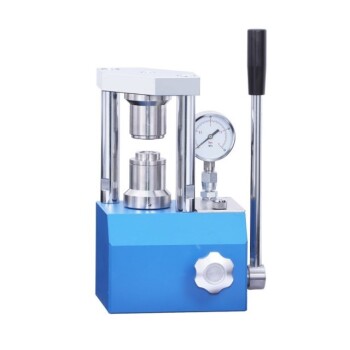
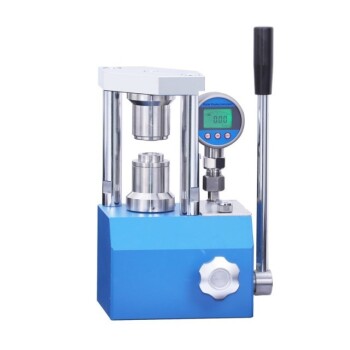
These powders must be subjected to high-pressure pressing. This is critical to transform loose powder into a solid form that mimics the behavior of a dense ceramic during the sputtering process.
Critical Performance Requirements
Electrical Conductivity
The target must exhibit excellent electrical conductivity. Without high conductivity, the sputtering process becomes inefficient or unstable, leading to poor film quality.
Ensuring Uniformity
Conductivity is also directly linked to the uniform deposition of the thin film components. A conductive target ensures a stable discharge, allowing the BaNbOxNy film to grow evenly across the substrate.
Mechanical Strength
The target must possess robust mechanical strength. The sputtering environment involves intense physical stress, specifically from the bombardment of high-energy ions.
Resistance to Ion Bombardment
If the target lacks sufficient strength, the ion bombardment can disintegrate the pressed powder. A weak target will fail mechanically, contaminating the vacuum chamber or halting the deposition process entirely.
Understanding the Trade-offs
The Manufacturing Challenge
Creating large, dense oxynitride ceramic targets is notoriously difficult. The material properties often lead to cracking or density issues during traditional sintering.
The Pressed Powder Solution
High-pressure pressed powder targets are the practical solution to this manufacturing bottleneck. However, the trade-off is that they are inherently less stable than a perfect ceramic, making the strict requirements for density and pressure non-negotiable to avoid failure.
Making the Right Choice for Your Goal
To ensure the successful deposition of BaNbOxNy films, prioritize the physical integrity of your target fabrication:
- If your primary focus is Process Stability: Ensure the pressing pressure is maximized to create high mechanical strength, preventing target disintegration during ion bombardment.
- If your primary focus is Film Uniformity: Verify that the ratio of Ba3N2 and NbN powders results in a target with high electrical conductivity to maintain a stable plasma discharge.
Success in this deposition process relies entirely on bridging the gap between loose powder and solid ceramic through high-pressure fabrication.
Summary Table:
| Requirement | Specification | Importance in Sputtering |
|---|---|---|
| Material Composition | Ba3N2 and NbN mixed powders | Introduces necessary Barium and Niobium elements |
| Electrical Conductivity | Excellent / High | Ensures stable discharge and uniform film deposition |
| Mechanical Strength | High-pressure pressed | Resists disintegration under intense ion bombardment |
| Physical State | Multi-phase solid | Overcomes the difficulty of manufacturing dense ceramic targets |
Optimize Your BaNbOxNy Thin Film Research with KINTEK
Achieving the perfect balance of conductivity and strength in pressed targets is critical for thin film success. KINTEK specializes in comprehensive laboratory pressing solutions designed for precision materials research.
Whether you are developing advanced oxynitride thin films or exploring next-generation battery technologies, our extensive range of manual, automatic, heated, and multifunctional presses—including cold and warm isostatic presses—ensures your targets meet the highest density and uniformity standards.
Ready to elevate your deposition process? Contact KINTEK today to find the ideal pressing solution for your laboratory needs.
References
- Yuji Masubuchi, Shinichi Kikkawa. Processing of dielectric oxynitride perovskites for powders, ceramics, compacts and thin films. DOI: 10.1039/c4dt03811h
This article is also based on technical information from Kintek Solution Knowledge Base .
Related Products
- Warm Isostatic Press for Solid State Battery Research Warm Isostatic Press
- Manual Laboratory Hydraulic Press Lab Pellet Press
- Lab Cylindrical Press Mold for Laboratory Use
- Laboratory Hydraulic Press Lab Pellet Press Machine for Glove Box
- Heated Hydraulic Press Machine with Heated Plates for Vacuum Box Laboratory Hot Press
People Also Ask
- Why must composite cathodes be sealed in vacuum lamination bags for WIP? Ensure Battery Stability and Density
- How do sacrificial volume materials (SVM) maintain microchannels in isostatic pressing? Ensure Structural Integrity
- What is the function of elastic molds in warm isostatic pressing? Achieve Uniform Density in Composite Particles
- What is the mechanism of a Warm Isostatic Press (WIP) on cheese? Master Cold Pasteurization for Superior Safety
- What is the role of the flexible material in warm isostatic pressing? Key to Uniform Density & Precision