
Titanium (Ti) is selected primarily for its unique ability to perform a dual function within a single experimental setup. It possesses the high mechanical strength required to compress Na3PS4 powder into a dense pellet and the chemical stability to act as an effective current collector during subsequent testing. This eliminates the need to remove or handle the fragile electrolyte pellet between the pressing and testing stages.
The Core Value of Titanium Plungers By combining structural rigidity with electrochemical inertness, titanium allows researchers to seamlessly transition from high-pressure fabrication to impedance spectroscopy. This "one-pot" approach minimizes sample contamination and ensures the physical integrity of the electrolyte layer remains compromised.
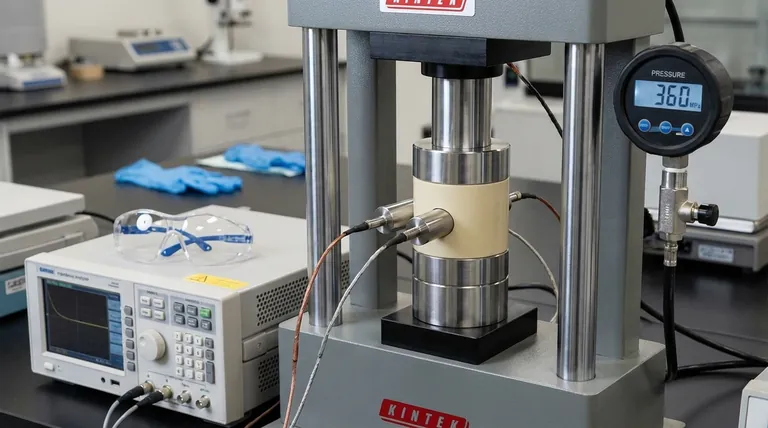
The Mechanical Necessity: High-Pressure Densification
Transmitting Extreme Force
To create a viable solid-state electrolyte, Na3PS4 powder must be compressed into a dense ceramic pellet. This requires applying significant hydraulic pressure, often reaching 360 MPa.
Reducing Grain Boundary Resistance
Titanium plungers are sufficiently strong to transmit this load from the lab press to the powder without deforming. This high-pressure compaction minimizes porosity and ensures intimate contact between particles, which is critical for reducing grain boundary resistance and achieving high ionic conductivity.
The Electrochemical Advantage: Stability and Function
Chemical Inertness
Sulfide-based electrolytes like Na3PS4 can be chemically reactive. Titanium is chosen because it is chemically stable when in contact with Na3PS4, ensuring that the plunger does not corrode or contaminate the sample during the experiment.
Acting as an Ion-Blocking Electrode
Beyond simply pressing the powder, the titanium plunger functions as an active component in the measurement circuit. It acts as an ion-blocking electrode, meaning it allows electrons to flow for measurement but prevents ions from entering the metal.
Simplifying the Circuit
Because the plunger acts as the current collector, the pressing assembly itself becomes the testing cell. You can connect the analyzer directly to the titanium plungers to perform Electrochemical Impedance Spectroscopy (EIS) immediately after compaction.
System Compatibility and Construction
The Role of PEEK Molds
The utility of titanium plungers relies on the surrounding infrastructure, specifically the use of a Polyetheretherketone (PEEK) mold. While the titanium delivers the pressure and conducts the current, the PEEK mold provides electrical insulation.
Preventing Short Circuits
This combination is essential. The PEEK mold withstands the 450 MPa pressure limits while preventing short circuits between the two titanium plungers. This setup guarantees that the electrical data collected reflects the properties of the Na3PS4 pellet, not the testing rig.
Understanding the System Dependencies
The "All-in-One" Requirement
While titanium allows for a simplified workflow, it creates a dependency on the specific testing cell design. You cannot use titanium plungers effectively for EIS if your mold is also conductive (e.g., steel), as this would bypass the sample entirely.
Pressure Limitations
Titanium is strong, but it is not infinitely rigid. While it handles the 360 MPa required for Na3PS4 densification, pushing pressures significantly higher (approaching the yield strength of the specific titanium alloy) could deform the plunger, causing it to seize inside the PEEK mold.
Making the Right Choice for Your Goal
When designing your solid-state electrolyte experiments, consider how the plunger material impacts your workflow efficiency and data quality.
- If your primary focus is streamlined testing: Use titanium plungers to enable "press-and-measure" workflows, allowing you to run EIS without extracting the pellet from the mold.
- If your primary focus is sample purity: Rely on titanium's chemical stability to prevent side reactions that could skew impedance data or degrade the sulfide electrolyte.
By selecting titanium, you effectively turn your fabrication tool into a precision measurement device, saving time while preserving the structural integrity of your sample.
Summary Table:
| Key Property of Titanium | Benefit for Na3PS4 Pellet Experiment |
|---|---|
| High Mechanical Strength | Withstands high pressure (up to 360 MPa) for effective powder densification. |
| Chemical Inertness | Prevents corrosion and contamination of the reactive sulfide electrolyte. |
| Ion-Blocking Electrode | Functions as a current collector for immediate Electrochemical Impedance Spectroscopy (EIS). |
| 'One-Pot' Workflow | Eliminates pellet handling between pressing and testing, saving time and preserving integrity. |
Ready to Streamline Your Solid-State Electrolyte Research?
KINTEK's specialized lab press systems, including automatic and heated lab presses, are designed to integrate seamlessly with precision components like titanium plungers and PEEK molds. This ensures you can achieve reliable, high-quality data from your Na3PS4 and other sensitive electrolyte pellets.
Contact us today to discuss how our equipment can enhance your 'press-and-measure' workflow, improve efficiency, and protect your sample integrity.
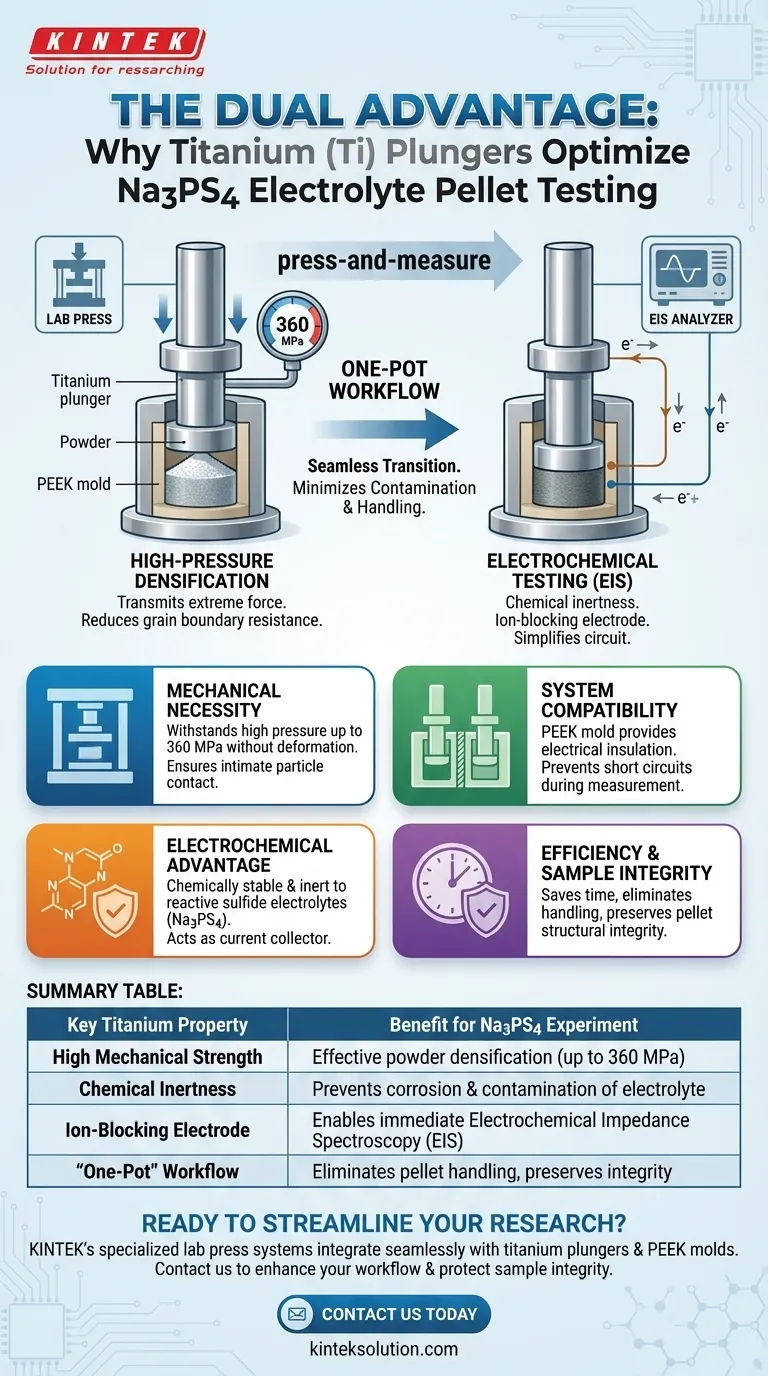
Visual Guide
Related Products
- Automatic Laboratory Hydraulic Press Lab Pellet Press Machine
- Manual Laboratory Hydraulic Pellet Press Lab Hydraulic Press
- Manual Laboratory Hydraulic Press Lab Pellet Press
- Laboratory Hydraulic Pellet Press for XRF KBR FTIR Lab Press
- Laboratory Hydraulic Press Lab Pellet Press Machine for Glove Box
People Also Ask
- What is the primary purpose of a manual lab hydraulic pellet press? Ensure Accurate Sample Prep for XRF and FTIR
- What is the primary purpose of manual lab hydraulic pellet presses? Achieve High-Precision Sample Preparation for Spectroscopy
- Why are high-precision automatic hydraulic presses required for Martian ISRU? Ensure Reliable Regolith Forming
- How does an automatic laboratory hydraulic press improve KBr pellet preparation? Achieve Precision IR Spectroscopy
- What are the advantages of using an automatic laboratory hydraulic press? Enhance Precision in Sample Preparation










