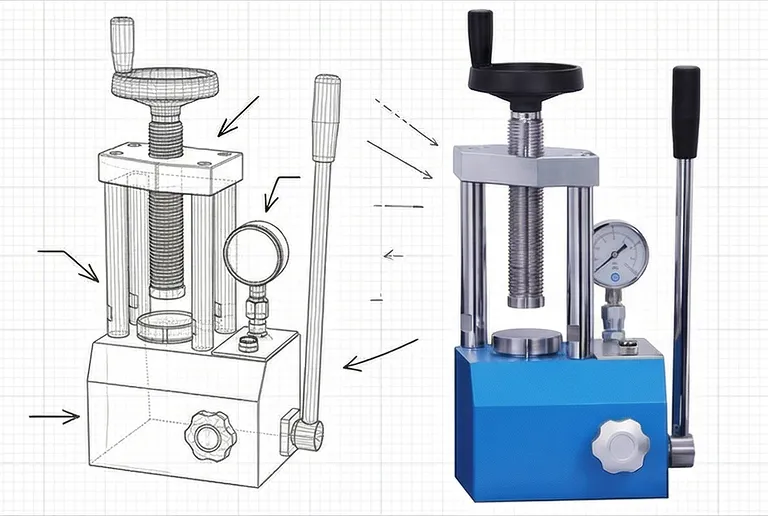
The Invisible Architecture of Energy
In the pursuit of the next generation of energy storage, we often focus on the "what"—the chemistry of the cathode or the conductivity of the electrolyte. But in the laboratory, the "how" is governed by mechanics.
Solid-state battery research is, at its core, a struggle against air. Specifically, the voids and gaps that exist between particles of sulfide electrolytes like $Li_6PS_5Cl$.
To turn a handful of Argyrodite powder into a functional ion highway, chemistry is not enough. You need the disciplined application of force.
The First Stage: 370 MPa and the "Cold Weld"
In traditional ceramics, we use heat to fuse particles—a process called sintering. Sulfide electrolytes allow for a different, more elegant path: plastic deformation.
At 370 MPa, something transformative happens to $Li_6PS_5Cl$. Because it is relatively ductile, the particles don't just touch; they flow into one another.
- Cold Welding: The high pressure forces particles to merge without external heat.
- Void Elimination: Internal porosity is the enemy of ion transport. 370 MPa acts as the physical cleanup crew, removing the "dead space" that increases bulk impedance.
- The Dendrite Barrier: Only a dense, void-free pellet possesses the mechanical strength to resist lithium dendrites. A loose pellet is a short circuit waiting to happen.
The Second Stage: The 80 MPa Handshake
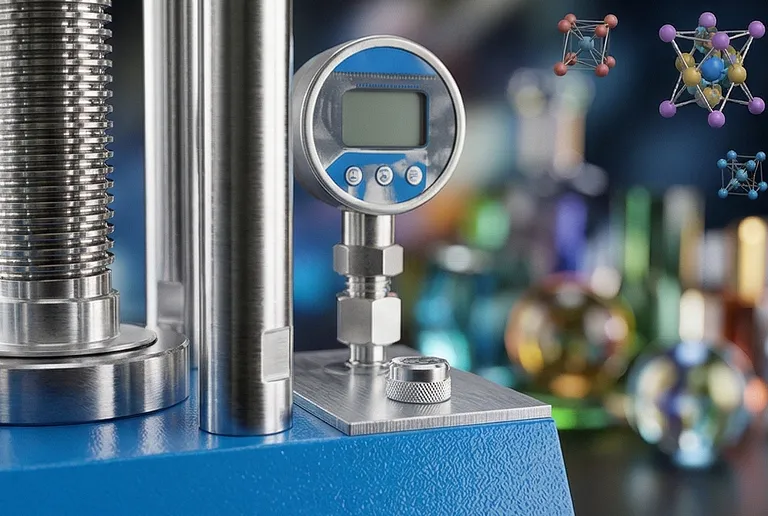
If the first stage is about brute force densification, the second stage is about delicate integration. Once you have a dense electrolyte pellet, you must introduce the anode.
Applying another 370 MPa during this stage would likely fracture the pre-formed electrolyte or damage the interface. Instead, the industry standard shifts to approximately 80 MPa.
This is "lamination." It is a handshake between layers. The goal is to establish seamless interfacial contact without compromising the structural integrity of the components. High enough to ensure low resistance; low enough to prevent mechanical failure.
The Psychological Trap of "Set and Forget"
A common mistake in battery assembly is treating pressure as a momentary event. In reality, sulfide materials are dynamic. They expand and contract during electrochemical cycling.
A press that cannot maintain a consistent mechanical constraint is a liability. If the contact is lost—even by a few microns—the interfacial resistance spikes, and the battery dies a "mechanical death" rather than a chemical one.
| Stage | Pressure Target | Primary Objective | Engineering Outcome |
|---|---|---|---|
| Densification | 370 MPa | Powder Compaction | Eliminates porosity; triggers plastic flow |
| Lamination | 80 MPa | Electrode Integration | Creates seamless, low-resistance interfaces |
| Cycling | Sustained Force | Pressure Maintenance | Counteracts volume changes during use |
The Engineer’s Instrument: Why the Press Matters
Precision in pressure is not a luxury; it is the boundary between a breakthrough and a failed experiment. Applying 370 MPa requires more than just a pump—it requires a system that can handle the fatigue of high-strength steel molds and the sensitivity of glovebox environments.
At KINTEK, we design laboratory pressing solutions that understand this duality of force and finesse. Whether you are performing the initial high-pressure crush or the delicate lamination handshake, the equipment must be as precise as the chemistry it supports.
Our suite of solutions for battery researchers includes:
- Automatic Presses: For repeatable, programmable pressure staging.
- Glovebox-Compatible Models: Protecting moisture-sensitive sulfides from degradation.
- Isostatic Presses (CIP/WIP): For achieving the ultimate uniform density in complex geometries.
The future of solid-state power isn't just written in chemical formulas—it is forged under the right amount of pressure.
To optimize your sulfide electrolyte processing with precision-engineered equipment, Contact Our Experts.
Related Products
- Warm Isostatic Press for Solid State Battery Research Warm Isostatic Press
- Manual Laboratory Hydraulic Pellet Press Lab Hydraulic Press
Related Articles
- How Warm Isostatic Pressing Transforms High-Performance Manufacturing
- How Warm Isostatic Pressing Optimizes Material Performance for Industrial Applications
- The Pressure to Be Perfect: How Hot Isostatic Pressing Achieves Absolute Material Integrity
- The Physics of Patience: Why Hot Isostatic Pressing Trades Speed for Certainty
- The Enemy Within: How Hot Isostatic Pressing Forges Perfect Material Integrity

