The End of the Liquid Crutch
In traditional battery chemistry, liquid electrolytes are a cheat code. Fluids are naturally forgiving; they flow into microscopic crevices, "wetting" the electrode and ensuring that every active particle is submerged in a sea of ion carriers.
In the solid-state world, we lose this luxury.
When you place a solid cathode against a solid electrolyte, they don't actually touch—not in the way ions require. At a microscopic level, they look like two mountain ranges pressed together. Only the peaks meet. The rest is a void, an insulating canyon that stops lithium ions in their tracks.
To bridge this gap, we don't just need contact. We need intimacy which can only be achieved through force.
The Physics of Yielding
Applying 375 MPa of pressure is not about "squeezing" the battery. It is about inducing plastic deformation.
Every material has a point where it stops resisting and begins to flow. For sulfide electrolytes and organic active materials, this pressure threshold is the moment of transformation.
- Microscopic Erasure: High pressure flattens the peaks and fills the valleys.
- Conformal Alignment: The surfaces mold around one another, eliminating the air-filled voids that act as barriers.
- Massive Integration: What were once two separate powder layers become a single, dense, integrated unit.
Without this deformation, you aren't building a battery; you are building a very expensive capacitor with infinite internal resistance.
The Highway for Ions
The primary metric of success in solid-state assembly is the reduction of interfacial impedance.
Every void in the interface is a detour. When we eliminate these gaps through high-pressure cold pressing, we create a "lithium highway."
| Mechanism | Physical Action | Electrochemical Result |
|---|---|---|
| Plastic Deformation | Particle molding | Integrated active units |
| Void Elimination | Removing air gaps | Minimal interfacial impedance |
| Conformal Contact | Surface alignment | Efficient ion transport |
| Structural Integrity | Inter-layer bonding | Resistance to delamination |
When a cathode is properly densified, we maximize active material utilization. Without sufficient pressure, parts of the cathode remain "electrically isolated"—dead weight that adds volume but contributes nothing to the battery’s capacity.
The Fragility of Force
There is a romantic tension in battery engineering: you need enough force to create contact, but not so much that you destroy the architecture.
This is the Fracture Threshold.
Brittle active materials can crack under excessive pressure. These new internal cracks create fresh resistance, defeating the purpose of the initial compression. Finding the "Golden Pressure"—often between 350 MPa and 450 MPa—requires a delicate balance between mechanical densification and structural preservation.
Engineering this balance is not just a chemical problem; it is a hardware problem.
Systemic Stability
Solid-state batteries are dynamic. As they charge and discharge, they breathe—expanding and contracting with the flow of ions.
The high-pressure assembly creates a robust pellet that resists interfacial delamination. By establishing a dense, interconnected network during the initial press, the battery develops the mechanical "grit" to stay together during thousands of cycles.
It is the difference between a stack of papers and a solid block of wood.
Precision Control in the Lab
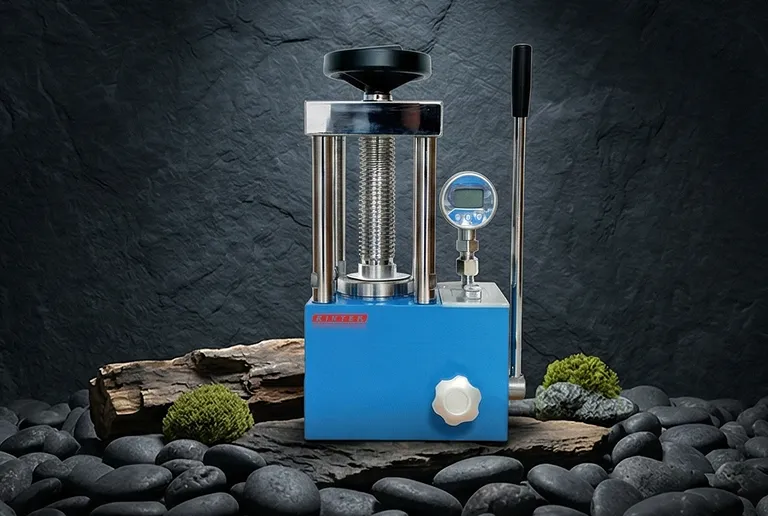
Achieving 375 MPa with consistency requires more than just raw power; it requires precision. In a laboratory setting, the equipment must handle high pressures while maintaining clean environments, often within the confines of a glovebox.
KINTEK provides the specialized tooling necessary to turn these high-pressure theories into high-performance reality. Our solutions are designed for the specific rigors of battery research:
- Automatic & Manual Presses: For repeatable, high-accuracy pressure application.
- Isostatic Presses (CIP/WIP): Ensuring uniform densification from every angle.
- Glovebox Integration: Maintaining material purity for air-sensitive sulfides.
- Heated Tooling: Combining thermal and mechanical energy for next-generation oxides.
The bridge between inactive powders and a functional energy storage device is the precision of your press.
Related Products
- Warm Isostatic Press for Solid State Battery Research Warm Isostatic Press
- Electric Lab Cold Isostatic Press CIP Machine
- Automatic Lab Cold Isostatic Pressing CIP Machine
- Lab Isostatic Pressing Molds for Isostatic Molding
- Manual Cold Isostatic Pressing CIP Machine Pellet Press
Related Articles
- How Warm Isostatic Pressing Transforms High-Performance Manufacturing
- How Warm Isostatic Pressing Optimizes Material Performance for Industrial Applications
- The Pressure to Be Perfect: How Hot Isostatic Pressing Achieves Absolute Material Integrity
- The Physics of Patience: Why Hot Isostatic Pressing Trades Speed for Certainty
- The Enemy Within: How Hot Isostatic Pressing Forges Perfect Material Integrity



















