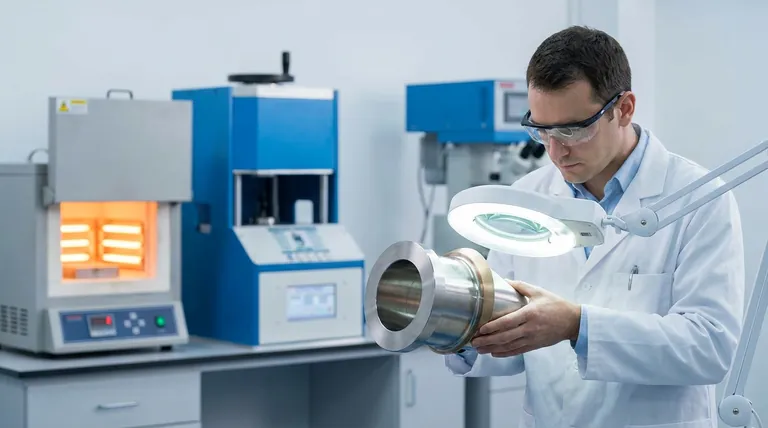
An engineer's world is a world of trade-offs. We design components that need to be hard, but also tough. Corrosion-resistant, but also cost-effective. We want it all, but the physics of a single, monolithic material rarely allows it.
So, we compromise. We join materials together with bolts, welds, or brazing. But in doing so, we introduce a seam—a line of potential failure, a source of engineering anxiety. We design around this weakness.
But what if the seam wasn't a weakness? What if it could be erased entirely, at the atomic level?
The Psychology of a Flawless Joint
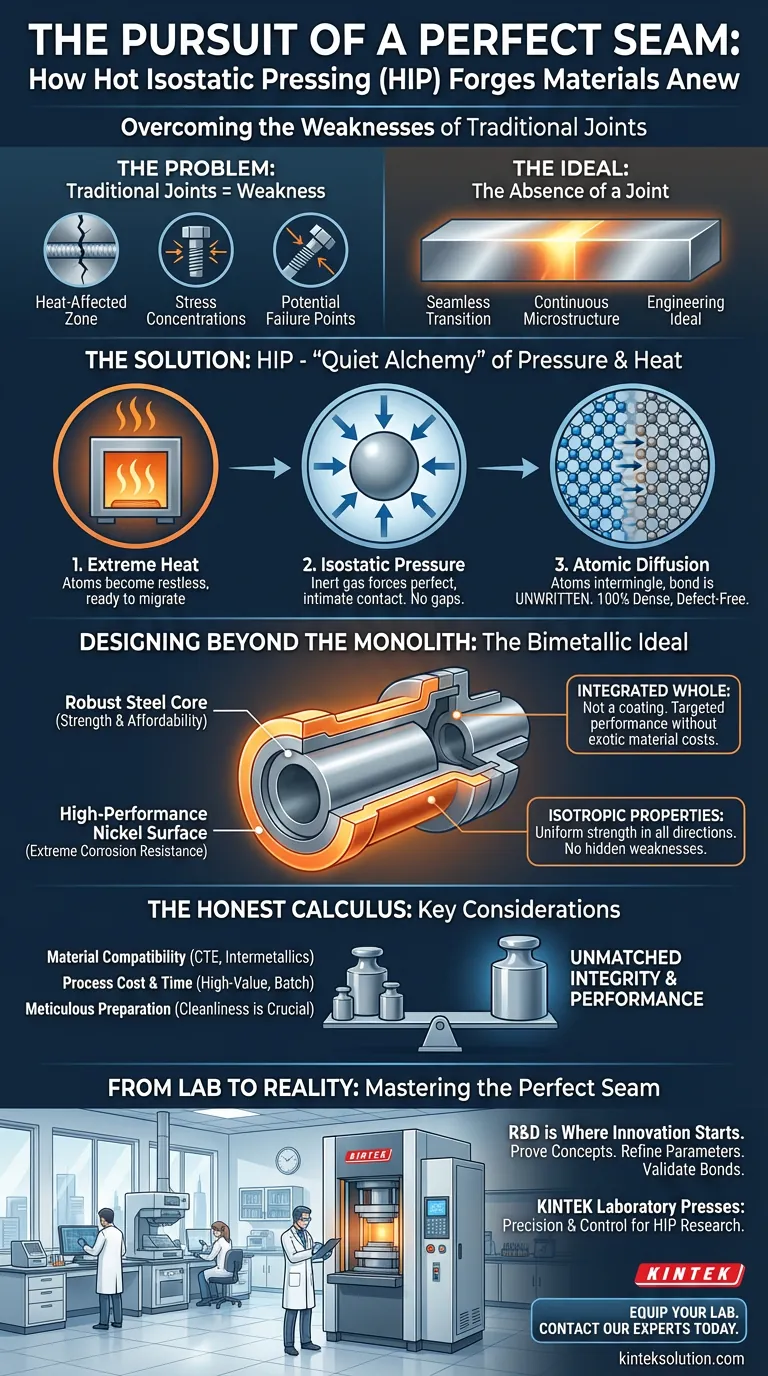
A traditional joint is more than a physical connection; it's a psychological one. A weld creates a heat-affected zone, a region of altered microstructure we inherently distrust. A bolt creates stress concentrations, points where we know cracks love to form.
These methods are admissions of a material's limitations. The true engineering ideal is not a stronger joint, but the absence of a joint. A seamless transition where two materials become one integrated entity, sharing a continuous, flawless microstructure.
This pursuit of perfection is what leads us to Hot Isostatic Pressing (HIP).
The Quiet Alchemy of Pressure and Heat
A metallurgical bond formed via HIP is not a weld. It is a quiet, profound transformation. It happens in an environment of extreme temperature and perfectly uniform pressure, allowing for a process that feels more like alchemy than manufacturing.
Creating the Conditions for Change
First, high temperature gives atoms the energy they need to move. It makes them restless, ready to migrate. But heat alone is not enough.
Immense isostatic pressure, applied equally from all directions by an inert gas, forces the mating surfaces of two materials into perfect, intimate contact. Every microscopic valley and peak is flattened. There are no gaps left.
Erasing the Boundary
With the surfaces in this state of perfect contact, something remarkable occurs: atomic diffusion. Atoms from each material begin to migrate across the interface, intermingling and forming shared metallic grains.
The original boundary between the two parts is not just glued together; it is fundamentally unwritten. The result is a 100% dense, defect-free component with a bond as strong as, or even stronger than, the parent materials.
Designing Beyond the Monolith
This ability to erase a seam unlocks a new design paradigm. We are no longer limited by the properties of a single alloy. We can engineer components based on ideal function.
The Bimetallic Ideal
The most powerful application is creating bimetallic or clad parts. Imagine a complex industrial component:
- Its core needs to be strong and affordable, so we use a robust steel alloy.
- Its surface needs to withstand extreme corrosion, so we bond a thin, high-performance layer of a nickel alloy to it.
Using HIP, this isn't a coating; it's an integrated whole. You get the targeted performance exactly where you need it, without the astronomical cost of making the entire part from the exotic alloy.
Trust in Every Direction
Because the pressure is isostatic, the resulting properties are isotropic—uniform in all directions. There are no hidden stresses or directional weaknesses introduced by processes like forging or welding. This creates a deep, measurable level of trust in the component's integrity under extreme vibration, pressure, or thermal cycling.
The Honest Calculus of an Advanced Process
HIP is not a universal solution. Its power comes with a set of honest, clear-eyed trade-offs. Understanding them is crucial.
| Consideration | Implication |
|---|---|
| Material Compatibility | Materials with vastly different coefficients of thermal expansion (CTE) can create immense stress during cooling. Some pairings form brittle intermetallic compounds at the bond line. Success requires deep material science knowledge. |
| Process Cost & Time | HIP is a sophisticated batch process. The long cycles and specialized equipment make it best suited for high-value, performance-critical applications where failure is not an option. |
| Meticulous Preparation | The surfaces must be impeccably clean for atomic diffusion to occur. Parts are often sealed in a metal "can" for processing, adding a layer of complexity. Perfection requires patience. |
The Laboratory: Where Theory Becomes Reality
Every revolutionary component—from a next-generation aerospace turbine blade to a life-saving medical implant—begins not on the factory floor, but as a hypothesis in a laboratory.
Before you can create a bimetallic part at scale, you must first prove the concept. You must test material compatibility, refine cycle parameters, and validate the integrity of the bond under controlled conditions. This foundational work is where the true innovation happens.
Achieving this requires equipment that offers absolute precision and control. KINTEK's specialized laboratory press machines are engineered for this exact purpose. Our range of automatic lab presses, heated presses, and advanced isostatic presses provides the tightly controlled environment essential for R&D in this field. They are the tools that empower scientists and engineers to turn the theoretical power of HIP into tangible, reliable reality.
To explore these possibilities and equip your lab to master the art of the perfect seam, Contact Our Experts.
Visual Guide
Related Products
- Warm Isostatic Press for Solid State Battery Research Warm Isostatic Press
- Lab Isostatic Pressing Molds for Isostatic Molding
- Electric Lab Cold Isostatic Press CIP Machine
- Automatic Lab Cold Isostatic Pressing CIP Machine
- Electric Split Lab Cold Isostatic Pressing CIP Machine
Related Articles
- How Warm Isostatic Pressing Transforms High-Performance Manufacturing
- How Warm Isostatic Pressing Optimizes Material Performance for Industrial Applications
- The Pressure to Be Perfect: How Hot Isostatic Pressing Achieves Absolute Material Integrity
- The Physics of Patience: Why Hot Isostatic Pressing Trades Speed for Certainty
- The Enemy Within: How Hot Isostatic Pressing Forges Perfect Material Integrity



















