The Illusion of a Flawless Surface
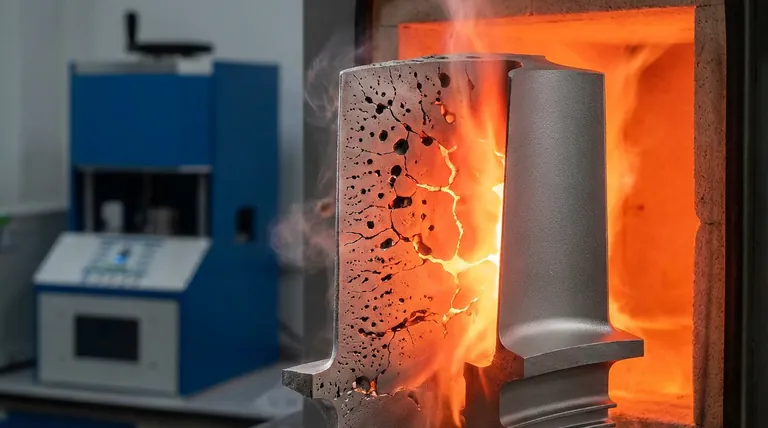
An aerospace turbine blade can be a work of art. Polished to a mirror finish, its geometry is perfect to the micron. It passes every visual and dimensional inspection.
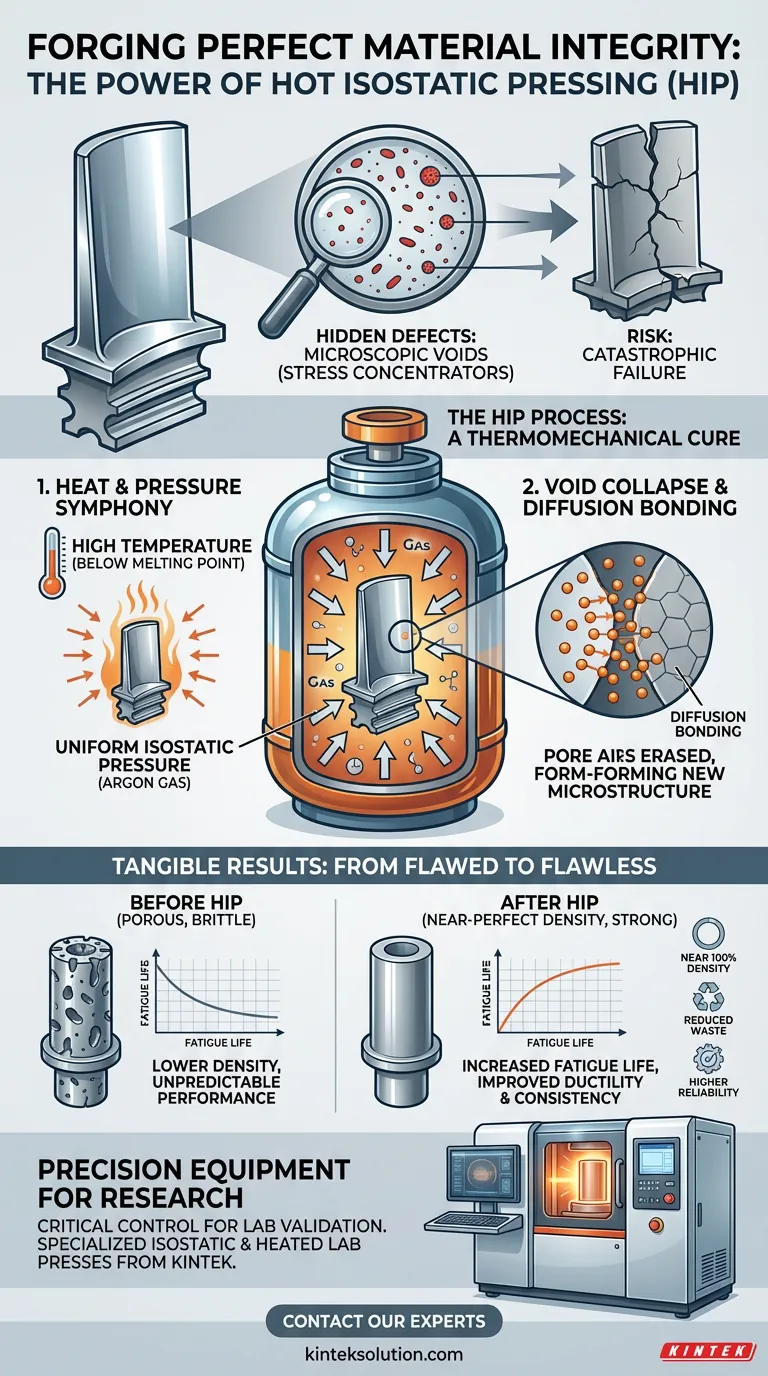
Yet, deep within its metallic structure, a hidden network of microscopic voids—remnants of its creation through casting or 3D printing—can lie in wait. These pores are invisible enemies. Under the immense stress of operation, they become the starting points for catastrophic failure.
This is the engineer's paradox: we trust what we can see, but the greatest risks often lie in what we cannot. The pursuit of reliability is not just about perfecting the external form, but about guaranteeing the integrity of the unseen interior.
Why a Void is More Than Just an Empty Space
On a microscopic level, a void is a stress concentrator. When a load is applied to a component, the lines of force must flow around this internal gap. This diversion dramatically multiplies the stress at the edges of the void, much like a river current accelerates around a rock.
A material that should be strong becomes brittle. A component designed for millions of cycles might fail after a few thousand. This internal porosity turns predictable engineering into a game of chance.
Eliminating this uncertainty is the true goal of advanced manufacturing.
A Thermomechanical Cure from Within
Hot Isostatic Pressing (HIP) is not a surface treatment. It is a fundamental process that re-forges a component from the inside out, using the laws of physics to heal it at the atomic level.
The process is an elegant symphony of two powerful forces: immense pressure and high temperature.
The Symphony of Heat and Pressure
A component is placed inside a sealed, high-pressure vessel. The vessel is then filled with an inert gas, like argon, and heated.
- Heat makes the material pliable. The temperature is raised to a point below the material's melting point, softening the metallic structure and allowing its atoms to move.
- Pressure closes the wounds. Simultaneously, the gas is pressurized to extreme levels. This pressure is isostatic—it acts uniformly from all directions, squeezing the component. The force is so great that it physically collapses the internal voids and pores.
The Final Act: Diffusion Bonding
Simply closing a void isn't enough; it must be healed permanently. At these elevated temperatures, the atoms on the opposing surfaces of a collapsed pore are energized. They migrate across the boundary, creating new, powerful metallurgical bonds.
This is diffusion bonding. The old void is not just filled; it is erased from existence, leaving behind a solid, continuous microstructure.
The Tangible Results of Internal Healing
The mechanism is fascinating, but the results are what truly matter. HIP transforms a standard component into a high-performance one by fundamentally improving its core structure.
The Pursuit of Near-Perfect Density
By eliminating internal gaps, HIP can increase a part’s density to nearly 100% of its theoretical maximum. A denser part is a stronger, more reliable part. This densification is directly linked to massive improvements in material properties.
Rewriting Material Limits
A fully dense microstructure has a profound impact on mechanical performance.
- Fatigue Life: With stress concentrators removed, a component can withstand dramatically more load cycles before failure.
- Ductility & Toughness: The material becomes more resilient and less prone to brittle fracture.
- Consistency: The properties become uniform throughout the part, making performance predictable and reliable.
The Economics of Redemption
For high-value components made from expensive alloys, internal porosity often means a one-way trip to the scrap bin. HIP offers a second chance. It can salvage parts that would otherwise be lost, dramatically improving manufacturing yields and reducing costly waste.
From Theory to Reality: The Role of Precision Equipment
Mastering this process, especially during material development or for validating production runs, requires more than just theoretical knowledge. It demands equipment capable of executing this delicate dance of heat and pressure with unfailing precision and repeatability.
This is where laboratory-scale systems become indispensable. They allow engineers and scientists to test HIP parameters, qualify new materials, and prove out manufacturing processes before scaling up. Achieving the correct thermal profile and pressure curve is critical. Specialized equipment, such as the advanced isostatic and heated lab presses from KINTEK, provides the robust control and reliability needed to turn the promise of HIP into a practical reality in the lab.
Understanding the Boundaries of HIP
While incredibly powerful, HIP is not a panacea. Its application requires understanding a few key limitations.
- The "Gas-Tight" Prerequisite: The process only works on internal, sealed-off defects. If a pore is connected to the surface, the high-pressure gas will simply fill the void instead of collapsing it.
- The Delicate Thermal Balance: The HIP temperature must be chosen carefully to enable diffusion without melting the material or causing unwanted changes to its grain structure.
- An Investment in Perfection: As a batch process, HIP adds time and cost to production. It is an investment best justified for critical components where failure is not an option.
Ultimately, Hot Isostatic Pressing does more than just fix flaws. It builds confidence from the atom up, ensuring a component's internal structure is as sound as its external design. It is the definitive step in transforming a well-made part into a truly perfect one.
If you're looking to push the boundaries of material performance in your laboratory, achieving higher density and reliability is the first step. Contact Our Experts
Visual Guide
Related Products
- Warm Isostatic Press for Solid State Battery Research Warm Isostatic Press
- Lab Isostatic Pressing Molds for Isostatic Molding
- Electric Lab Cold Isostatic Press CIP Machine
- Automatic Lab Cold Isostatic Pressing CIP Machine
- Electric Split Lab Cold Isostatic Pressing CIP Machine
Related Articles
- How Warm Isostatic Pressing Transforms High-Performance Manufacturing
- How Warm Isostatic Pressing Optimizes Material Performance for Industrial Applications
- The Pressure to Be Perfect: How Hot Isostatic Pressing Achieves Absolute Material Integrity
- The Physics of Patience: Why Hot Isostatic Pressing Trades Speed for Certainty
- The Pursuit of a Perfect Seam: How Hot Isostatic Pressing Forges Materials Anew



















