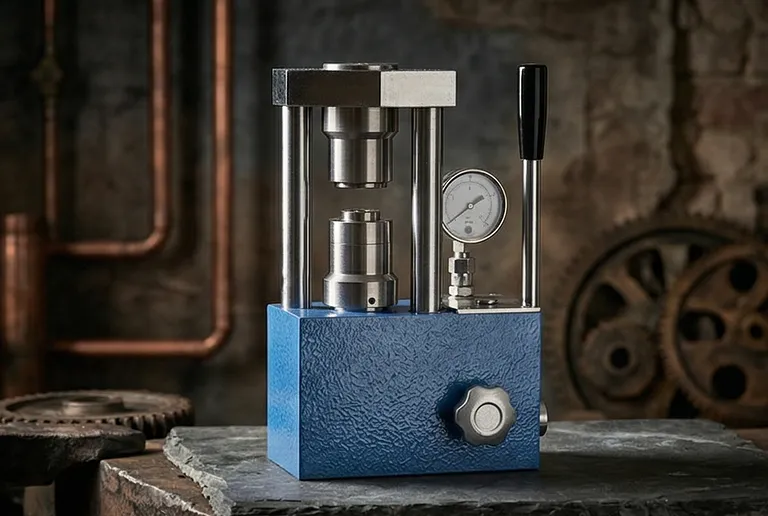
The Alchemy of Consolidation
In material science, there is a distinct gap between a "collection of ingredients" and a "functional structure."
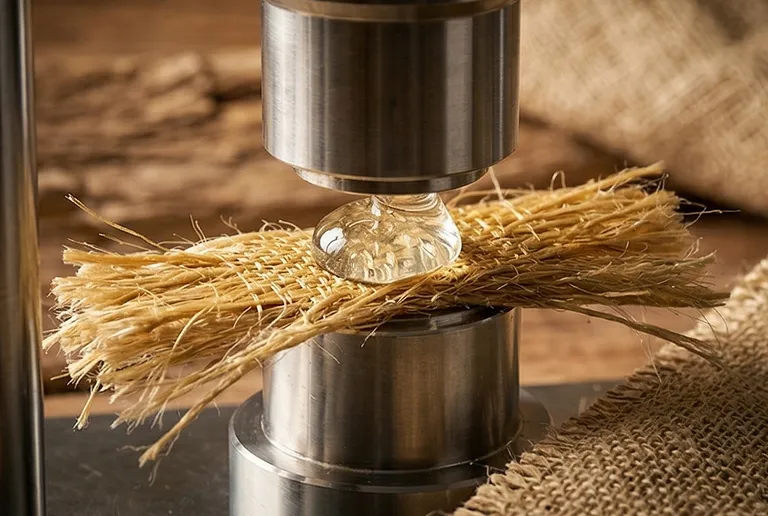
Raw flax fibers are delicate; epoxy resin is a viscous liquid. To transform them into a high-performance composite, one must do more than simply mix them. You must force them into a permanent, molecular agreement.
This is the role of the heated press. It is the invisible architect that uses thermal energy and mechanical force to dictate the final properties of the material.
The War on Voids: Achieving Structural Integrity
A composite’s greatest enemy is the air trapped inside it. Every microscopic bubble acts as a stress concentrator—a pre-installed failure point waiting for a load to trigger a crack.
Facilitating Resin Infiltration
The first act of a heated press is one of persuasion. By heating the plates, the viscosity of the epoxy resin drops. It becomes fluid, seeking out every crevice within the flax fiber bundles. This "wetting" ensures that no fiber is left naked; each is encapsulated, ready to transfer mechanical load.
Eliminating the "Nothingness"
As the press applies constant pressure (typically between 0.7 MPa and 5 MPa), it performs a literal purge. It squeezes the laminate, forcing residual air and volatiles out of the structure.
- The Result: A dense, homogeneous material.
- The Benefit: Prevention of premature delamination under stress.
Thermodynamics as a Creative Force
Precision in a composite isn't just about how hard you press; it’s about how carefully you heat.
The Chemical Handshake
At specific temperatures—often around 130°C for epoxy—a chemical cross-linking reaction begins. The heated press provides the isothermal stability required for this reaction to occur uniformly. If the heat is uneven, the material cures at different rates, leading to internal "tug-of-wars" that result in warping.
Management of Residual Stress
Every material expands when hot and shrinks when cold. By controlling the ramp-down of temperature, the press manages these thermal contractions. This prevents the composite from cracking or "potato-chipping" once it is removed from the mold.
The Geometry of Performance
In engineering, weight is a tax. Strength is a dividend. The heated press allows you to optimize the ratio between the two.
- Dimensional Stability: The press acts as an absolute mechanical stop, ensuring the final plate has a uniform thickness across its entire surface.
- The Fiber-to-Resin Ratio: By extruding excess resin during the consolidation phase, the press allows manufacturers to reach a specific fiber volume content. This maximizes the strength-to-weight ratio, ensuring the material is as light as possible without sacrificing safety.
The Housel-esque Paradox: Understanding Trade-offs
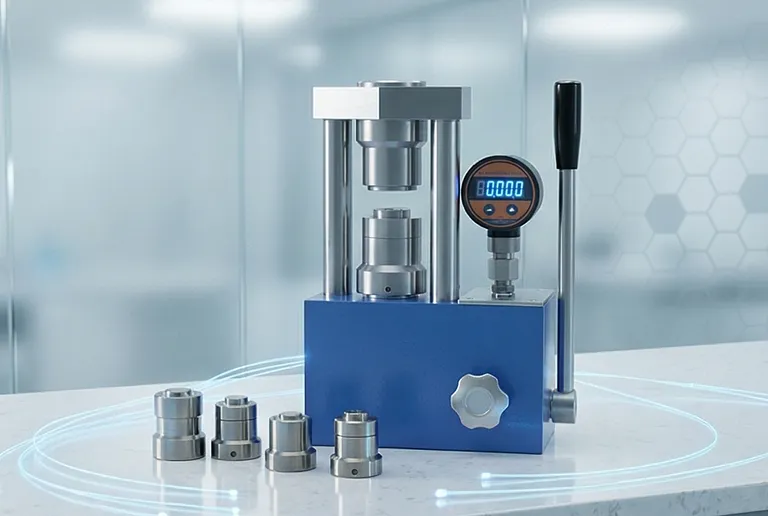
In the pursuit of performance, more is not always better. The heated press requires a mastery of "just enough."
| The Variable | The Risk of Excess | The Consequence |
|---|---|---|
| Pressure | Crushing the natural flax fibers | Brittle failure and reduced tensile strength |
| Temperature | Thermal degradation of cellulose | Weakened fiber-to-matrix bond |
| Speed | Resin starvation | "Dry" spots where fibers lack support |
Designing the System for Success
Success in composite fabrication is not a matter of luck; it is a matter of systemic control. When choosing your path, consider your primary objective:
- For Maximum Strength: Focus on precise pressure increments to reach the highest fiber volume without fiber damage.
- For Lightweight Applications: Prioritize the press’s ability to maintain strict dimensional tolerances during resin extrusion.
- For Defect-Free Parts: Ensure the heating platens offer a uniform thermal field to eliminate localized under-curing.
Precision Research with KINTEK

At KINTEK, we understand that the difference between a breakthrough and a failure lies in the decimals. We provide the tools that turn laboratory variables into industrial constants.
Our laboratory solutions are designed for the rigors of modern material science:
- Manual & Automatic Heated Presses for flawless thermal cycles.
- Glovebox-Compatible Models for sensitive chemical environments.
- Cold and Warm Isostatic Presses (CIP/WIP), the gold standard for high-density battery and composite research.
The integrity of your material depends on the integrity of your process. Let us help you master the cycle.
Related Products
- Heated Hydraulic Press Machine with Heated Plates for Vacuum Box Laboratory Hot Press
- Automatic High Temperature Heated Hydraulic Press Machine with Heated Plates for Lab
- Heated Hydraulic Press Machine With Heated Plates For Vacuum Box Laboratory Hot Press
- Automatic Heated Hydraulic Press Machine with Hot Plates for Laboratory
- Automatic Heated Hydraulic Press Machine with Heated Plates for Laboratory
Related Articles
- The Architecture of Slow: Why Physical Precision Dictates Chemical Destiny
- The Architecture of Certainty: Why the Laboratory Press is the Anchor of Material Science
- The Vanishing Boundary: The Hidden Thermodynamics of LTCC Lamination
- The Alchemy of 160°C: Why Precision Pressing is the Silent Backbone of Rubber Science
- The Invisible Forge: Why the Laboratory Press is the Soul of Nano-Composites



















