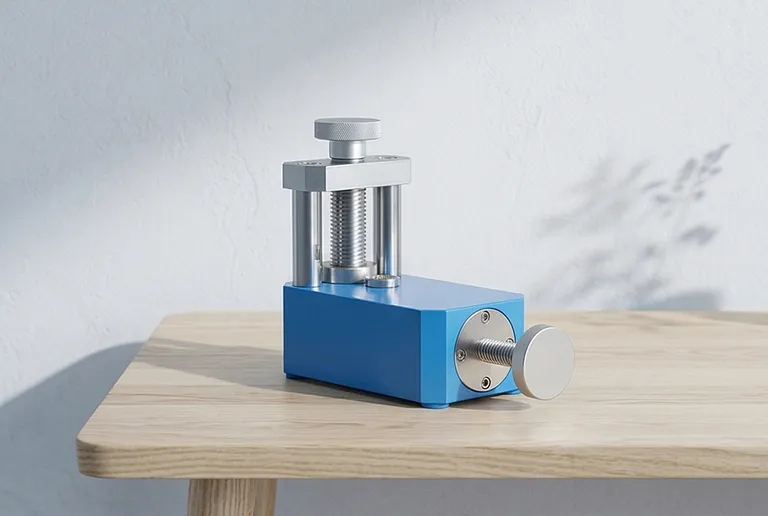
The Chaos of the Uncompressed
In its raw state, powder is a mess of contradictions. It is a solid that behaves like a fluid, a material trapped in an erratic network of air pockets and irregular geometries.
In the laboratory, this inconsistency is the enemy. When you attempt to measure the conductivity of a loose powder or bounce an X-ray off an uneven surface, you aren't measuring the material. You are measuring the chaos of its storage.
Precision in analysis begins not with the sensor, but with the press.
The Geometry of Truth
The primary function of a laboratory hydraulic press is the systematic removal of variables. By applying high-precision axial pressure, we transform loose chemical substances into dense, uniform pellets—what engineers call the "green body."
This transformation serves three structural mandates:
- Eliminating the Void: Controlled force expels the air trapped between particles. This prevents air pockets from distorting light or heat.
- Standardizing the Path: A press ensures every sample has the identical volume and surface area. In comparative studies, this makes the "geometry" a constant, not a variable.
- Maximizing Contact: For battery research, density is destiny. High pressure maximizes the contact area between particles, ensuring that charge transport is a reflection of the chemistry, not the gaps.
The Signal and the Noise
Analytical instruments are incredibly sensitive, but they are also easily fooled by physical imperfections.
Spectroscopic Clarity
In Fourier-Transform Infrared Spectroscopy (FT-IR), the sample must be thin and dense enough to be translucent. A hydraulic press forces the material to give up its opacity. The result is a dramatic increase in the signal-to-noise ratio; the light passes through the material rather than scattering into the void.
The Mirror Finish of XRF
X-ray Fluorescence (XRF) demands a surface so flat it borders on the mirror-like. Any shadow cast by a tiny peak or valley on the sample disc will lead to detection inaccuracies. The press acts as the ultimate equalizer, ensuring the X-ray beam interacts with a consistent, two-dimensional plane.
The Psychology of Pressure
In science, as in finance, there is a temptation to believe that if some force is good, more must be better. This is a fallacy.
Every material has a "breakpoint." Over-pressurization does not lead to better data; it leads to structural trauma.
- Phase Changes: Excessive force can unintendedly alter the chemical structure of the sample.
- Internal Stress: A pellet pressed too hard may look perfect until it is ejected, at which point internal stresses cause it to shatter—a phenomenon known as "capping."
- The Ghost of Experiments Past: A press is only as good as its cleanliness. Residual material on a die is a form of "data contamination" that can haunt subsequent tests.
Choosing the Right System
The tool you choose determines the limits of your inquiry. Different research goals require different mechanical strategies:
| Research Goal | Ideal Compression Strategy | Critical Requirement |
|---|---|---|
| FTIR Spectroscopy | High-Precision Manual/Auto | Minimal thickness & high translucency |
| XRF Analysis | High Load Automatic | Surface flatness & edge stability |
| Battery/Solid State | Isostatic (CIP/WIP) | Uniform density across all 3 axes |
| Sensitivity Tasks | Glovebox-Compatible | Atmospheric isolation & purity |
Engineering the Perfect Sample
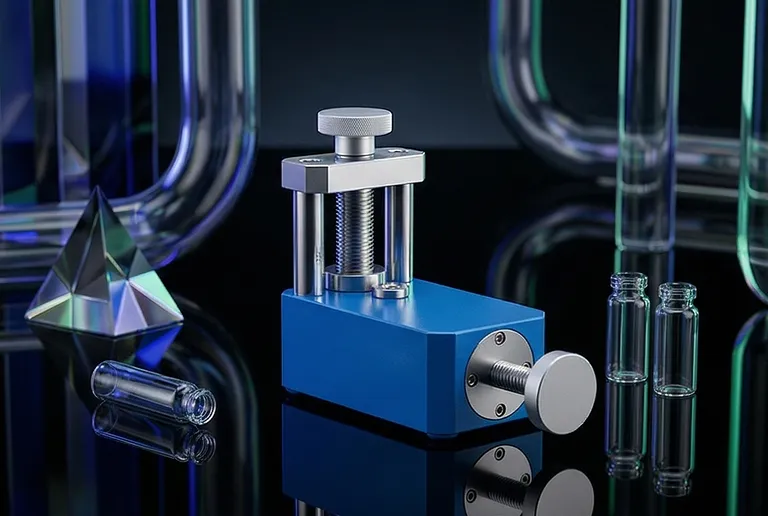
At KINTEK, we view the hydraulic press as more than a piece of hardware; it is the bridge between a raw substance and reliable data. Whether you are working with manual systems for quick pellets or automatic isostatic presses for advanced battery research, the goal remains the same: the imposition of order onto chaos.
Precision is not an accident. It is a deliberate application of force.
Related Products
- Laboratory Hydraulic Press Lab Pellet Press Machine for Glove Box
- Laboratory Hydraulic Press 2T Lab Pellet Press for KBR FTIR
- 24T 30T 60T Heated Hydraulic Lab Press Machine with Hot Plates for Laboratory
- Laboratory Hydraulic Press Lab Pellet Press Button Battery Press
- Laboratory Hydraulic Pellet Press for XRF KBR FTIR Lab Press
Related Articles
- The Physics of Transparency: Why Pressure is the Silent Architect of Spectroscopic Clarity
- The Architecture of Density: Why Pressure is the Silent Architect of Solid-State Batteries
- The Geometry of Electrons: Why Surface Precision is the Silent Partner in SECM Research
- The Geometry of Ionic Flow: Why Precision Pressing Dictates Material Truth
- The Architecture of Heat: Why Sample Density Dictates the Truth in Metal Hydride Research



















