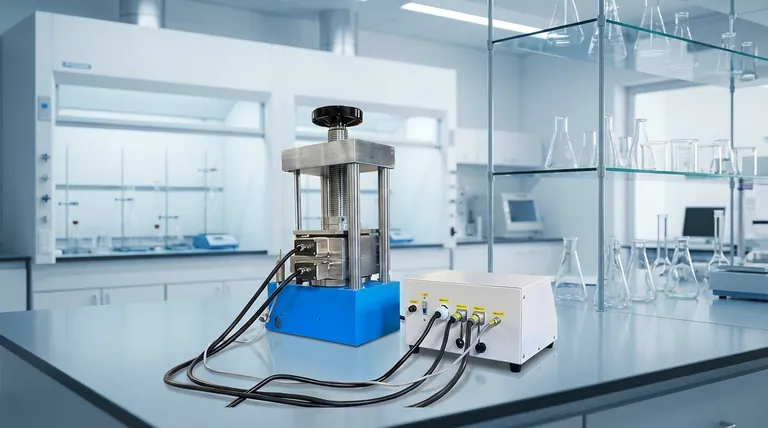
The Specter of the Outlier
Every researcher knows the feeling. An experiment yields a perfect result, but the next five attempts fail to replicate it.
Was it the sample? The environment? Or the equipment? This ghost in the machine—the specter of the outlier—haunts laboratories. In the world of materials science and sample preparation, the source of this anxiety often lies in a single, powerful tool: the laboratory press.
The common assumption is that precision is simply a matter of force. But true repeatability is a deeper, systemic quality. It's an architecture of trust built from hydraulics, feedback loops, and uncompromising physical integrity.
Two Philosophies of Force
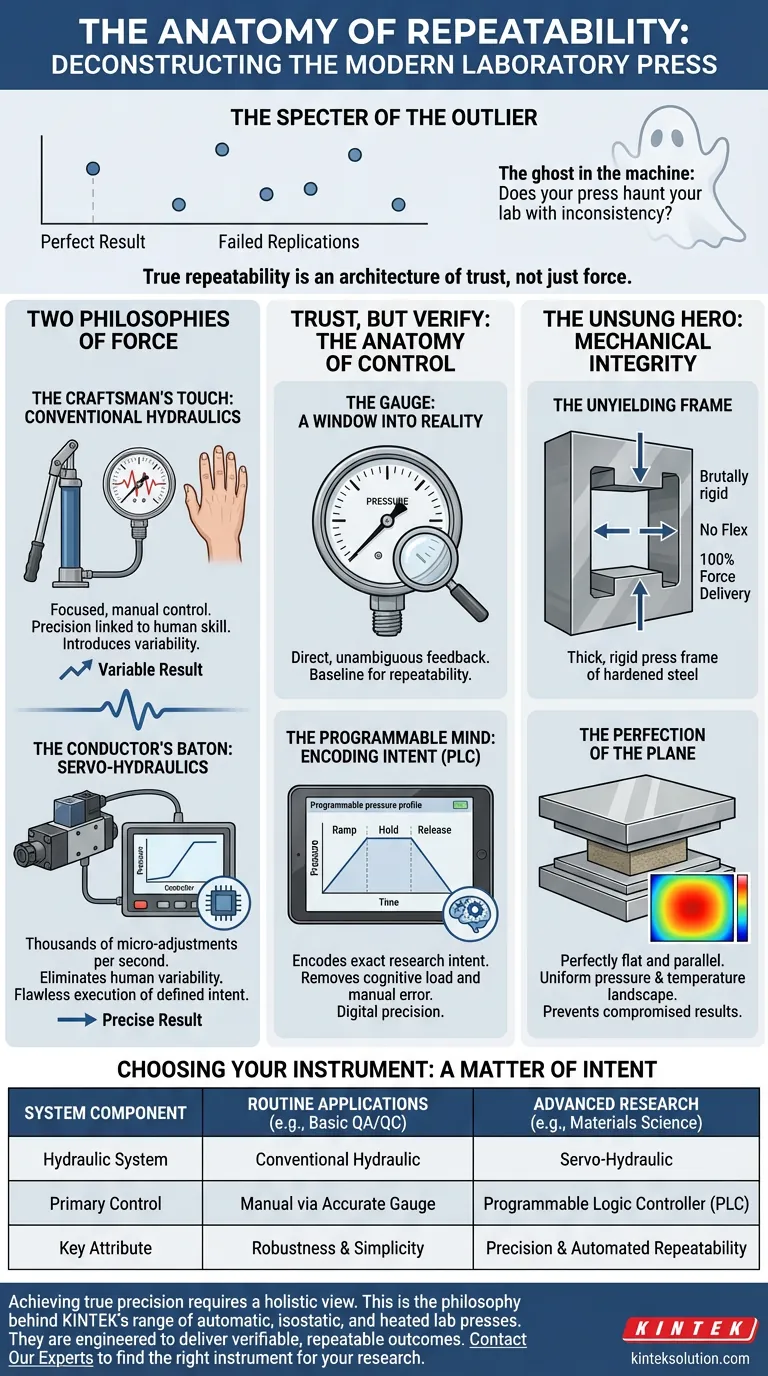
At the core of every press is the hydraulic system, the engine that generates pressure. But how that pressure is created and controlled reveals two fundamentally different philosophies of operation.
The Craftsman's Touch: Conventional Hydraulics
The conventional hydraulic system is an exercise in focused, manual control. Using a pump, often hand-operated, an operator watches a gauge and becomes a direct part of the feedback loop.
This is a robust and straightforward approach. But its precision is inextricably linked to human skill and attention. It relies on the operator's ability to consistently hit a target, which introduces a variable—the human element—that can be difficult to control across operators or even over the course of a single day.
The Conductor's Baton: Servo-Hydraulics
Servo-hydraulic systems seek to eliminate that human variability. They operate less like a craftsman and more like an orchestra conductor.
A highly responsive servo valve, guided by a programmable controller, acts as the conductor. It makes thousands of micro-adjustments per second based on real-time feedback, ensuring the pressure follows a pre-defined "score"—a precise ramp, hold, and release cycle. The operator defines the intent, and the machine executes it flawlessly, every time.
Trust, But Verify: The Anatomy of Control
Generating force is simple. Knowing and controlling that force with certainty is what separates a crude tool from a scientific instrument.
The Gauge: A Window Into Reality
The pressure gauge is the most fundamental instrument of trust. It provides a direct, unambiguous window into the invisible forces at play. For applications like creating consistent KBr pellets for FTIR spectroscopy, this visual confirmation is the baseline for repeatability. It’s the operator's handshake with the physical process.
The Programmable Mind: Encoding Intent
Advanced presses, especially those with servo-hydraulics, take this a step further by using Programmable Logic Controllers (PLCs). A PLC doesn't just execute a task; it encodes the researcher's exact intent.
By programming the entire pressure profile, you remove cognitive load and the potential for manual error. It’s the difference between following a recipe by feel and having a machine execute it with digital precision. This guarantees that sample number one and sample number one hundred undergo the exact same thermodynamic journey.
The Unsung Hero: Mechanical Integrity
Even the most intelligent hydraulic control system is useless if the press's physical body is weak. The mechanical structure is the silent partner in precision, and its role cannot be overstated.
The Unyielding Frame
A laboratory press frame is forged from hardened steel for a reason that goes beyond safety. It must be brutally rigid. Under immense loads, any flex in the frame is energy stolen from the sample. It introduces a variable, an uncertainty. A rock-solid frame ensures that 100% of the generated force is delivered directly, uniformly, and predictably.
The Perfection of the Plane
The platens—the surfaces that touch the sample—are where the macro world of the press meets the micro world of the material. They must be perfectly flat and parallel. Any imperfection, any slight misalignment, translates into an uneven pressure landscape across the sample, compromising the integrity of the result. For heated presses, this extends to perfect temperature uniformity.
Choosing Your Instrument: A Matter of Intent
The right laboratory press is not the one with the most features, but the one whose systems align with your research goals. It's about matching the tool to the task with a clear understanding of what drives repeatable results.
| System Component | Routine Applications (e.g., Basic QA/QC) | Advanced Research (e.g., Materials Science) |
|---|---|---|
| Hydraulic System | Conventional Hydraulic | Servo-Hydraulic |
| Primary Control | Manual via Accurate Gauge | Programmable Logic Controller (PLC) |
| Key Attribute | Robustness & Simplicity | Precision & Automated Repeatability |
Achieving true precision requires a holistic view, where the hydraulics, controls, and mechanical frame are designed as a single, coherent system. This is the philosophy behind KINTEK's range of automatic, isostatic, and heated lab presses. They are engineered not just to apply force, but to deliver verifiable, repeatable outcomes.
Understanding this complex interplay is key, and our engineers specialize in designing systems where every component works in harmony. To find the right instrument for your research, Contact Our Experts.
Visual Guide
Related Products
- Laboratory Hydraulic Press 2T Lab Pellet Press for KBR FTIR
- Laboratory Hydraulic Press Lab Pellet Press Button Battery Press
- Laboratory Hydraulic Press Lab Pellet Press Machine for Glove Box
- Laboratory Split Manual Heated Hydraulic Press Machine with Hot Plates
- Laboratory Hydraulic Split Electric Lab Pellet Press
Related Articles
- The Physics of Transparency: Why Pressure is the Silent Architect of Spectroscopic Clarity
- The Architecture of Density: Why Pressure is the Silent Architect of Solid-State Batteries
- The Architecture of Heat: Why Sample Density Dictates the Truth in Metal Hydride Research
- The Geometry of Electrons: Why Surface Precision is the Silent Partner in SECM Research
- The Geometry of Ionic Flow: Why Precision Pressing Dictates Material Truth



















