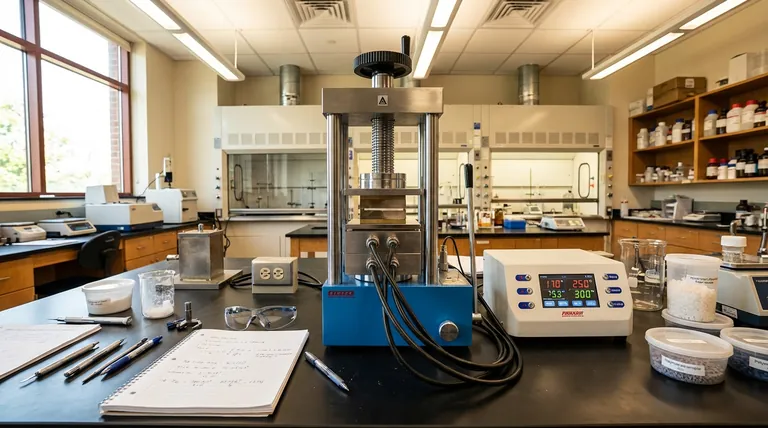
An experiment fails. The polymer sample is brittle in one corner, perfectly cured in the other. The researcher checks the formulation, the mix times, the precursor materials. Everything is perfect.
The process is repeated. The results are, again, inconsistent.
This is a familiar story in materials science. We often blame the material or the method, but rarely do we question the silent partner in our work: the instrument itself. The lab press, often seen as a simple machine of brute force, is a complex system. And the psychology of choosing one often leads us down the wrong path.
The Deception of a Single Number
We are naturally drawn to big, simple metrics. When buying a car, we look at horsepower. When buying a computer, we look at processor speed. When buying a lab press, we fixate on tonnage.
This is a cognitive shortcut, and it's a dangerous one.
A 50-ton press is not inherently "better" than a 20-ton press if your process is compromised by uneven heating or imprecise control. The most important specification isn't the maximum force the machine can exert, but its ability to deliver the correct conditions to your sample, every single time.
From Abstract PSI to Concrete Tons
Your material doesn't care about the press's total tonnage. It only experiences the pressure applied to its surface—measured in pounds per square inch (PSI) . The first step is to translate your process requirement into the language of the machine.
The calculation is straightforward but essential:
Force (lbs) = Required Pressure (PSI) x Sample Area (in²)
Convert this force to tons (1 ton = 2,000 lbs) and add a small safety margin. This number, derived from your specific application, is the true tonnage requirement. It's an output of your process, not an arbitrary input for your search.
The Soul of the Machine: Heat and Uniformity
For many applications, from composites to polymers, heat is as critical as force. But like force, the maximum temperature rating is another deceptive, single metric.
The real measure of a high-quality heated press is temperature uniformity.
Imagine a platen that is 300°C in the center but only 285°C at the edges. For a sensitive material, that 15° variance is a canyon. It guarantees an inconsistent result. True precision comes from a system that creates a perfectly even thermal field across the entire platen, ensuring every part of your sample experiences the exact same conditions.
The Geometry of Possibility: Platens and Daylight
The physical dimensions of the press define the boundaries of your work.
- Platens: These heated plates must be large enough to accommodate your largest mold or sample with a small, practical border.
- Daylight Opening: The vertical space between the platens dictates the maximum height of your tooling.
Thinking about these isn't just about "fitting it in." It's about designing a workspace that doesn't constrain future possibilities.
The Conductor of the Orchestra: Manual vs. Automated Control
The control system is the brain of the press. It's what elevates a machine from a simple tool to a scientific instrument. It dictates the repeatability, accuracy, and sophistication of your work.
Manual Control: The Artisan's Touch
For simple, non-critical applications like basic pelletizing for spectroscopy, a manual press offers simplicity and cost-effectiveness. The operator is in direct control, making it ideal for processes that require constant adjustment or are highly variable.
Automated Control: The Pursuit of Perfect Repetition
For research, development, and quality control, repeatability is the bedrock of valid science. This is where automated control becomes non-negotiable.
An automated system, like those integrated into KINTEK's automatic lab presses, allows you to program multi-step recipes. You can define precise ramp rates for both heating and pressure, set hold times down to the second, and then execute that exact cycle hundreds of times.
This isn't just about convenience. For advanced materials, the rate of change is a critical process variable. An automated system's ability to control these ramps and hold setpoints with minimal deviation is what ensures that your tenth sample is identical to your first. It's the key to process validation and reliable data.
A Framework for Your Decision
Instead of starting with a machine, start with your goal.
- For Basic Material Testing: A manual benchtop press with accurate force and basic heating is a robust and economical choice. The focus is on simplicity and reliability.
- For Process Development (R&D): Prioritize a fully programmable, automated press. The ability to precisely control complex cycles, log data, and ensure repeatability is paramount for discovery.
- For Quality Control & Small-Scale Production: Automation, robust safety features, and durability are key. The goal is consistent, reliable output with minimal operator variance.
Choosing a lab press is an investment in the integrity of your results. By looking beyond the simple, headline specifications, you equip yourself not just with a machine, but with a reliable partner in your work. At KINTEK, we specialize in building these partners—from heated and isostatic presses to fully automated systems designed for the exacting demands of modern labs.
Let's ensure your instrument is an enabler, not a variable. Contact Our Experts
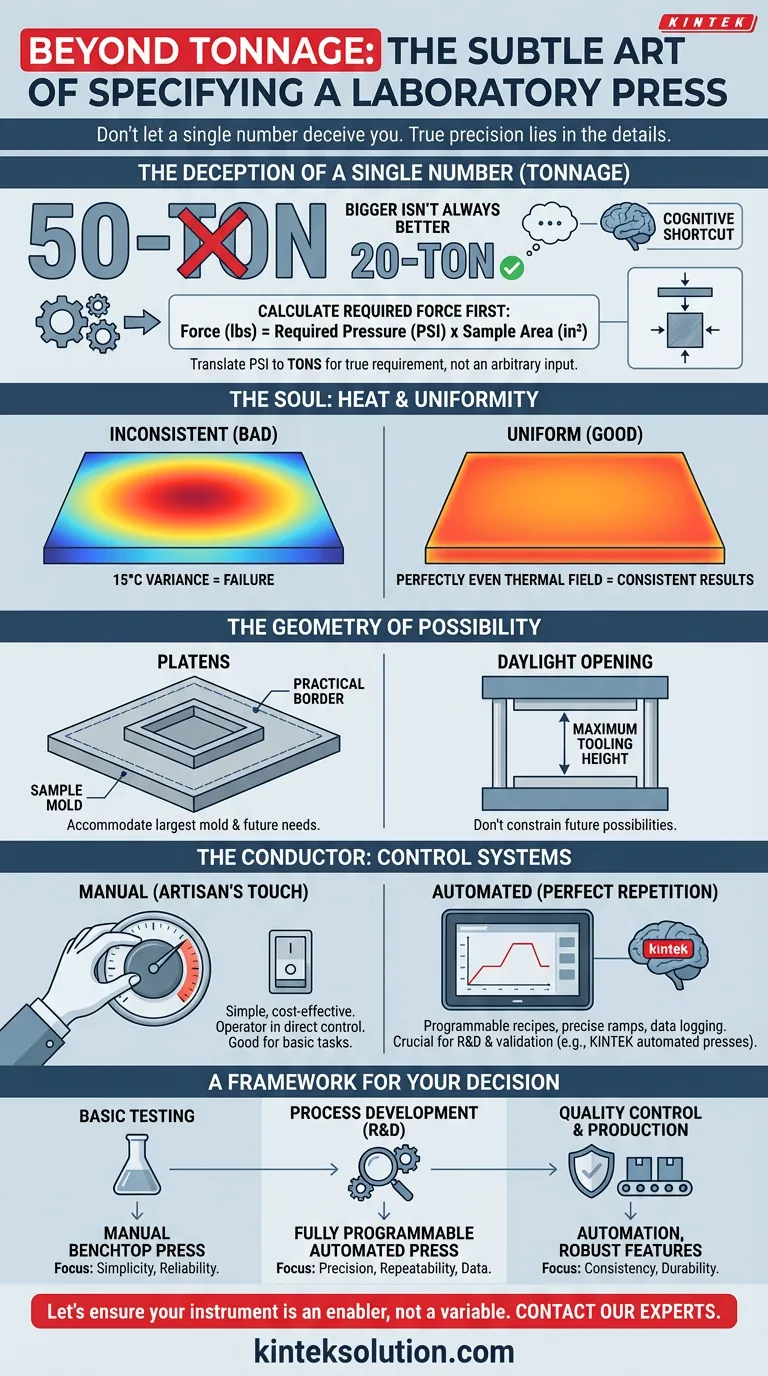
Visual Guide
Related Products
- Laboratory Hydraulic Press Lab Pellet Press Button Battery Press
- Laboratory Hydraulic Press 2T Lab Pellet Press for KBR FTIR
- Laboratory Hydraulic Press Lab Pellet Press Machine for Glove Box
- Laboratory Split Manual Heated Hydraulic Press Machine with Hot Plates
- Laboratory Hydraulic Pellet Press for XRF KBR FTIR Lab Press
Related Articles
- The Architecture of Density: Why Pressure is the Silent Architect of Solid-State Batteries
- The Physics of Transparency: Why Pressure is the Silent Architect of Spectroscopic Clarity
- The Architecture of Heat: Why Sample Density Dictates the Truth in Metal Hydride Research
- The Geometry of Ionic Flow: Why Precision Pressing Dictates Material Truth
- The Geometry of Electrons: Why Surface Precision is the Silent Partner in SECM Research



















