The Hidden Enemy in Every Material
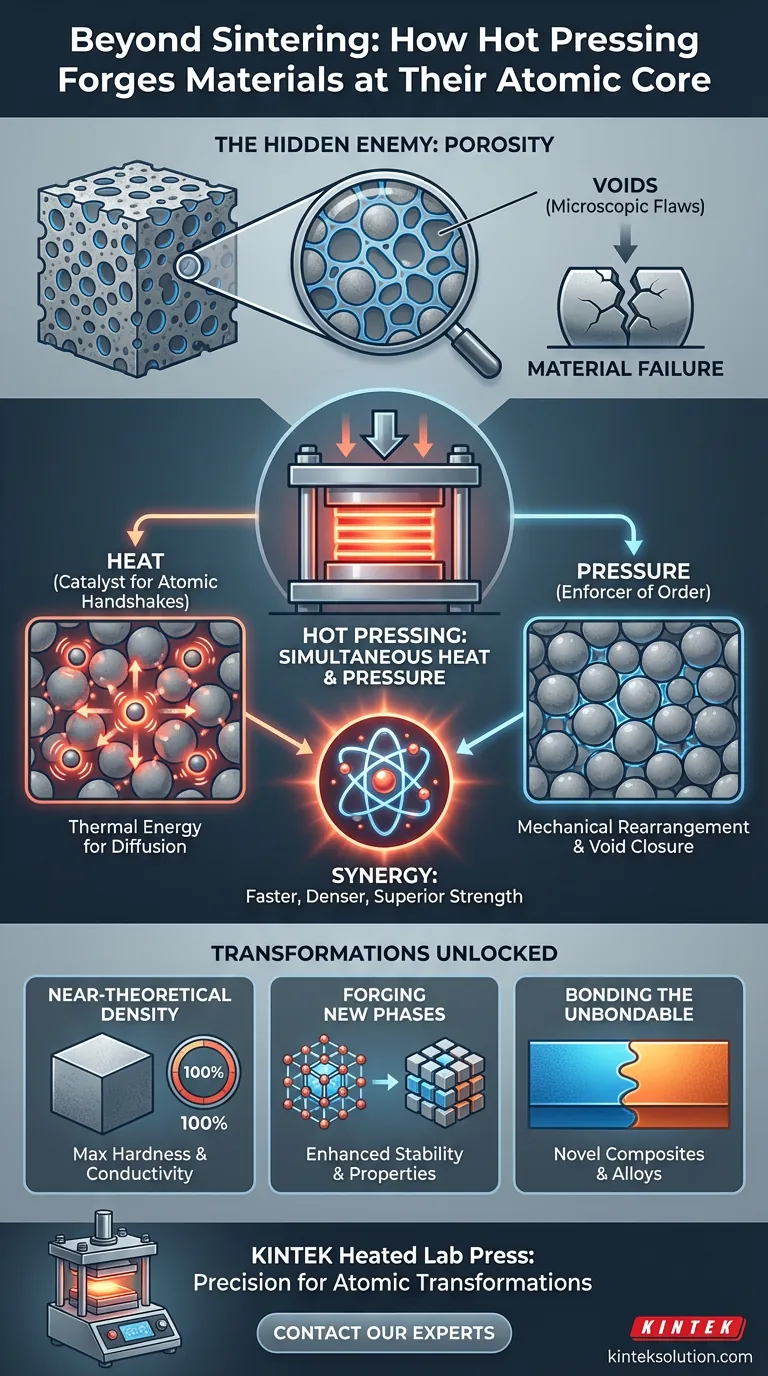
Material failure is rarely a dramatic, sudden event. It often begins in silence, with an invisible flaw—a microscopic void between particles, left over from the manufacturing process.
This porosity, the empty space within a supposedly solid object, is the root cause of countless mechanical weaknesses. It's a hidden enemy that compromises strength, fractures under stress, and limits the potential of even the most advanced materials.
For scientists and engineers, the central challenge has always been the elimination of these voids. You can't just wish them away. You must force them out.
An Elegant Answer to a Messy Problem
Hot pressing is a deceptively simple concept that solves this profound problem. It combines two fundamental forces—intense heat and immense uniaxial pressure—and applies them simultaneously.
Imagine building a fortress wall from loose stones. Without mortar, it's porous and weak. Conventional sintering is like heating those stones until their edges begin to melt and fuse—a slow process that can warp the stones.
Hot pressing, however, is like using a giant vise to squeeze the stones together while heating them. The pressure forces every stone into intimate contact, eliminating gaps, while the heat provides just enough energy for their surfaces to bond permanently. The result is a monolithic, impenetrable structure.
The Physics of Synergy: Heat and Pressure in Concert
The power of hot pressing doesn't come from heat or pressure alone, but from their powerful interaction. Understanding this synergy is key to appreciating why it creates materials that are often impossible to produce otherwise.
Heat: The Catalyst for Atomic Handshakes
Thermal energy makes atoms move. In a process called sintering, heat gives atoms the energy they need to diffuse across the boundaries of individual powder particles. This is the microscopic equivalent of a handshake, where particles bond to their neighbors, forming a solid mass.
But heat alone has drawbacks. It often requires extremely high temperatures and long processing times, which can lead to undesirable grain growth and a weaker final product.
Pressure: The Enforcer of Order
Directional pressure is the brute force in the equation. It mechanically rearranges the particles, forcing them into a denser configuration and physically closing the pores and voids. It imposes order on the chaotic arrangement of the initial powder.
Why Together is Better
When applied simultaneously, pressure dramatically reduces the temperature and time needed for effective sintering. The pressure brings particle surfaces into such close contact that the "atomic handshakes" can occur far more easily and efficiently.
This synergistic effect allows for the creation of an incredibly dense, uniform material in a fraction of the time, preserving a fine-grained microstructure that is essential for superior strength.
From Dense to Different: The Transformations It Unlocks
Hot pressing does more than just compact powders; it enables fundamental transformations at an atomic level, creating materials with entirely new properties.
-
Achieving Near-Theoretical Density: The primary goal is densification. By virtually eliminating porosity, hot pressing can create components that approach 100% of their theoretical maximum density. This translates directly into radical improvements in hardness, mechanical strength, and thermal conductivity.
-
Forging New Material Phases: The extreme conditions inside a hot press can force a material’s atomic lattice to reconfigure into a new, often more desirable, crystalline phase. This is how engineers create materials with enhanced stability or hardness that don't exist under normal conditions.
-
Bonding the Unbondable: The process is a master at creating novel composites and alloys. By forcing different powders together in their solid state, hot pressing facilitates diffusion and chemical reactions, creating strong bonds between dissimilar materials that would otherwise never fuse.
This level of control requires instrumentation built for precision. A high-performance KINTEK Heated Lab Press, for example, provides the stable temperature and consistent pressure necessary to guide these delicate atomic transformations reliably, turning a theoretical formula into a tangible, high-performance component.
A Pragmatist's Guide to Hot Pressing
While powerful, hot pressing is a specialized technique. Its application is a strategic choice based on clear objectives and an understanding of its practical considerations.
| Aspect | Key Details |
|---|---|
| Process | Simultaneous heat and uniaxial pressure to consolidate powders. |
| Primary Benefits | Achieves superior density, improves strength, and shortens cycle times. |
| Ideal Applications | High-performance ceramics, novel composites, alloys, and rapid R&D. |
| Key Considerations | Best for simple geometries (discs, plates); requires a controlled atmosphere. |
Speed as a Strategic Advantage
For researchers, time is the most valuable resource. The significantly shorter cycle times of hot pressing compared to conventional sintering accelerate the iterative loop of material formulation, testing, and discovery. More experiments per week mean faster breakthroughs.
The Need for a Controlled Atmosphere
At high temperatures, many advanced materials will react with oxygen in the air, leading to oxidation that degrades their properties. For this reason, hot pressing is almost always performed in a vacuum or an inert gas environment to protect the material's integrity. Modern automatic lab presses are designed with this necessity in mind, integrating vacuum capabilities for clean, reliable processing.
The quest for perfect materials is a quest for control over the microscopic. Hot pressing offers an unparalleled degree of control over density, microstructure, and composition. For the teams on the front lines of materials science, having an instrument that can reliably execute this process is fundamental to success. Contact Our Experts
Visual Guide
Related Products
- Automatic High Temperature Heated Hydraulic Press Machine with Heated Plates for Lab
- Heated Hydraulic Press Machine with Heated Plates for Vacuum Box Laboratory Hot Press
- Automatic Heated Hydraulic Press Machine with Hot Plates for Laboratory
- Heated Hydraulic Press Machine With Heated Plates For Vacuum Box Laboratory Hot Press
- Laboratory Split Manual Heated Hydraulic Press Machine with Hot Plates
Related Articles
- The Architecture of Slow: Why Physical Precision Dictates Chemical Destiny
- The Architecture of Certainty: Why the Laboratory Press is the Anchor of Material Science
- The Vanishing Boundary: The Hidden Thermodynamics of LTCC Lamination
- The Alchemy of 160°C: Why Precision Pressing is the Silent Backbone of Rubber Science
- The Invisible Forge: Why the Laboratory Press is the Soul of Nano-Composites



















