In the world of material science, a pellet is more than just compressed powder. It is a captured moment of physics, a dense architecture designed to hold the secrets of a material’s thermal, electrical, or chemical properties.
But when a pellet cracks, or when data becomes "noisy," the fault rarely lies in the magnitude of the force applied. It lies in the invisible architecture of the mixture itself.
The Geometry of Failure
In laboratory pressing, we often succumb to the "brute force" fallacy: the belief that enough pressure can coerce any powder into a stable solid.
However, pressure acts as an amplifier. If a mixture is non-homogeneous, the press does not create a uniform solid; it creates a landscape of localized stress. This leads to several systemic failures:
- Internal Voids: Microscopic pockets of air that become structural weak points.
- Micro-cracks: Stress fractures that propagate during the release of pressure.
- Capping: The catastrophic separation of the pellet’s "cap" or layers, often occurring the moment the die is opened.
The Physics of Fairness
For a pellet to achieve structural integrity, the applied force must be "democratic"—every particle must experience the same stress at the same time. This is only possible through high mixture homogeneity.
Achieving Force Equilibrium
When a mixture is thoroughly homogenized—often through magnetic stirring or high-energy milling—the particles are distributed in a way that allows the laboratory press to distribute pressure equally. Equilibrium prevents the formation of "hot spots" where density is higher than the surrounding matrix.
The Density Gradient Problem
Without uniformity, you create a density gradient. One side of your sample might be a dense, glassy solid, while the other remains porous. For researchers measuring conductivity or diffusion, this gradient is a silent killer of data reproducibility. It turns a scientific measurement into a lottery.
The Psychology of Preparation
We tend to focus on the press because the press is powerful, heavy, and expensive. We ignore the mixing because it feels like a preliminary chore.
But in the lifecycle of a micropore-confined organic solid, the mixing phase is where the "soul" of the pellet is formed.
- Homogeneity is the Foundation: You cannot fix a bad mixture with a good press.
- Stability is the Goal: A uniform mixture locks components into place, preventing the elemental segregation that occurs when loose powders settle.
- Reproducibility is the Metric: If two pellets from the same batch yield different results, your problem isn't your instrument; it's your symmetry.
Strategic Selection: Matching Method to Material
Every research objective requires a specific approach to how force is applied to a homogenized mixture.
| Research Objective | Pressing Strategy | Structural Priority |
|---|---|---|
| Mechanical Stability | High-energy Homogenization + Manual Press | Elimination of internal micro-cracks |
| Analytical Precision | Precise Force Control + Automatic Press | Elimination of density gradients |
| Sensitive Environments | Glovebox-Integrated Pressing | Prevention of oxidation/moisture contamination |
| Absolute Uniformity | Isostatic Pressing (CIP/WIP) | Multi-directional force for complex geometries |
The Engineer’s Romanticism: Precision in Every Micron
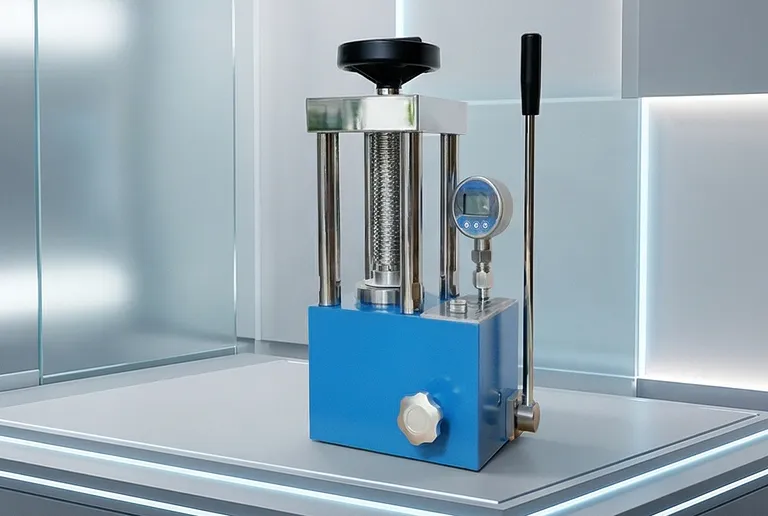
There is a certain beauty in a perfectly pressed pellet. It is smooth, reflective, and structurally sound. It represents a harmony between the chemist’s preparation and the engineer’s machine.
At KINTEK, we understand that the press is the final guardian of your sample’s integrity. We provide the tools that turn your homogenized mixtures into high-fidelity data carriers.
Whether you are working on the next generation of solid-state batteries or exploring micropore-confined organic solids, our range of equipment is designed to respect the physics of your material:
- Manual and Automatic Presses for controlled, repeatable compaction.
- Heated and Multifunctional Models for phase-change and synthesis research.
- Glovebox-Compatible Solutions for the most sensitive chemical environments.
- Cold and Warm Isostatic Presses (CIP/WIP) for those who demand the ultimate in density uniformity.
Success in the lab is a chain where every link must hold. Don't let a lack of homogeneity be the break in your research.
To find the precise instrument for your material's unique requirements, Contact Our Experts.
Related Products
- Laboratory Hydraulic Split Electric Lab Pellet Press
- Manual Laboratory Hydraulic Pellet Press Lab Hydraulic Press
- Laboratory Hydraulic Pellet Press for XRF KBR FTIR Lab Press
- Automatic Laboratory Hydraulic Press Lab Pellet Press Machine
- XRF KBR Plastic Ring Lab Powder Pellet Pressing Mold for FTIR
Related Articles
- The Physics of Transparency: Why Pressure is the Silent Architect of Spectroscopic Clarity
- The Architecture of Density: Why Pressure is the Silent Architect of Solid-State Batteries
- The Anatomy of Repeatability: Deconstructing the Modern Laboratory Press
- The Physics of Trust: A Disciplined Approach to Laboratory Press Safety and Reliability
- The Three-Body Problem of Pellet Pressing: Material, Machine, and Method