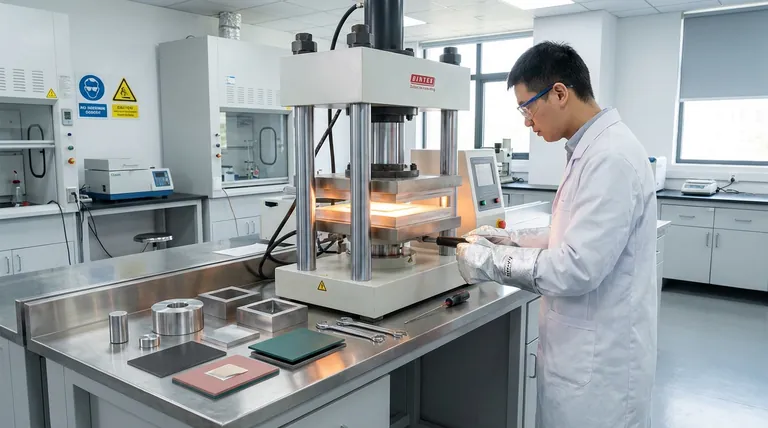
The Silent Accumulation of Risk
A laboratory press is an instrument of immense, concentrated force. It sits quietly in the corner of a lab, a testament to hydraulic power. But its quiet nature is deceptive.
We have a cognitive bias for visible, immediate threats. A broken beaker or a spilled chemical demands our attention. A high-tonnage press, operating smoothly, does not. We see it work, so we assume it is well. This assumption is the starting point for most preventable failures. The most dangerous risks are not the ones that announce themselves, but the ones that accumulate silently, cycle after cycle.
The Slow-Motion Failure
Imagine a graduate student running a series of polymer tests, weeks away from a thesis deadline. For days, the lab press has emitted a slightly different hum during pressurization, a change too subtle to register over the background noise of the lab.
The pressure gauge reads correctly. The temperature controller is stable. Yet, deep within the machine, a hydraulic hose, fatigued by thousands of pressure cycles, has developed micro-fractures. The hydraulic fluid, contaminated with microscopic particles, has lost some of its lubricating properties, accelerating wear on the pump.
This isn't a single point of failure. It’s a systemic breakdown, happening in slow motion. The eventual result—a burst hose, a catastrophic loss of pressure, or a cracked frame—seems sudden, but it was entirely predictable. It’s the expensive, dangerous outcome of treating maintenance as an afterthought rather than a core principle.
Building a System of Trust
Trust in a scientific instrument shouldn't be an emotion; it should be the engineered outcome of a reliable system. A robust maintenance program is not a checklist of chores. It's a culture of discipline that transforms a potential hazard into a trusted partner in research.
This system is built on two pillars: constant awareness and scheduled intervention.
The Daily Ritual: From Operator to Guardian
The most effective line of defense is the person who uses the press every day. Turning pre-operation checks into a non-negotiable, two-minute ritual transforms an operator into a guardian of the equipment.
- The Environment: Is the area around the press clear? Clutter is a safety hazard.
- The Safeguards: Are all safety guards properly in place?
- The Foundation: Are there any drips or puddles beneath the machine? A single drop of hydraulic fluid is an early signal.
This isn't about bureaucracy. It’s about cultivating situational awareness. It's the same discipline a pilot applies before every flight.
The Scheduled Dialogue: Listening to the Machine
Periodic inspections are a deeper conversation with the equipment. This is where you look for the subtle signs of stress that precede failure.
| Component | What to Look For | Why It Matters |
|---|---|---|
| Hydraulic Hoses | Cracking, abrasions, or bulging | The primary conduits of force; their failure is instantaneous. |
| Structural Frame | Stress fractures, especially around welds | High tonnage fatigues metal over time; integrity is paramount. |
| System Vitals | Changes in pump sound, new vibrations, slower cycle times | Sensory clues are often the first indicator of internal wear. |
The Anatomy of Reliability
Beyond looking and listening, hands-on maintenance ensures the long-term precision and safety of the press.
The Lifeblood: Hydraulic Fluid Integrity
Hydraulic fluid does more than just transmit force. It lubricates, cleans, and cools the system's internal components. Over time, it degrades.
Following the manufacturer's schedule for fluid replacement is non-negotiable. More importantly, using the exact type of hydraulic oil specified is critical. The wrong fluid can destroy seals and compromise the entire system. It’s not a commodity; it’s a precision-engineered component.
The Surface of Truth: Platen and Calibration
For a researcher, the press platens are where theory meets reality. Any residue on their surface can interfere with heat transfer. Any deviation from perfect parallelism can create uneven pressure.
A dirty or misaligned platen doesn't just ruin a sample; it corrupts your data. The pursuit of perfectly clean, parallel platens is the pursuit of scientific truth. Regular calibration of temperature and alignment ensures your results are not just consistent, but also accurate.
Your Goal Determines Your Focus
A disciplined maintenance program is not one-size-fits-all. It should be tailored to your lab’s primary mission.
- If your priority is absolute safety: Focus on daily pre-use checks, mandatory use of personal protective equipment, and regular testing of all emergency stop functions.
- If your priority is unimpeachable data accuracy: Obsess over platen cleanliness and schedule rigorous verification of platen parallelism and temperature controller calibration.
- If your priority is maximum uptime and longevity: Adhere strictly to the manufacturer's schedule for hydraulic fluid replacement and conduct thorough inspections of the frame and hoses.
Ultimately, the reliability of your work is inseparable from the reliability of your tools. It starts with a foundation of robust engineering—a machine built for precision and durability. A well-designed system, like KINTEK's range of automatic, isostatic, and heated lab presses, makes implementing a culture of safety and discipline feel intuitive, not burdensome.
Protect your personnel, your research, and your investment by building a system of trust with your equipment. Contact Our Experts to learn how the right foundation can make all the difference.
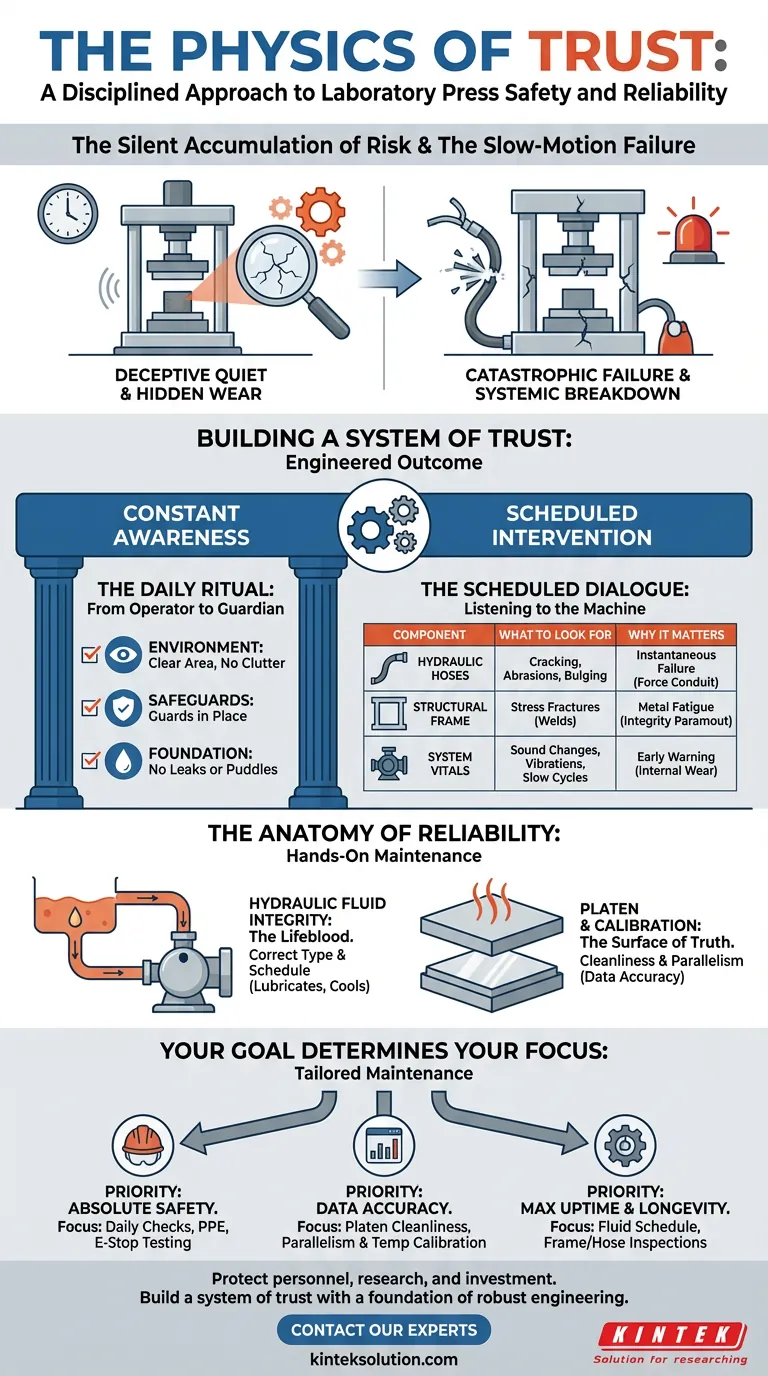
Visual Guide
Related Products
- Laboratory Hydraulic Press 2T Lab Pellet Press for KBR FTIR
- Laboratory Hydraulic Press Lab Pellet Press Button Battery Press
- Laboratory Hydraulic Press Lab Pellet Press Machine for Glove Box
- Laboratory Split Manual Heated Hydraulic Press Machine with Hot Plates
- Laboratory Hydraulic Split Electric Lab Pellet Press
Related Articles
- The Physics of Transparency: Why Pressure is the Silent Architect of Spectroscopic Clarity
- The Architecture of Density: Why Pressure is the Silent Architect of Solid-State Batteries
- The Architecture of Heat: Why Sample Density Dictates the Truth in Metal Hydride Research
- The Geometry of Electrons: Why Surface Precision is the Silent Partner in SECM Research
- The Geometry of Ionic Flow: Why Precision Pressing Dictates Material Truth



















