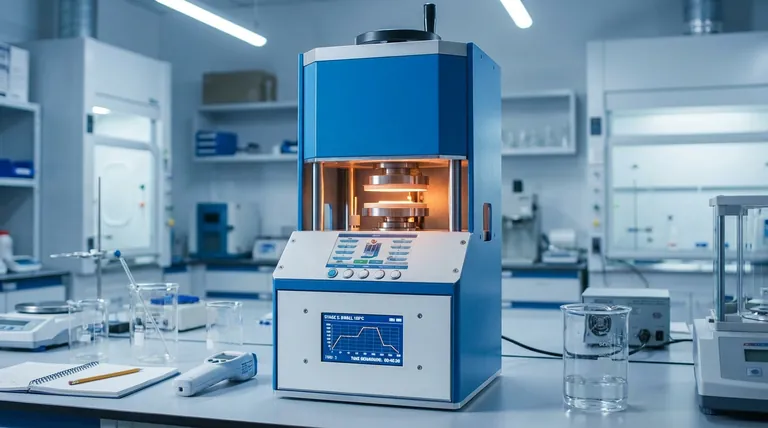
The Silent Variable That Invalidates Everything
A materials scientist spends six months developing a novel polymer composite. The formula is perfect, the theory is sound. In the final validation test, the sample fails under stress, exhibiting properties that defy the team's calculations.
The culprit wasn't the chemistry. It was a 3°C temperature overshoot in the lab press during the curing cycle—a brief, unrecorded fluctuation that silently sabotaged the material's molecular structure.
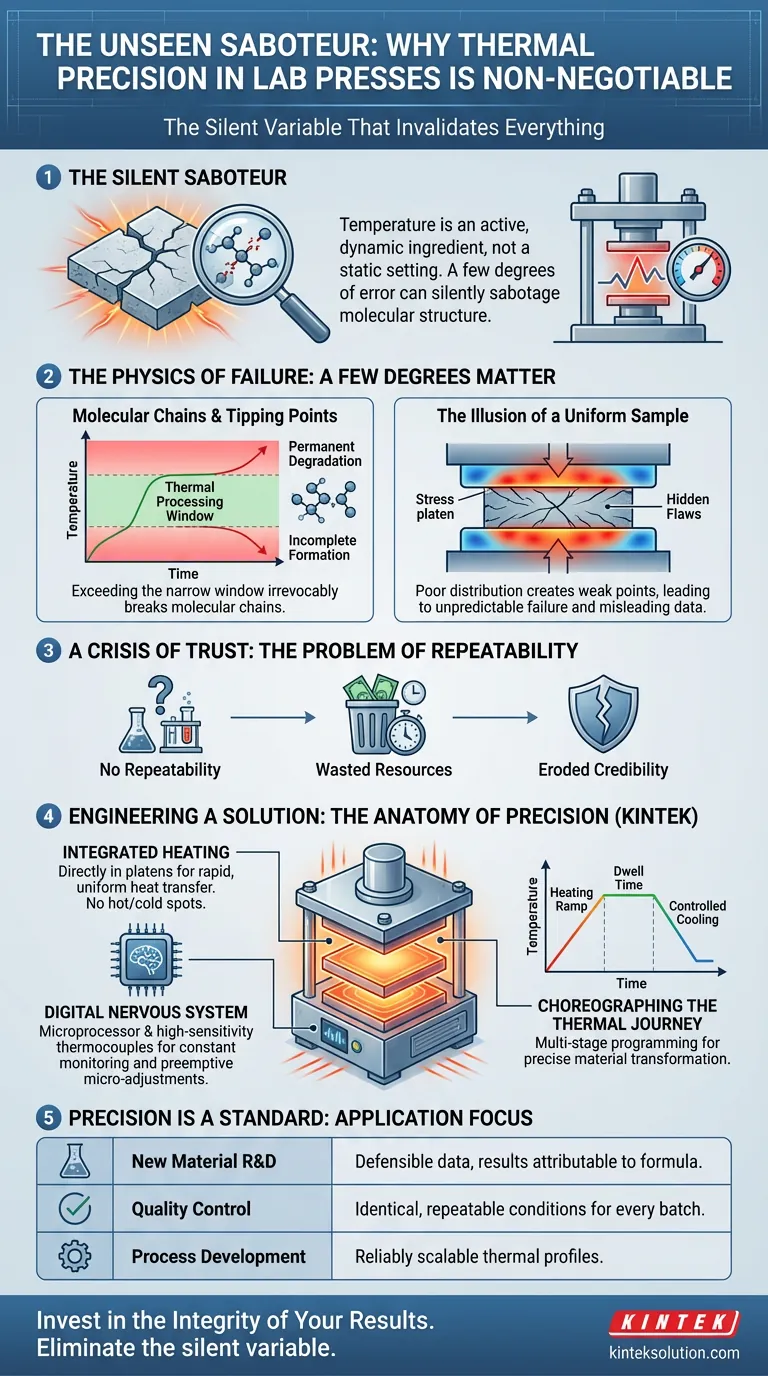
In materials science, we are trained to focus on the grand variables: chemical composition, pressure, and time. We often treat temperature as a simple setpoint. This is a critical psychological error. Temperature is not a static setting; it's an active, dynamic ingredient. Without absolute control, it becomes an invisible saboteur.
The Physics of Failure: Why a Few Degrees Matter
The difference between a breakthrough material and a useless piece of plastic can be just a few degrees. The consequences of thermal imprecision are not minor; they are fundamental and often irreversible.
Molecular Chains and Tipping Points
Many advanced materials, from polymers to pharmaceuticals, exist within a narrow thermal processing window.
Exceeding this window, even for a moment, isn't just like leaving a cake in the oven too long. It's a process of permanent degradation. Molecular chains are irrevocably broken. Crystalline structures fail to form correctly. The material's intended properties—its strength, flexibility, or chemical stability—are lost forever.
The Illusion of a Uniform Sample
Even if the average temperature is correct, poor distribution across the press platens creates hidden flaws. One area of the sample cures faster than another, inducing internal stresses and microscopic inconsistencies.
The sample may look perfect to the naked eye, but it is a landscape of weak points. When tested, it fails unpredictably. The data it produces is not just inaccurate; it's misleading.
The Problem of Repeatability: A Crisis of Trust
Science and quality control are built on the bedrock of repeatability. If an experiment cannot be reliably reproduced, its results are meaningless.
A lab press with inconsistent temperature control makes reproducibility impossible. You are left to wonder: Did my new parameters cause the change in outcome, or was it the ghost in the machine—a thermal profile that was different from the last run?
This uncertainty erodes the currency of scientific work: trust. It makes it impossible to scale a process from the lab to production, as the foundational conditions can never be accurately replicated. Investing in a low-precision press is a form of technical debt, paid for with wasted time, squandered materials, and compromised professional credibility.
Engineering a Solution: The Anatomy of Precision
Achieving true thermal precision is not about brute force. It's about intelligent, responsive control—an engineering art form. This is where the design of the press itself becomes paramount.
Integrated Heating, Not Just Attached
High-performance presses, like those engineered by KINTEK, feature heating elements integrated directly into the platens. This design is not an incidental detail; it is crucial for ensuring rapid and uniform heat transfer, eliminating the hot and cold spots that plague lesser designs.
A Digital Nervous System
The core of modern thermal control is a microprocessor-based system. Using high-sensitivity thermocouples, it functions like a digital nervous system, constantly monitoring and making micro-adjustments. It anticipates and corrects deviations before they can impact the material, maintaining the setpoint with extreme fidelity.
Choreographing the Thermal Journey
Advanced materials don't just need a single temperature; they need a thermal journey. Leading lab presses allow for multi-stage programming:
- Heating Ramps: Controlling the rate of temperature increase.
- Dwell Times: Holding a precise temperature for a specific duration.
- Controlled Cooling: Managing the rate of cooling to prevent stress fractures.
This allows a researcher to choreograph a material's transformation with absolute certainty, viewing the real-time temperature curve as proof that the machine is executing the plan flawlessly.
Precision is a Standard, Not a Feature
The level of precision you require is a direct reflection of the standards you uphold. Whether for pure research or industrial quality control, the goal is the same: eliminate uncontrolled variables.
| Application Focus | Why Precision is Non-Negotiable |
|---|---|
| New Material R&D | To ensure data is defensible and results are attributable to your formula, not the equipment. |
| Quality Control | To guarantee that every batch is produced under identical, repeatable conditions. |
| Process Development | To create a thermal profile that can be reliably scaled and transferred to other machines. |
Ultimately, choosing a lab press is a decision about risk mitigation. By prioritizing precise, verifiable temperature control, you are not just buying a piece of equipment; you are investing in the integrity of your results.
To eliminate the silent variable of thermal inconsistency from your work, Contact Our Experts.
Visual Guide
Related Products
- 24T 30T 60T Heated Hydraulic Lab Press Machine with Hot Plates for Laboratory
- Manual Heated Hydraulic Lab Press with Integrated Hot Plates Hydraulic Press Machine
- Laboratory Hydraulic Pellet Press for XRF KBR FTIR Lab Press
- Lab Infrared Press Mold for Laboratory Applications
- Laboratory Hydraulic Press Lab Pellet Press Machine for Glove Box
Related Articles
- The Invisible Forge: Why the Laboratory Press is the Soul of Nano-Composites
- The Architecture of Slow: Why Physical Precision Dictates Chemical Destiny
- The Architecture of Density: Why Pressure is the Silent Architect of Solid-State Batteries
- The Physics of Transparency: Why Pressure is the Silent Architect of Spectroscopic Clarity
- The Architecture of Certainty: Why the Laboratory Press is the Anchor of Material Science



















