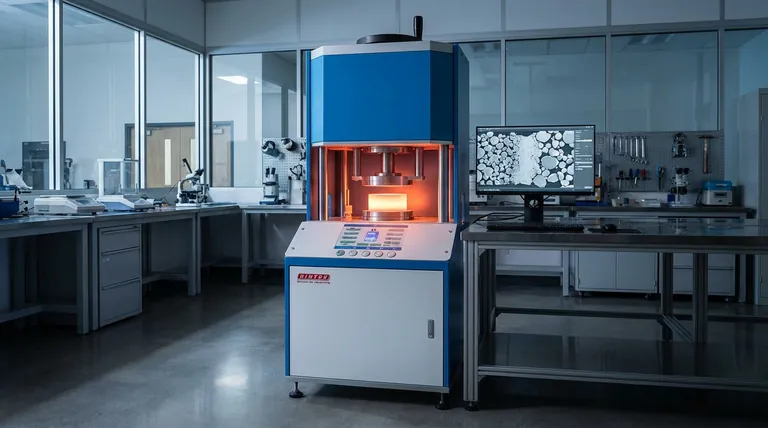
The Illusion of Solidity
A pile of bricks is not a wall. A mound of sand is not glass. In material science, the gap between a collection of individual particles and a truly unified, high-performance solid is vast.
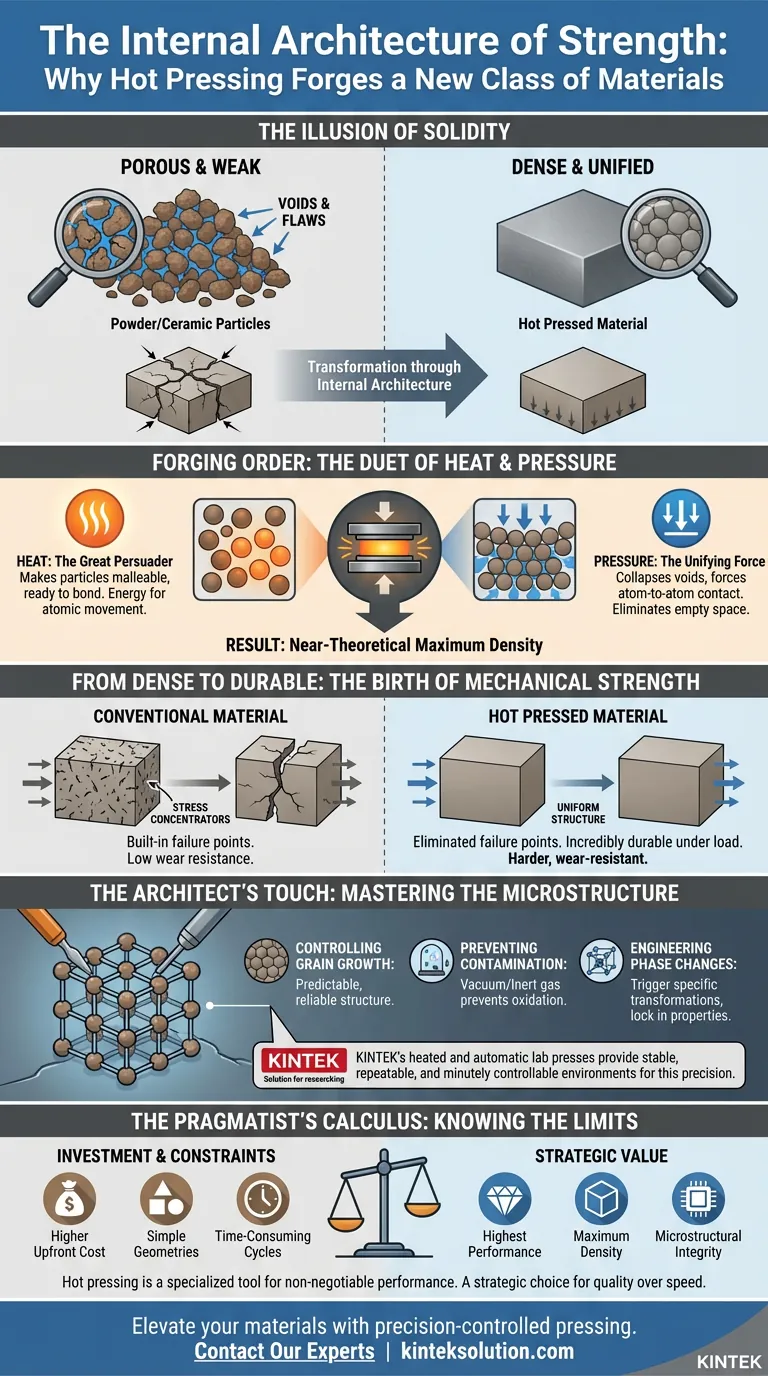
From the outside, a component made from powdered metal or ceramic might look solid. But on a microscopic level, it is a landscape of tiny voids, gaps, and imperfect connections. These invisible flaws are the hidden enemies of performance. They are the starting points for cracks, the pathways for wear, and the reason a material fails long before its theoretical potential is reached.
The fundamental challenge isn't just shaping material, but transforming its very internal architecture—turning chaos into order.
Forging Order: The Duet of Heat and Pressure
Hot pressing is less about brute force and more about elegant persuasion. It uses two fundamental forces of nature in a precise duet to convince individual particles to abandon their separateness and become a single, monolithic entity.
Heat: The Great Persuader
Heat is the agent of change. By raising a material's temperature, we give its atoms the energy to move. The material softens and becomes plastic, reducing its internal resistance. Particles that were once rigid and unyielding become malleable, ready to form new, stronger bonds with their neighbors.
Pressure: The Unifying Force
If heat makes particles willing to bond, pressure makes it impossible for them not to. As immense, uniform force is applied, the voids and pores that separate the particles collapse. The particles are forced into intimate, atom-to-atom contact across their entire surfaces, eliminating the empty space that defines weakness.
The result of this duet is a material that approaches its theoretical maximum density. This isn't just about making something heavier; it's about systematically removing internal points of failure.
From Dense to Durable: The Birth of Mechanical Strength
Our intuition tells us that a dense object is a strong one. This is psychologically true, but it's also physically an absolute. The near-perfect density achieved through hot pressing directly translates to a dramatic increase in mechanical strength.
Think of a tiny crack in a car's windshield. That small imperfection is a stress concentrator; all the forces on the glass are amplified at that single point until it fails. The microscopic voids in a conventional material act just like that tiny crack, repeated thousands of times.
By eliminating these voids, hot pressing removes the built-in failure points. The resulting material is not only harder and more resistant to wear but also distributes stress evenly, making it incredibly durable under load. It behaves as a single, robust structure because, internally, it finally is one.
The Architect's Touch: Mastering the Microstructure
The true elegance of modern hot pressing lies beyond simply making things dense. It offers engineers a level of control that is akin to being an architect at the atomic scale.
The final properties of an advanced material—be it a ceramic for body armor or a composite for aerospace—are dictated by its internal microstructure. This includes the size, shape, and orientation of its crystalline grains.
- Controlling Grain Growth: The precise temperature and pressure profiles can be managed to ensure grains grow uniformly, creating a predictable and reliable internal structure.
- Preventing Contamination: By operating in a vacuum or inert gas, the process prevents oxidation and other chemical reactions that could compromise the material's integrity.
- Engineering Phase Changes: The process can even be used to intentionally trigger specific phase transformations within the material, locking in desirable properties.
Achieving this level of architectural control requires equipment of equal precision. To conduct this orchestra of heat, pressure, and time, laboratories and research facilities rely on advanced systems. KINTEK's heated and automatic lab presses are designed for exactly this purpose, providing the stable, repeatable, and minutely controllable environments needed to translate theoretical material science into tangible, high-performance components.
The Pragmatist's Calculus: Knowing the Limits
For all its power, hot pressing is a specialized tool, not a universal solution. Its application is a strategic choice based on a clear understanding of its trade-offs.
- The Investment in Perfection: Hot press machines are complex systems engineered for extreme conditions. This represents a higher upfront capital cost, an investment reserved for applications where material performance is non-negotiable.
- The Constraints of Form: The process is best suited for producing parts with relatively simple geometries, like blocks, discs, or plates. The component's size is also limited by the press's physical dimensions and force capacity.
- The Price of Patience: The heating, soaking, and cooling cycles are deliberate and can be time-consuming. It is a process that prioritizes quality over sheer speed.
The decision is clear. If your goal is the absolute highest material performance, density, and microstructural integrity, hot pressing is often the only path. For applications where failure is not an option, its precision is invaluable.
By understanding that you are not just forming a part but engineering its internal architecture from the ground up, you can make the right choice for your goals. To explore how precision-controlled pressing can elevate your materials, Contact Our Experts
Visual Guide
Related Products
- Heated Hydraulic Press Machine with Heated Plates for Vacuum Box Laboratory Hot Press
- Automatic High Temperature Heated Hydraulic Press Machine with Heated Plates for Lab
- Automatic Heated Hydraulic Press Machine with Hot Plates for Laboratory
- Laboratory Split Manual Heated Hydraulic Press Machine with Hot Plates
- Laboratory Manual Heated Hydraulic Press Machine with Hot Plates
Related Articles
- The Architecture of Slow: Why Physical Precision Dictates Chemical Destiny
- The Architecture of Certainty: Why the Laboratory Press is the Anchor of Material Science
- The Vanishing Boundary: The Hidden Thermodynamics of LTCC Lamination
- The Alchemy of 160°C: Why Precision Pressing is the Silent Backbone of Rubber Science
- The Invisible Forge: Why the Laboratory Press is the Soul of Nano-Composites



















