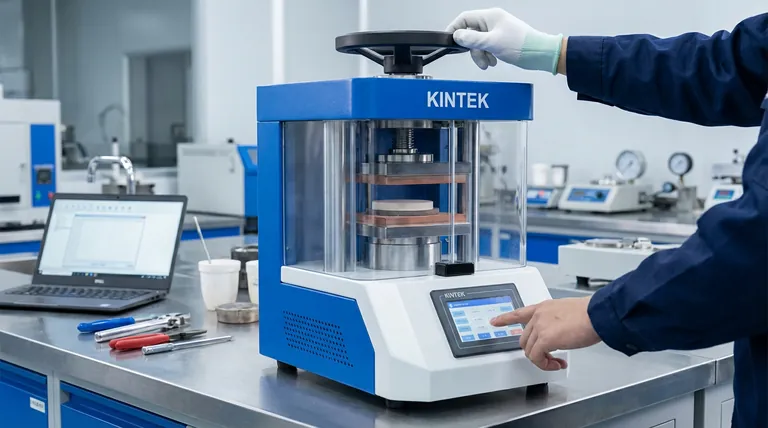
The Engineer's Dilemma: A Fight Against Heat
Imagine an engineer tasked with creating a perfectly flat, high-density ceramic disc. It's a critical component for a satellite sensor, where even micron-level warping can throw off the entire system.
They try conventional sintering. They carefully place the green part in the furnace, ramp up the temperature, and wait. The result? A dense part, but it's slightly warped, slumped, and shrunken in ways that are frustratingly unpredictable.
This isn't a failure of skill; it's a battle against physics. At high temperatures, materials want to relax into lower energy states. Atoms rearrange, grains grow, and the part's carefully defined geometry gives way to the subtle, powerful pull of thermal entropy. The psychological toll is one of diminishing returns—more effort for less control.
But what if we could fundamentally change the rules of the game? What if, instead of relying solely on the chaotic energy of heat, we imposed order with brute, mechanical force?
This is the philosophy behind hot pressing.
A Deliberate Trade-Off: Control Over Complexity
At its core, hot pressing is a conscious decision to sacrifice geometric complexity for exceptional dimensional control and density.
It’s an admission that heat, while necessary, is a wild horse. Pressure is the harness. By making mechanical pressure the primary driver for consolidation, we can operate at temperatures low enough to prevent melting, slumping, or the significant shrinkage that plagues other methods.
We are, in essence, telling the material exactly what shape to hold while we force its particles into a dense, ordered state.
The Physics of Controlled Densification
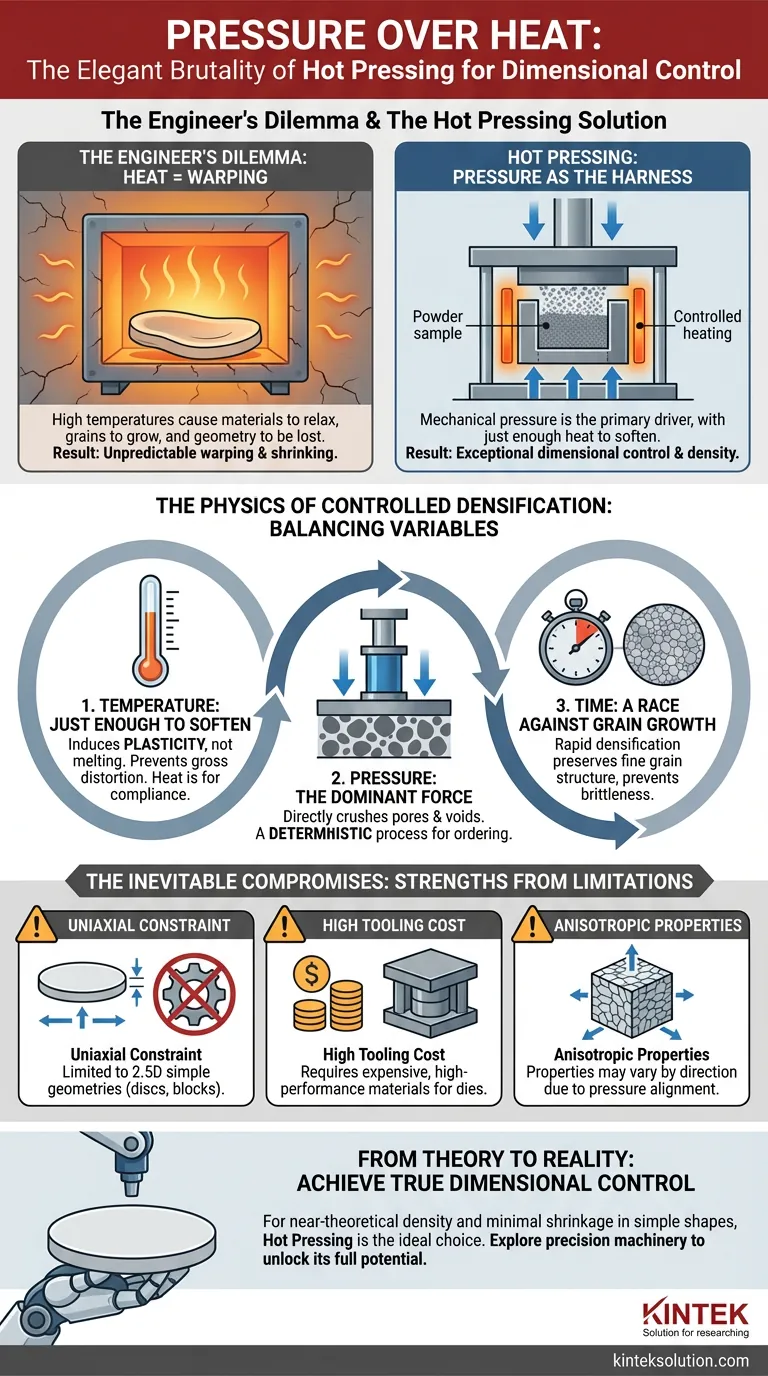
The magic of hot pressing lies in its precise manipulation of three variables: temperature, pressure, and time. Getting this balance right is the key to creating a dimensionally stable, high-performance part.
Temperature: Just Enough to Soften
The role of heat in hot pressing is carefully limited. The goal is to reach a temperature that induces plasticity—making the material soft and malleable enough for its particles to deform and bond.
Crucially, the temperature remains well below the material's melting point. The part never becomes a liquid. This single constraint is what prevents the gross distortion, slumping, and dimensional instability seen in processes like casting or liquid-phase sintering. Heat is used as a tool for compliance, not as the primary engine of densification.
Pressure: The Dominant Force for Order
While temperature makes the material compliant, pressure does the real work. The externally applied mechanical force is immense, directly crushing the pores and voids between material particles.
This is a far more direct and controllable path to densification than relying on heat to slowly sinter particles together. It’s a deterministic process, replacing the probabilistic nature of atomic diffusion with the certainty of mechanical force.
Time: A Race Against Microstructural Change
Because high pressure is so effective at accelerating densification, the entire process can be completed in a much shorter time frame.
This speed is not just about efficiency; it's critical for material integrity. Prolonged exposure to high heat encourages excessive grain growth, which can make a material brittle. By achieving full density quickly, hot pressing preserves a fine, strong grain structure while ensuring the component holds its intended shape.
The Inevitable Compromises
Hot pressing is a powerful solution, but it is not a universal one. Its strengths are born from its limitations, and understanding them is crucial for making an informed decision.
The Uniaxial Constraint
The most significant limitation is that standard hot pressing applies pressure along a single axis. This restricts its use to relatively simple geometries like discs, cylinders, and rectangular blocks. It's a master of 2.5D shapes but cannot produce complex, fully three-dimensional parts.
The Price of Power
The dies used to contain the workpiece must withstand extreme pressure and high temperatures simultaneously. This requires expensive, high-performance materials like specialty graphite or refractory metals, making the tooling a significant investment. For one-off prototypes or low-volume runs, this cost can be prohibitive.
A Directional World
Because pressure is applied uniaxially, the material's grain structure can become aligned. This can result in anisotropic properties—meaning the component might be stronger or behave differently along one axis compared to another. For applications requiring perfect uniformity in all directions, this is a critical consideration.
From Theory to Reality: The Right Tool for the Job
The theoretical benefits of hot pressing—unparalleled density and dimensional control—are only realized when the equipment can flawlessly execute the delicate dance between temperature, pressure, and time. This is not a process for crude machinery. It requires a system built for precision.
Choosing the right manufacturing process means aligning its strengths with your primary goal.
- For near-theoretical density and minimal shrinkage in a simple shape: Hot pressing is the ideal choice.
- For complex 3D net-shape parts: Alternative methods like Hot Isostatic Pressing (HIP) are better suited.
- For low-cost, high-volume production of less critical components: Conventional press-and-sinter powder metallurgy may be more economical.
When your objective is ultimate control over form and density, you need equipment that can deliver that control repeatably and reliably. KINTEK's advanced laboratory presses—including automatic, heated, and isostatic models—are engineered to provide the precise process management required to turn theoretical advantages into tangible results.
To move beyond the compromises of heat-driven processes and achieve true dimensional control in your materials, explore how precision machinery can unlock the full potential of hot pressing. Contact Our Experts
Visual Guide
Related Products
- Automatic High Temperature Heated Hydraulic Press Machine with Heated Plates for Lab
- Heated Hydraulic Press Machine with Heated Plates for Vacuum Box Laboratory Hot Press
- Automatic Heated Hydraulic Press Machine with Hot Plates for Laboratory
- Heated Hydraulic Press Machine With Heated Plates For Vacuum Box Laboratory Hot Press
- Laboratory Split Manual Heated Hydraulic Press Machine with Hot Plates
Related Articles
- The Architecture of Slow: Why Physical Precision Dictates Chemical Destiny
- The Architecture of Certainty: Why the Laboratory Press is the Anchor of Material Science
- The Vanishing Boundary: The Hidden Thermodynamics of LTCC Lamination
- The Alchemy of 160°C: Why Precision Pressing is the Silent Backbone of Rubber Science
- The Invisible Forge: Why the Laboratory Press is the Soul of Nano-Composites



















