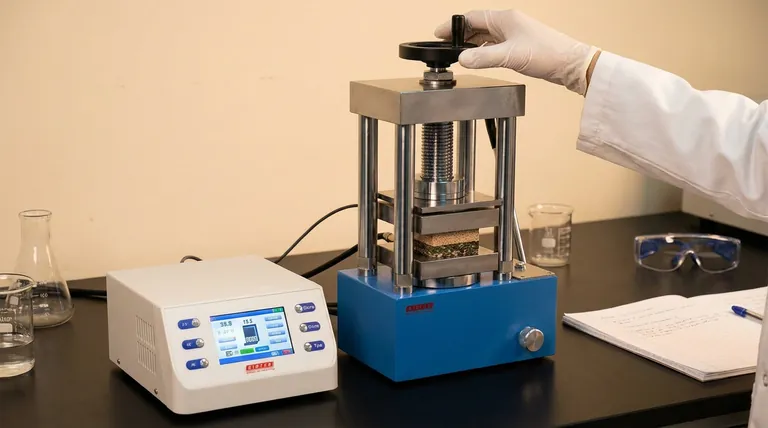
The Seduction of the Spec Sheet
When choosing a critical piece of lab equipment, our instincts often pull us toward the biggest numbers. The highest tonnage, the widest temperature range. It's a natural bias—we equate more power with more capability.
But a lab press isn't a blunt instrument. It's a tool of persuasion. Its job is to coax a material into a new state with precision and repeatability. The most important decision isn't finding the most powerful press, but the one that perfectly fits your specific process window.
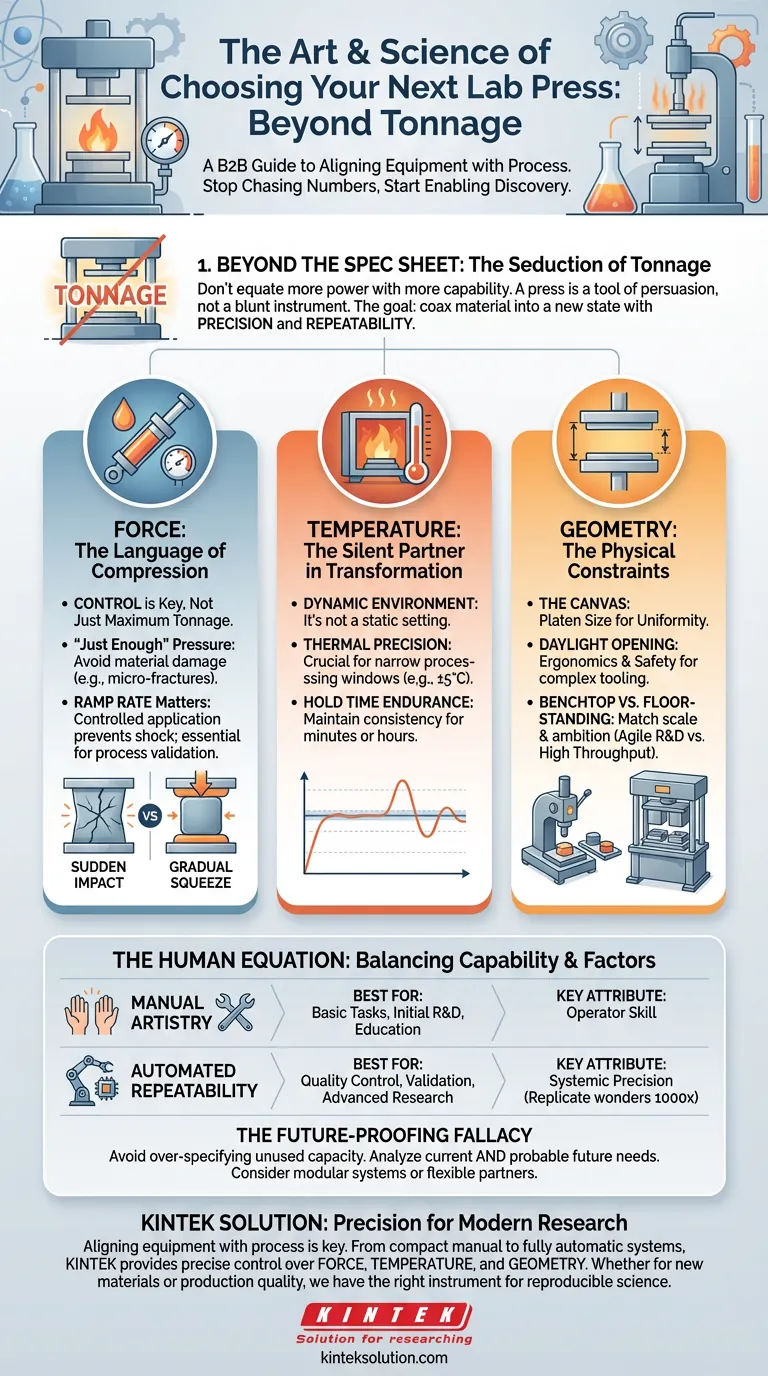
This decision rests on three pillars: Force, Temperature, and Geometry. Get them right, and you enable discovery. Get them wrong, and you generate noise.
Pillar 1: Force, The Language of Compression
Force is the primary function, but thinking only of maximum tonnage is a trap. The real value lies in control.
Tonnage and the Art of "Just Enough"
Imagine curing a delicate composite laminate. Too much force, applied too quickly, doesn't just compress; it shatters the internal matrix, creating micro-fractures invisible to the eye but catastrophic in application. The goal is not to crush, but to apply precisely the right pressure (force per unit area) to achieve consolidation.
Your first question shouldn't be "How many tons can it do?" but "What pressure does my sample need, and how much control do I need to get there?"
The Ramp Rate: A Dialogue with Your Material
For many polymers and sensitive materials, the speed at which force is applied—the ramp rate—is as critical as the final value. A programmable ramp rate allows you to have a controlled dialogue with the material, preventing thermal shock or mechanical stress. It’s the difference between a sudden impact and a gradual, persuasive squeeze. This level of control is fundamental for process validation and repeatable results.
Pillar 2: Temperature, The Silent Partner in Transformation
In a heated lab press, temperature is not a static setting; it’s a dynamic environment that you must command with absolute precision.
The Tyranny of a Narrow Processing Window
For many advanced materials, the difference between a perfect cure and a brittle, useless sample is a mere 5°C. A press that overshoots its target temperature, even for a moment, has already failed the experiment.
Look beyond the maximum temperature range. Focus on thermal precision—the machine's ability to hit a setpoint and hold it without deviation. This is non-negotiable for serious R&D and quality control.
The Test of Endurance: Hold Time
Your process may require a sample to be held at a specific temperature and pressure for minutes or even hours. This tests the thermal endurance and stability of the entire system. Ensure the press is designed to maintain both parameters with unwavering consistency for your longest required cycle times.
Pillar 3: Geometry, The Physical Constraints of Your Ambition
Force and temperature are invisible forces. Geometry is the tangible reality of the machine—the physical space where your work happens.
The Canvas: Platen Size and Daylight
The platens are your canvas. They must be large enough to accommodate your molds and samples while providing uniform heat and pressure distribution from edge to edge.
The space between the platens, the daylight opening, is a measure of both capability and ergonomics. It must be large enough to safely insert and remove complex tooling, but not so large that it compromises the machine's rigidity or footprint. Daylight isn't just a measurement; it's a factor in lab safety and workflow efficiency.
Benchtop vs. Floor-Standing: A Strategic Choice
This isn't just about space. A benchtop press is perfect for agile R&D and smaller samples. A floor-standing model is a commitment to higher throughput, larger parts, and higher forces. The choice reflects the scale of your current work and your future ambitions.
The Human Equation: Automation, Bias, and Trust
Your decision ultimately comes down to a series of trade-offs that balance capability with human factors.
Manual Artistry vs. Automated Repeatability
A manual press in the hands of a skilled technician can produce wonders. An automated press, like the advanced systems offered by KINTEK, ensures that wonder can be replicated a thousand times over, by anyone on your team. For quality control, process validation, or advanced research where variables must be eliminated, automation isn't a luxury; it's a necessity.
| Control Type | Best For | Key Attribute |
|---|---|---|
| Manual | Basic tasks, initial R&D, education | Operator skill |
| Automated | Quality control, process validation, advanced research | Systemic precision |
The Future-Proofing Fallacy
There's a strong temptation to "future-proof" by over-specifying a machine. While planning for growth is wise, paying for unused capacity is not. A better approach is to deeply analyze your current and probable future needs. A modular system or a partner who can provide a range of solutions offers more flexibility than a single, oversized machine.
Choosing the right instrument is the first step toward reproducible science. At KINTEK, we specialize in building heated lab presses—from compact manual models to fully automatic systems—that provide the precise control over force, temperature, and geometry that modern research demands. Whether you're exploring new materials or ensuring production quality, aligning your equipment with your process is key. Contact Our Experts to find the press that fits your specific needs.
Visual Guide
Related Products
- 24T 30T 60T Heated Hydraulic Lab Press Machine with Hot Plates for Laboratory
- Manual Heated Hydraulic Lab Press with Integrated Hot Plates Hydraulic Press Machine
- Automatic High Temperature Heated Hydraulic Press Machine with Heated Plates for Lab
- Automatic Heated Hydraulic Press Machine with Hot Plates for Laboratory
- Heated Hydraulic Press Machine with Heated Plates for Vacuum Box Laboratory Hot Press
Related Articles
- The Invisible Forge: Why the Laboratory Press is the Soul of Nano-Composites
- The Architecture of Slow: Why Physical Precision Dictates Chemical Destiny
- The Architecture of Density: Why Pressure is the Silent Architect of Solid-State Batteries
- The Physics of Transparency: Why Pressure is the Silent Architect of Spectroscopic Clarity
- The Architecture of Certainty: Why the Laboratory Press is the Anchor of Material Science



















