The Frustration of an Invisible Variable
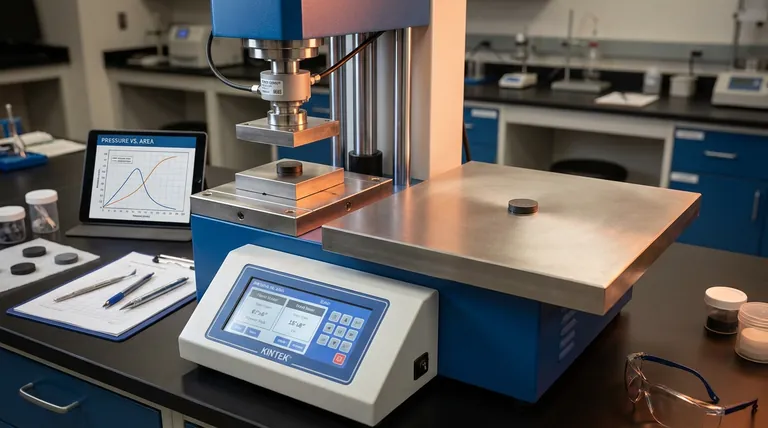
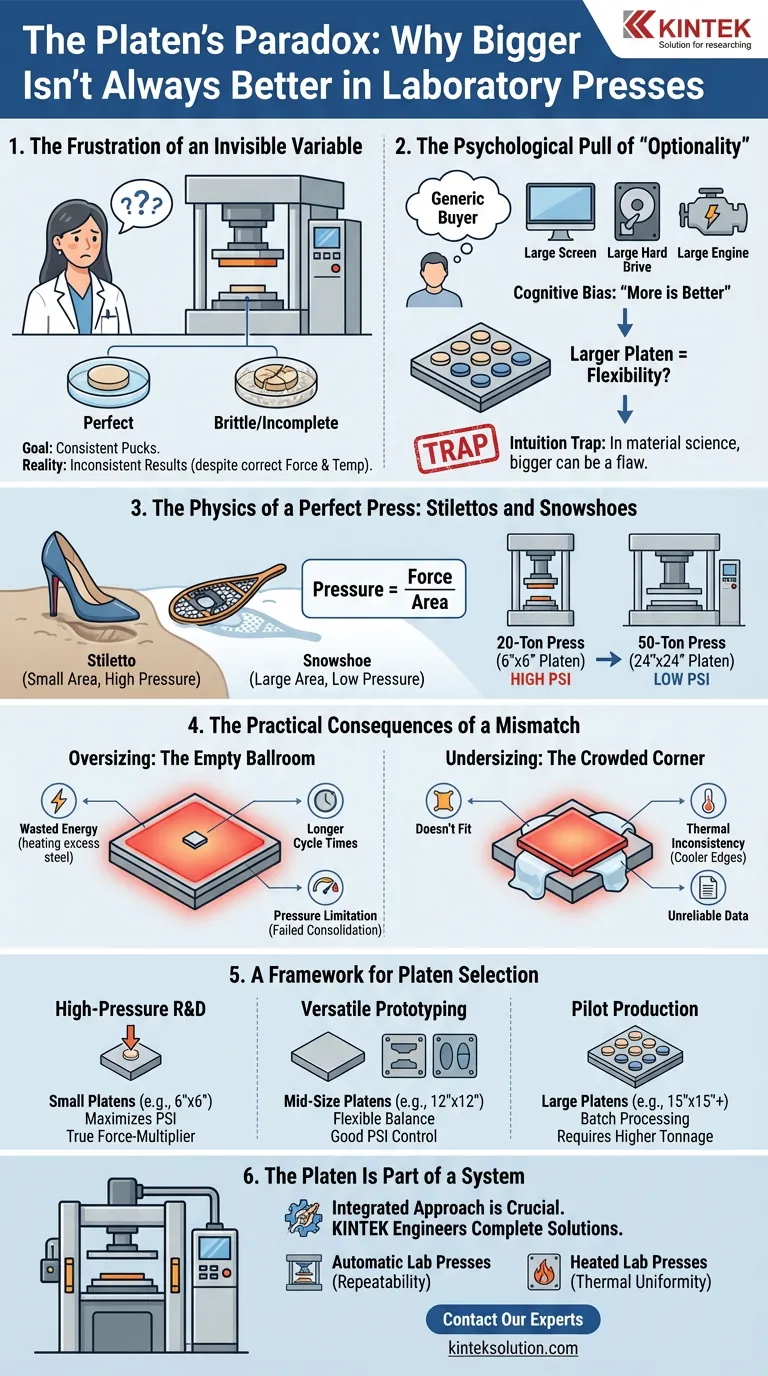
A materials scientist stands before a state-of-the-art laboratory press. Her goal is to create a series of polymer pucks for tensile testing. The press is a high-tonnage model, a beast of precision engineering. Yet, the results are maddeningly inconsistent. Some samples are perfect; others are brittle, showing clear signs of incomplete consolidation.
The force is correct. The temperature is stable. The material is from the same batch. What is the invisible variable sabotaging her work?
The answer lies not in the power of the press, but on the surface where the work happens: the platen.
The Psychological Pull of "Optionality"
When choosing equipment, there's a deep-seated cognitive bias toward "more." A bigger screen, a larger hard drive, a more powerful engine. We buy for the potential of future needs, a concept called optionality.
In the world of laboratory presses, this translates to a simple assumption: a larger platen is better. It offers the flexibility to handle bigger samples or run multiple smaller ones simultaneously.
But here, this intuition is a trap. In the precise world of material science, where pressure and temperature are everything, choosing a platen that's too big is not a feature; it's a fundamental flaw in the experimental design.
The Physics of a Perfect Press: Stilettos and Snowshoes
The core of the issue is the deceptive relationship between force and pressure. They are not the same thing.
- Force is the total load applied by the press, measured in tons.
- Pressure is that force distributed over a specific area, measured in pounds per square inch (PSI).
The governing equation is elegant in its simplicity: Pressure = Force / Area.
Think of a person walking on snow. Their weight (force) is constant. On a stiletto heel (a tiny area), the pressure is immense, and they sink deeply. On a snowshoe (a large area), the same force is distributed, the pressure is low, and they stay on top.
A 20-ton press with small 6" x 6" platens can generate far higher PSI than a 50-ton press with massive 24" x 24" platens. The goal isn't just to apply force; it's to achieve the specific pressure your material requires to transform.
The Practical Consequences of a Mismatch
Selecting a platen size is not about what might fit. It's about optimizing the physics for your primary application. Choosing incorrectly introduces significant, often invisible, inefficiencies.
The Cost of Oversizing: The Empty Ballroom
Using a platen that is vastly larger than your sample is like heating an entire ballroom for a two-person dance.
- Wasted Energy & Time: You are heating and cooling excess tons of steel, dramatically increasing cycle times. For processes requiring rapid thermal changes, this kills throughput.
- Pressure Limitation: Most critically, you may find it impossible to achieve the required PSI. The press's force is spread too thin across the oversized area, failing to properly consolidate your material.
The Constraint of Undersizing: The Crowded Corner
This is a more obvious problem. Your mold or sample simply doesn't fit. But even if it barely fits, you introduce another risk.
- Thermal Inconsistency: The edges of a heated platen can be slightly cooler than the center. Placing a sample too close to the edge can result in uneven heating, leading to inconsistent cures and unreliable data.
A Framework for Platen Selection
The right choice is driven by your most common application, not your most extreme one.
| Application Focus | Recommended Platen Strategy | Why It Works |
|---|---|---|
| High-Pressure R&D | Small Platens (e.g., 6"x6" to 9"x9") | Maximizes achievable PSI for a given tonnage. A true force-multiplier. |
| Versatile Prototyping | Mid-Size Platens (e.g., 12"x12") | A flexible balance between accommodating various mold sizes and good PSI control. |
| Pilot Production / Multi-Sample | Appropriately Sized Large Platens (e.g., 15"x15" and up) | Accommodates larger parts or batch processing, but must be paired with a higher-tonnage press. |
The Platen Is Part of a System
Ultimately, the platen doesn't work in isolation. Its performance is intrinsically linked to the press that controls it. The most perfectly sized platen is useless without a rigid frame to prevent deflection and a control system that can deliver force and temperature with absolute precision.
This is why an integrated approach is crucial. At KINTEK, we don't just sell presses; we engineer complete solutions. Our range of automatic lab presses ensures repeatability, while our heated lab presses provide the thermal uniformity essential for consistent results, regardless of platen size. The system is designed to work in harmony.
Choosing the right platen size is a strategic decision that reflects a deep understanding of your materials and process. It's the difference between fighting your equipment and achieving a state of effortless precision. If you're navigating these trade-offs and need a press engineered for your specific needs, Contact Our Experts.
Visual Guide
Related Products
- Laboratory Hydraulic Press Lab Pellet Press Button Battery Press
- Laboratory Hydraulic Press 2T Lab Pellet Press for KBR FTIR
- Laboratory Hydraulic Press Lab Pellet Press Machine for Glove Box
- Laboratory Split Manual Heated Hydraulic Press Machine with Hot Plates
- Laboratory Hydraulic Pellet Press for XRF KBR FTIR Lab Press
Related Articles
- The Architecture of Density: Why Pressure is the Silent Architect of Solid-State Batteries
- The Physics of Transparency: Why Pressure is the Silent Architect of Spectroscopic Clarity
- The Architecture of Heat: Why Sample Density Dictates the Truth in Metal Hydride Research
- The Geometry of Ionic Flow: Why Precision Pressing Dictates Material Truth
- The Geometry of Electrons: Why Surface Precision is the Silent Partner in SECM Research



















