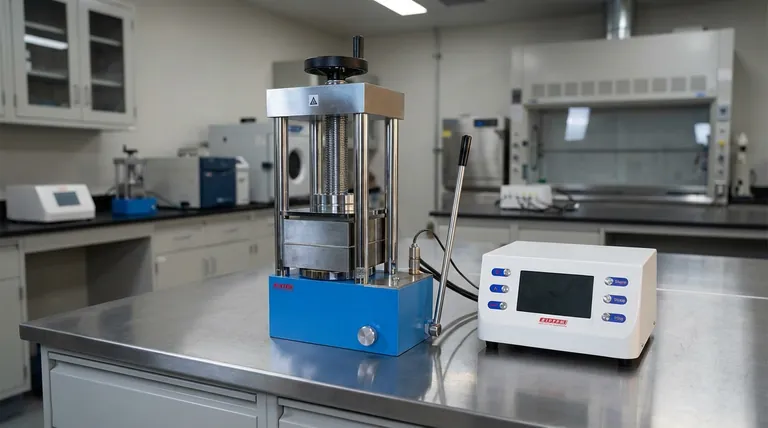
The Allure of the Limit
We have a psychological attraction to maximums. We want to know the highest temperature, the greatest pressure, the fastest speed. When we buy equipment, these numbers on the spec sheet feel like a promise of capability.
But in the world of materials science and engineering, longevity is rarely found at the limit. A laboratory hot press, a machine built to withstand immense force and heat, doesn't fail catastrophically in a single moment. It succumbs to the slow, invisible accumulation of stress—a death by a thousand cycles.
Understanding this process is not just about maintenance; it's about shifting our mindset from "what can it do?" to "how long can it endure?"
The Invisible Forces of Wear
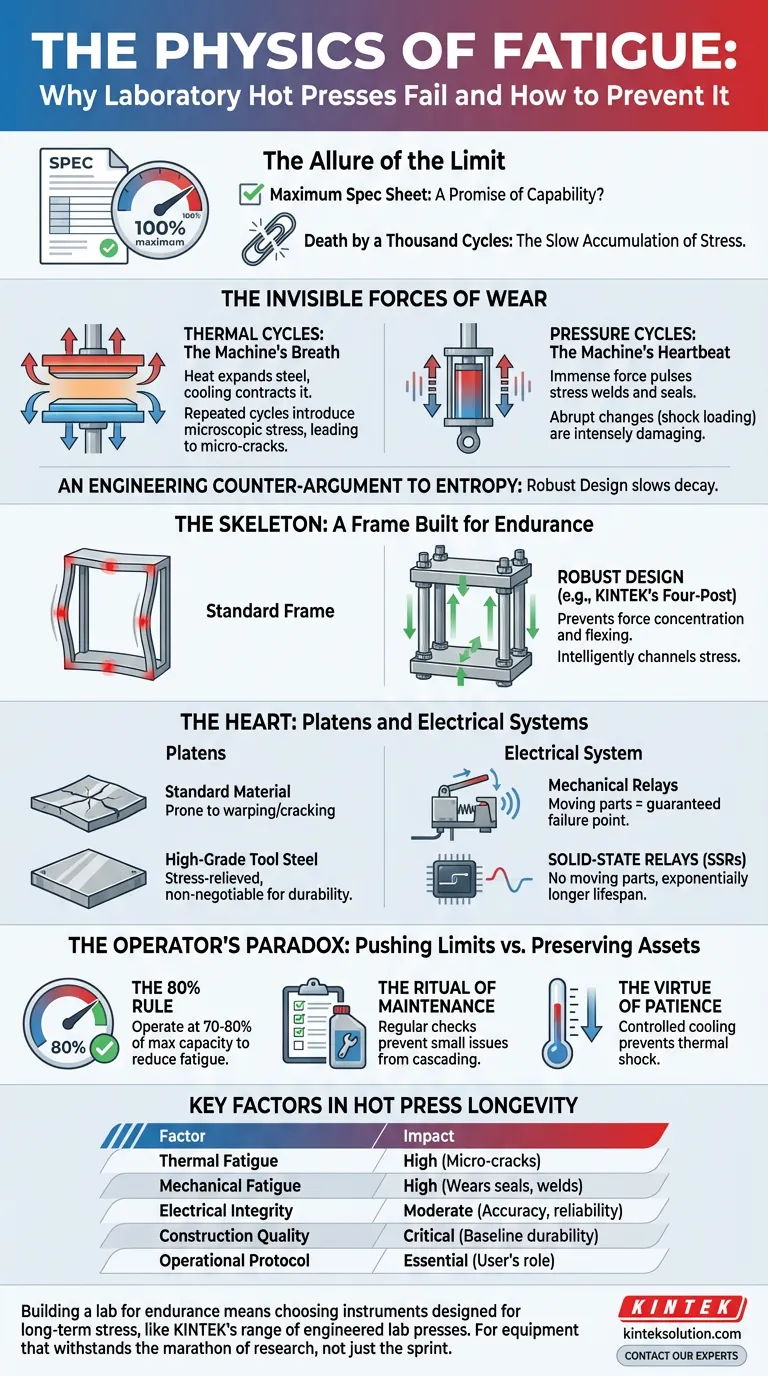
Think of a paperclip. You can bend it once, and it holds its new shape. Bend it back and forth a dozen times, and it snaps. This is mechanical fatigue. A hot press experiences a more complex version of this with every single operation.
Thermal Cycles: The Machine's Breath
Each time the platens heat up, the steel expands. When they cool, they contract. This is the machine breathing.
While seemingly benign, each breath introduces microscopic stress. Over thousands of cycles, these stresses accumulate, leading to micro-cracks in the platens and frame. It’s an unavoidable consequence of physics, accelerated by running at peak temperatures continuously.
Pressure Cycles: The Machine's Heartbeat
With every press, the hydraulic system sends a pulse of immense force through the machine's structure. This is its heartbeat.
This force stresses welds, compresses seals, and tests the rigidity of the frame. Abrupt pressure changes or shock loading are like an arrhythmia—intensely damaging and a primary cause of wear on hydraulic components.
An Engineering Counter-Argument to Entropy
If decay is inevitable, then robust design is the art of slowing it down. The difference between a press that lasts five years and one that lasts fifteen lies in the engineering choices made to counter these forces of fatigue.
The Skeleton: A Frame Built for Endurance
A well-engineered frame doesn't just hold the components together; it actively manages stress. Thick, reinforced steel and rigid four-post designs, like those used in KINTEK's laboratory presses, are designed to distribute pressure evenly.
This prevents force from concentrating in weak spots, protecting the entire system from the flexing that can lead to premature failure. It’s the difference between a structure that merely resists force and one that intelligently channels it.
The Heart: Platens and Electrical Systems
The platens bear the brunt of both heat and pressure. Using high-grade, stress-relieved tool steel is non-negotiable for durability, as it is far less prone to warping or cracking under repeated cycles.
Equally important is the "AC load"—the electrical system powering the heaters. Low-quality mechanical relays click on and off, their moving parts a guaranteed point of failure. In contrast, premium systems use Solid-State Relays (SSRs). With no moving parts, their lifespan is exponentially longer, ensuring consistent and reliable temperature control for years. This is a deliberate choice for reliability that defines a well-built machine.
The Operator's Paradox: Pushing Limits vs. Preserving Assets
The most robustly built machine can be broken by poor habits. The final, and perhaps most critical, factor in a hot press's lifespan is the human operating it.
-
The 80% Rule: A press rated for 30 tons is not designed to run at 30 tons all day, every day. Operating consistently at 70-80% of maximum capacity drastically reduces the fatigue on all components, adding years to the machine's life. It isn't underutilization; it's strategic preservation.
-
The Ritual of Maintenance: Simple checks on hydraulic fluid, cleaning debris from platens, and inspecting electrical connections are not chores. They are the disciplined rituals that prevent small issues from cascading into major failures.
-
The Virtue of Patience: Allowing a press to cool down in a controlled manner prevents thermal shock—the aggressive stress caused by rapid temperature change. Patience is an engineering virtue.
Key Factors in Hot Press Longevity
| Consideration | Primary Factors | Impact on Longevity |
|---|---|---|
| Thermal Fatigue | Heating/cooling cycles, material expansion | High: Leads to micro-cracks in platens and frame. |
| Mechanical Fatigue | Pressure cycles, force distribution | High: Wears down hydraulic seals and stresses welds. |
| Electrical Integrity | Component quality (e.g., SSRs vs. relays) | Moderate: Affects temperature accuracy and reliability. |
| Construction Quality | Frame rigidity, platen material | Critical: Determines the machine's baseline durability. |
| Operational Protocol | Operating below max limits, controlled cooling | Essential: The user's role in mitigating cumulative stress. |
Building a lab where equipment endures requires choosing instruments designed for the realities of long-term stress. KINTEK's range of lab presses—from automatic to heated isostatic models—is engineered with this philosophy of endurance at its core.
For equipment designed to withstand the marathon of research, not just the sprint, Contact Our Experts.
Visual Guide
Related Products
- 24T 30T 60T Heated Hydraulic Lab Press Machine with Hot Plates for Laboratory
- Laboratory Split Manual Heated Hydraulic Press Machine with Hot Plates
- Heated Hydraulic Press Machine with Heated Plates for Vacuum Box Laboratory Hot Press
- Automatic Heated Hydraulic Press Machine with Hot Plates for Laboratory
- Laboratory Manual Heated Hydraulic Press Machine with Hot Plates
Related Articles
- The Invisible Forge: Why the Laboratory Press is the Soul of Nano-Composites
- The Architecture of Slow: Why Physical Precision Dictates Chemical Destiny
- The Architecture of Density: Why Pressure is the Silent Architect of Solid-State Batteries
- The Physics of Transparency: Why Pressure is the Silent Architect of Spectroscopic Clarity
- The Architecture of Certainty: Why the Laboratory Press is the Anchor of Material Science



















