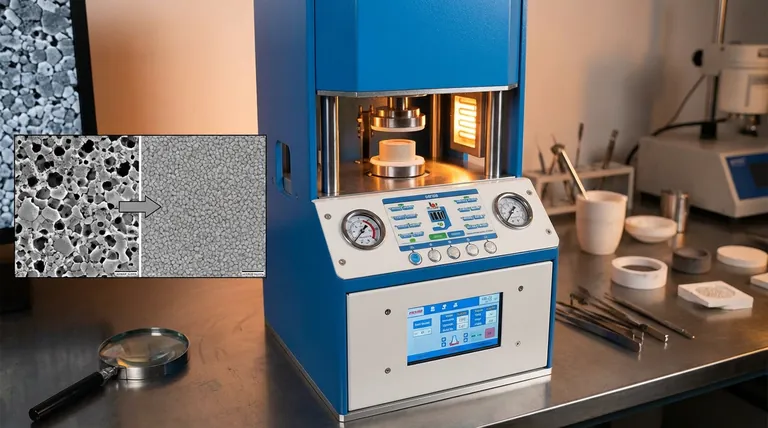
The Material Scientist's Dilemma
In materials science, the pursuit of perfection is often a battle against chaos. You design a material on paper with theoretical properties of immense strength, conductivity, or resilience. But after processing it through a conventional furnace, the result is a shadow of its potential.
The culprit? Its internal architecture—the microstructure.
Traditional sintering, which relies solely on heat, is a blunt instrument. It bakes powders together, but the high temperatures and long times required for densification also encourage grains to grow large and unruly. Pores, the tiny voids between particles, stubbornly remain. These imperfections are not just cosmetic; they are failure points, scattering paths for energy, and gateways for corrosion.
This is the fundamental frustration: you are forced to trade one goal (density) for another (fine grain structure). But what if you could achieve both?
A New Dimension of Control: Adding Pressure
Hot pressing introduces a second, powerful variable into the equation: pressure. By applying immense force simultaneously with heat, it fundamentally rewrites the rules of material consolidation.
This isn't just about squeezing things together. It's about creating an environment where densification happens on your terms—at lower temperatures and in drastically shorter times.
Winning the Race Against Grain Growth
The primary advantage of this process is its ability to outpace a destructive phenomenon: grain growth.
- Accelerated Densification: Pressure introduces new mechanisms like particle rearrangement and plastic flow, which rapidly close the gaps between particles.
- Lower Thermal Budget: Because the process is so efficient, you can achieve full density at lower temperatures or hold times.
- Preserved Finesse: Less time at high temperatures means the material's grains have significantly less opportunity to coarsen.
The result is a material that is not only dense but also possesses a fine, uniform, and powerful grain structure. You have successfully suppressed the chaos.
The Pursuit of Absolute Density
Pores are the enemy of performance. They are microscopic voids that act as stress concentrators, cracking a component under load, and as barriers that impede the flow of heat and electricity.
Pressureless sintering struggles to eliminate the last few percent of porosity. Hot pressing, however, is relentlessly efficient. The external force actively collapses pores, creating a solid, virtually void-free material that can approach its theoretical maximum density.
This homogeneity isn't just about density, but also consistency. The combination of uniform heating and pressure ensures that densification occurs evenly, preventing weak spots and internal stresses.
From Microstructure to Macro Performance
This obsession with internal structure is not academic. It has a direct and profound impact on how a material behaves in the real world.
The Hall-Petch Effect in Action
The relationship between grain size and strength is one of the cornerstones of materials science. The Hall-Petch effect states that smaller grains lead to a stronger material.
Why? Grain boundaries act as roadblocks that stop dislocations (defects) from moving through the material—the primary way materials deform and break. A fine-grained structure, achieved through hot pressing, creates a dense network of these roadblocks. This directly translates to higher hardness, strength, and durability.
Unlocking Functional Properties
The benefits extend far beyond mechanical strength.
- Electrical & Thermal Conductivity: By eliminating pores that scatter electrons and phonons, hot pressing creates a clear highway for energy transfer, pushing conductivity closer to theoretical limits.
- Corrosion Resistance: A fully dense surface has no interconnected pathways for corrosive agents to penetrate and degrade the material from within.
- Optical Transparency: In ceramics, eliminating pores is the key to achieving optical transparency, as voids scatter light.
The Pragmatic Trade-Offs
No technology is a universal solution. The power of hot pressing comes with practical considerations. The equipment, which integrates high-force hydraulics with a high-temperature controlled atmosphere furnace, represents a significant investment over simpler kilns.
The process is also best suited for simpler geometries, as the pressure is typically applied along a single axis. However, for developing and proving the potential of high-performance materials in a laboratory setting, these limitations are often secondary to the goal of achieving peak properties.
This is where the right tools become critical. In the lab, you need a system that offers precise control over temperature, pressure, and atmosphere to truly explore a material's potential.
Engineering Materials, Not Just Making Them
The choice to use hot pressing is a strategic one. It's a shift in mindset—from simply fabricating a part to intentionally engineering its internal architecture.
| Microstructural Goal | Hot Pressing Outcome | Real-World Impact |
|---|---|---|
| Suppress Grain Growth | Fine, uniform grains | Superior strength & hardness |
| Achieve Full Density | Elimination of porosity | Enhanced conductivity & durability |
| Ensure Homogeneity | Consistent structure | Reliable, predictable performance |
For applications where performance cannot be compromised—from advanced ceramics and cutting tools to aerospace components—the control offered by hot pressing is not a luxury; it is a necessity.
At KINTEK, we specialize in providing the precise and reliable laboratory press machines that put this control in your hands. Whether you need an automatic, isostatic, or heated lab press, our systems are designed to help you move beyond the limitations of conventional methods and unlock the true potential of your materials. If you are ready to engineer the future of high-performance materials, Contact Our Experts.
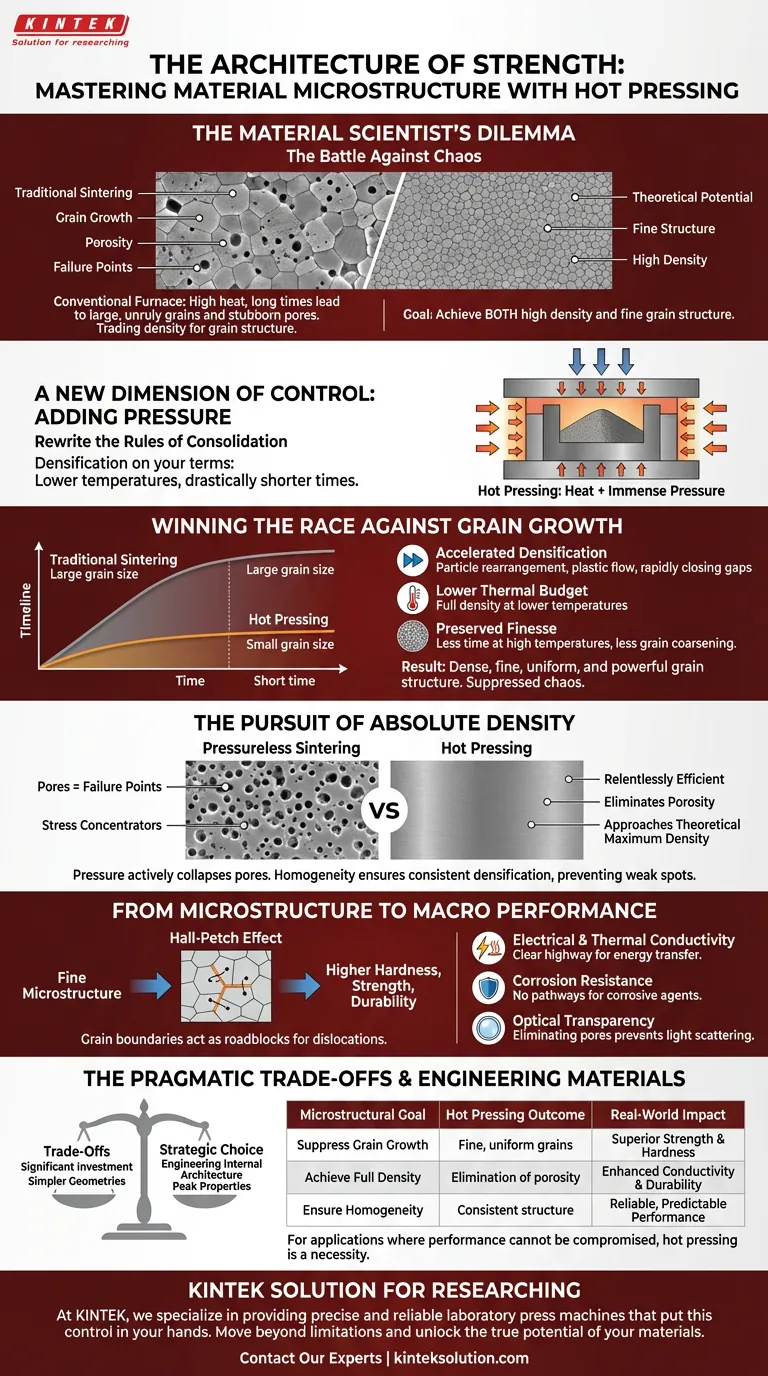
Visual Guide
Related Products
- Automatic High Temperature Heated Hydraulic Press Machine with Heated Plates for Lab
- Heated Hydraulic Press Machine with Heated Plates for Vacuum Box Laboratory Hot Press
- Automatic Heated Hydraulic Press Machine with Hot Plates for Laboratory
- Heated Hydraulic Press Machine With Heated Plates For Vacuum Box Laboratory Hot Press
- Laboratory Split Manual Heated Hydraulic Press Machine with Hot Plates
Related Articles
- The Architecture of Slow: Why Physical Precision Dictates Chemical Destiny
- The Architecture of Certainty: Why the Laboratory Press is the Anchor of Material Science
- The Vanishing Boundary: The Hidden Thermodynamics of LTCC Lamination
- The Alchemy of 160°C: Why Precision Pressing is the Silent Backbone of Rubber Science
- The Invisible Forge: Why the Laboratory Press is the Soul of Nano-Composites



















