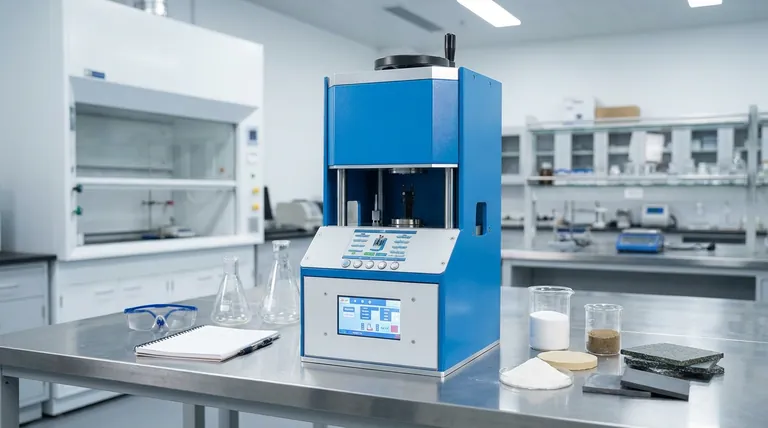
The Elegant Brutality of Creation
Great engineering breakthroughs often aren't about inventing something entirely new. They are about mastering fundamental forces—leverage, electricity, friction.
In materials science, two of the most primal forces are heat and pressure.
Hot pressing is the art of applying these forces with deliberate, controlled precision. It's not just a manufacturing process; it's a method of microscopic architecture. You aren't just squeezing a material into shape; you are fundamentally rearranging its internal structure to create properties that did not exist before.
From Loose Powder to Indestructible Solid
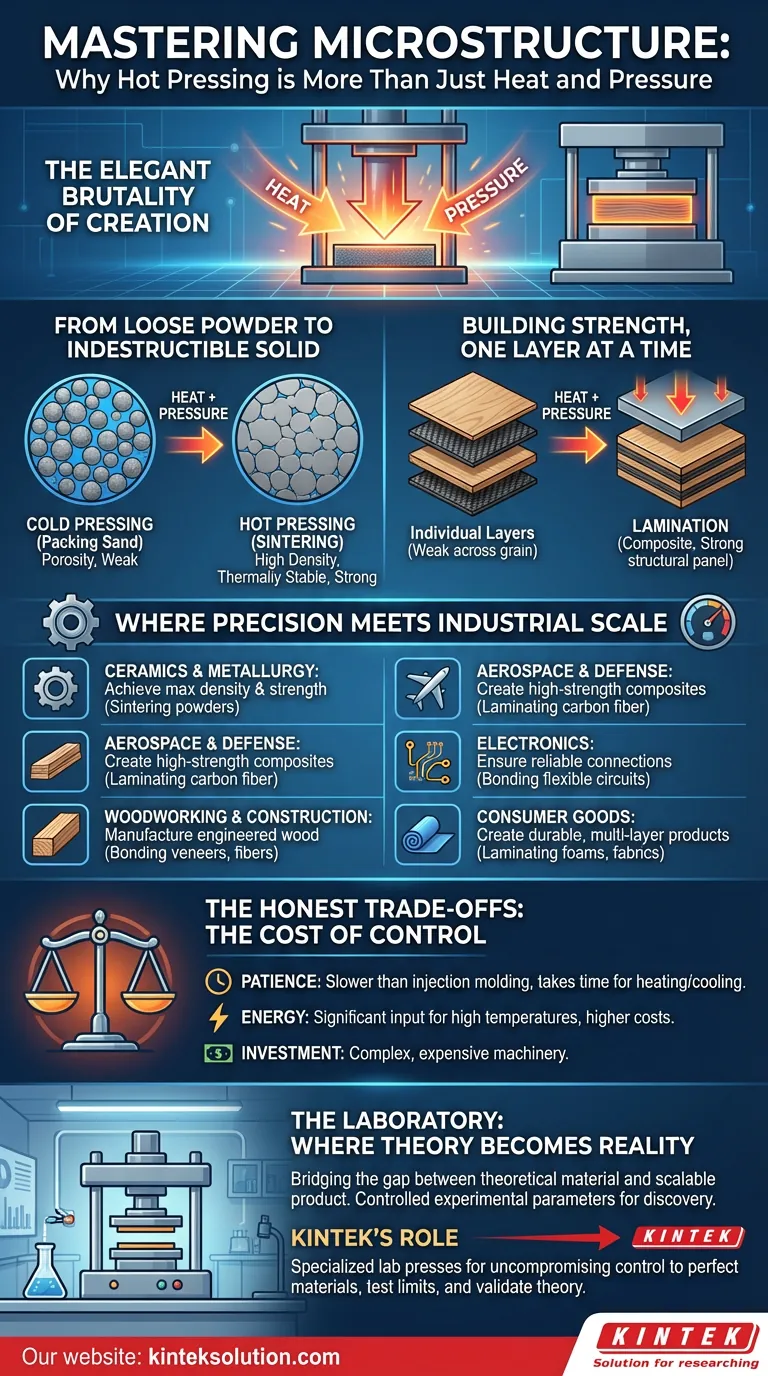
Consider a pile of advanced ceramic powder. Each grain is an island, separated by a sea of empty space, or porosity. Simply compressing this powder at room temperature—cold pressing—is like packing sand. It gets denser, but it remains fundamentally weak and unconsolidated.
The psychological barrier is getting those individual grains to give up their independence and fuse into a monolithic whole.
Heat provides the motivation. By raising the temperature, you give the atoms at the surface of each grain the energy they need to move, to diffuse across boundaries. Pressure provides the direction. It forces the grains into intimate contact, closing the voids and ensuring there is nowhere for atoms to go but into a bond with their neighbors.
This process, called sintering, is how we transform a fragile powder into a high-density, thermally stable component used in everything from jet engines to body armor.
Building Strength, One Layer at a Time
The same principle applies to building materials from layers. Plywood is the classic example. A single sheet of wood veneer is strong along the grain but splits easily across it.
The genius of lamination is not just in gluing layers together. It’s in arranging them so that the strength of one layer compensates for the weakness of another.
A hot press provides the uniform heat and pressure needed to cure the adhesive that bonds these layers, turning a stack of flimsy veneers into a single, incredibly robust structural panel. This concept extends directly to high-tech aerospace composites and the multi-layered circuit boards that power our digital world. The final product is far greater than the sum of its parts.
Where Precision Meets Industrial Scale
Because this principle of "heat + pressure" is so fundamental, its applications are vast. The specific goal dictates how the forces are applied.
| Industry | Primary Goal | The Role of Hot Pressing |
|---|---|---|
| Ceramics & Metallurgy | Achieve maximum density & strength | Sintering powders into solid, non-porous components. |
| Aerospace & Defense | Create high-strength composites | Laminating and curing layers of carbon fiber or aramids. |
| Woodworking & Construction | Manufacture engineered wood panels | Bonding wood veneers, particles, or fibers with resin. |
| Electronics | Ensure reliable connections | Bonding flexible circuits to rigid boards or displays. |
| Consumer Goods | Create durable, multi-layer products | Laminating foams, fabrics, and plastics (e.g., yoga mats). |
The Honest Trade-Offs: The Cost of Control
This level of control doesn't come for free. Every engineering decision involves a trade-off, and hot pressing is no exception.
-
Patience is a Virtue: Heating massive steel platens, allowing that heat to penetrate the material, applying pressure, and then cooling the part takes time. It’s inherently slower than processes like injection molding.
-
Energy is a Factor: Maintaining high temperatures requires a significant and constant energy input, which translates to higher operational costs, especially at an industrial scale.
-
Investment is Required: The machinery capable of safely and reliably generating extreme temperatures and pressures is complex and expensive.
These aren't flaws in the process. They are the price of admission for achieving the microstructural perfection that other methods cannot provide.
The Laboratory: Where Theory Becomes Reality
On the factory floor, these trade-offs are production realities to be managed. But in a laboratory, they are variables to be mastered.
You don't test a new high-performance ceramic formula on a multi-million-dollar industrial press. The cost of error is too high, and the ability to make precise adjustments is too low. The fundamental challenge for any innovator is bridging the gap between a theoretical material and a scalable product.
This is the essential role of the laboratory hot press.
A dedicated lab press transforms the industrial challenges of cost, time, and energy into controlled experimental parameters. It's a focused environment built for discovery, not mass output. It’s where researchers determine the precise temperature ramp, pressure curve, and dwell time needed to achieve optimal density or perfect lamination.
This is precisely the domain where KINTEK operates. Our specialized equipment—from automatic and isostatic presses to heated lab presses—is designed to give scientists and engineers the uncompromising control needed to perfect materials. We provide the tools to test the limits, validate the theory, and define the process before it ever reaches the factory floor.
Mastering these variables is the difference between a theoretical material and a groundbreaking product. If your goal is to turn theory into reality, precise and reliable laboratory equipment is not just an asset—it's the foundation of your work. Contact Our Experts
Visual Guide
Related Products
- Heated Hydraulic Press Machine with Heated Plates for Vacuum Box Laboratory Hot Press
- Automatic High Temperature Heated Hydraulic Press Machine with Heated Plates for Lab
- Automatic Heated Hydraulic Press Machine with Hot Plates for Laboratory
- Laboratory Split Manual Heated Hydraulic Press Machine with Hot Plates
- Laboratory Manual Heated Hydraulic Press Machine with Hot Plates
Related Articles
- The Architecture of Slow: Why Physical Precision Dictates Chemical Destiny
- The Architecture of Certainty: Why the Laboratory Press is the Anchor of Material Science
- The Vanishing Boundary: The Hidden Thermodynamics of LTCC Lamination
- The Alchemy of 160°C: Why Precision Pressing is the Silent Backbone of Rubber Science
- The Invisible Forge: Why the Laboratory Press is the Soul of Nano-Composites



















