The Illusion of Simplicity
Heating a material and pressing it seem like two of the most fundamental actions in a lab. One applies thermal energy. The other applies mechanical force. Our minds tend to see them as separate, linear steps.
But the creation of advanced materials is rarely linear.
When you simply press a powder, you get a brittle compact, riddled with microscopic voids—the hidden weaknesses that lead to failure. When you simply heat it, particles may begin to bond, but the process is slow and often incomplete. The result is a material that falls short of its theoretical potential.
The real challenge, the one that stands between a raw powder and a high-performance component, is the elimination of these voids. It's a battle against porosity.
The Synergistic Force: When Heat Meets Pressure
A laboratory hot press doesn't just perform two actions at once. It creates a new, synergistic effect that fundamentally changes how a material consolidates. It's the difference between brute force and sophisticated persuasion.
Why Heat Alone Isn't Enough
Heating a powder initiates sintering. At a microscopic level, the edges of individual particles become "tacky" and begin to fuse where they touch. But this process leaves countless tiny gaps between the particles. Closing these gaps through heat alone requires extremely high temperatures and long durations, which can damage the material's desired microstructure.
Why Pressure Alone is Inefficient
Cold pressing can compact a powder, but it requires immense force. This brute-force approach can introduce internal stress, cause micro-fractures, and still fail to eliminate the smallest, most stubborn pores. It's like trying to build a solid wall by just hammering the bricks harder; you risk shattering them before they ever form a perfect bond.
The Hot Pressing Breakthrough: A Controlled Collapse
This is where the elegance of the hot press emerges.
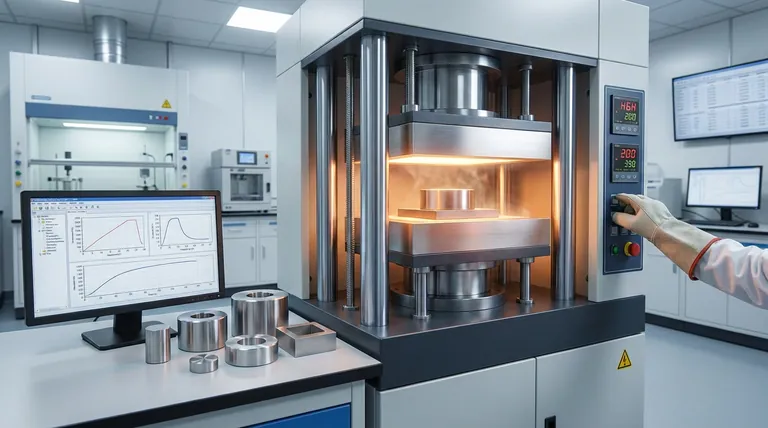
Heat makes the material pliable, lowering its resistance to deformation. At the same time, uniformly applied pressure doesn't just crush the particles together; it guides them. The softened material flows into the voids, collapsing them from within.
This simultaneous action dramatically accelerates densification at lower temperatures and pressures than would otherwise be required. It allows a scientist to create a dense, uniform material without destroying its carefully designed internal structure.
The Psychology of Precision: Who Needs This Level of Control?
The demand for a hot press isn't driven by a task list; it's driven by a mindset. It's for those who cannot afford uncertainty.
The Materials Scientist: Architecting the Microstructure
Imagine developing a new ceramic for a jet engine turbine blade. Failure isn't an option. The scientist isn't just making a "piece" of material; they are meticulously architecting its internal grain structure to withstand extreme temperatures and forces. For them, a hot press isn't just a machine—it's the instrument that allows them to translate a theoretical design into a physical reality with predictable properties.
The Polymer Engineer: Taming Molecular Chains
Consider the challenge of creating a multi-layered, biocompatible polymer for a medical implant. The layers must be perfectly fused, with zero chance of delamination once inside the human body. A hot press provides the controlled environment to meld these layers at a molecular level, ensuring the final product is a single, reliable entity. It replaces hope with certainty.
The Quality Control Guardian: Eliminating Doubt
In an aerospace or medical device QC lab, the job is to find the breaking point. If the test sample prepared from a production batch is itself flawed—if it contains porosity or inconsistencies not present in the final product—the test data is meaningless. The hot press is used to create the "gold standard" sample, removing a critical variable and providing unshakeable confidence in the quality and safety of the material.
The Discipline of Power: Operating with Respect
A tool that combines immense force and high temperatures demands more than just a user; it demands a disciplined operator. It is not an appliance, but a powerful instrument. Its effective use hinges on a foundation of safety and expertise.
| Principle | Details |
|---|---|
| The Operator's Mindset | Only trained personnel who understand the material's behavior under heat and pressure should operate the equipment. |
| The Physical Hazards | High temperatures and pressures are unforgiving. Appropriate PPE, like heat-resistant gloves, is non-negotiable. |
| The Workshop Context | Ensure the machine is properly grounded in a dry, well-ventilated area, especially if processing materials that may off-gas. |
| The Protocol of Checks | Never leave the press unattended during a cycle. Know the location of the emergency stop. Perform regular maintenance. |
The Decisive Question: What is the Cost of Inconsistency?
Choosing the right equipment begins with a simple question: What is the cost of inconsistency in your work?
If your goal is simply to shape a material where precise density and microstructure are secondary, a separate press and oven might suffice.
But if you are in the business of creating novel materials with predictable, repeatable, and high-performance properties, then gaining absolute control over the consolidation process is essential. You need a tool designed for that specific purpose. This is precisely why instruments like KINTEK's heated lab presses exist. They are built to provide the precise control over temperature and pressure that turns theoretical material designs into tangible, reliable innovation.
If you're ready to move from approximation to absolute control in your material development, it’s time to equip your lab with the right instrument. Contact Our Experts
Visual Guide

Related Products
- 24T 30T 60T Heated Hydraulic Lab Press Machine with Hot Plates for Laboratory
- Laboratory Split Manual Heated Hydraulic Press Machine with Hot Plates
- Heated Hydraulic Press Machine with Heated Plates for Vacuum Box Laboratory Hot Press
- Automatic Heated Hydraulic Press Machine with Hot Plates for Laboratory
- Laboratory Manual Heated Hydraulic Press Machine with Hot Plates
Related Articles
- The Invisible Forge: Why the Laboratory Press is the Soul of Nano-Composites
- The Architecture of Slow: Why Physical Precision Dictates Chemical Destiny
- The Architecture of Density: Why Pressure is the Silent Architect of Solid-State Batteries
- The Physics of Transparency: Why Pressure is the Silent Architect of Spectroscopic Clarity
- The Architecture of Certainty: Why the Laboratory Press is the Anchor of Material Science



















