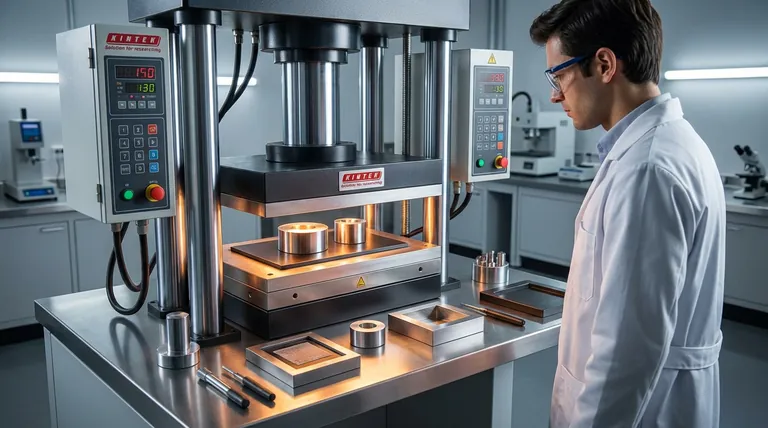
The Human Problem in a Perfect Sample
Imagine a polymer scientist trying to create a series of thin films. The first is perfect. The second is brittle. The third has uneven thickness. The experiment is compromised, not by a flaw in the theory, but by the subtle, unavoidable inconsistency of the human hand.
This is the fundamental challenge in material science: variability. We can design a perfect formula, but its physical expression depends on the process. The greatest source of process variability is often us.
The romance of engineering isn't just about building complex things. It's about building systems that create order out of chaos. A heated lab press is one such system—a tool designed to remove the ghost of human inconsistency from the machine.
Deconstructing Precision: The Two Pillars of Transformation
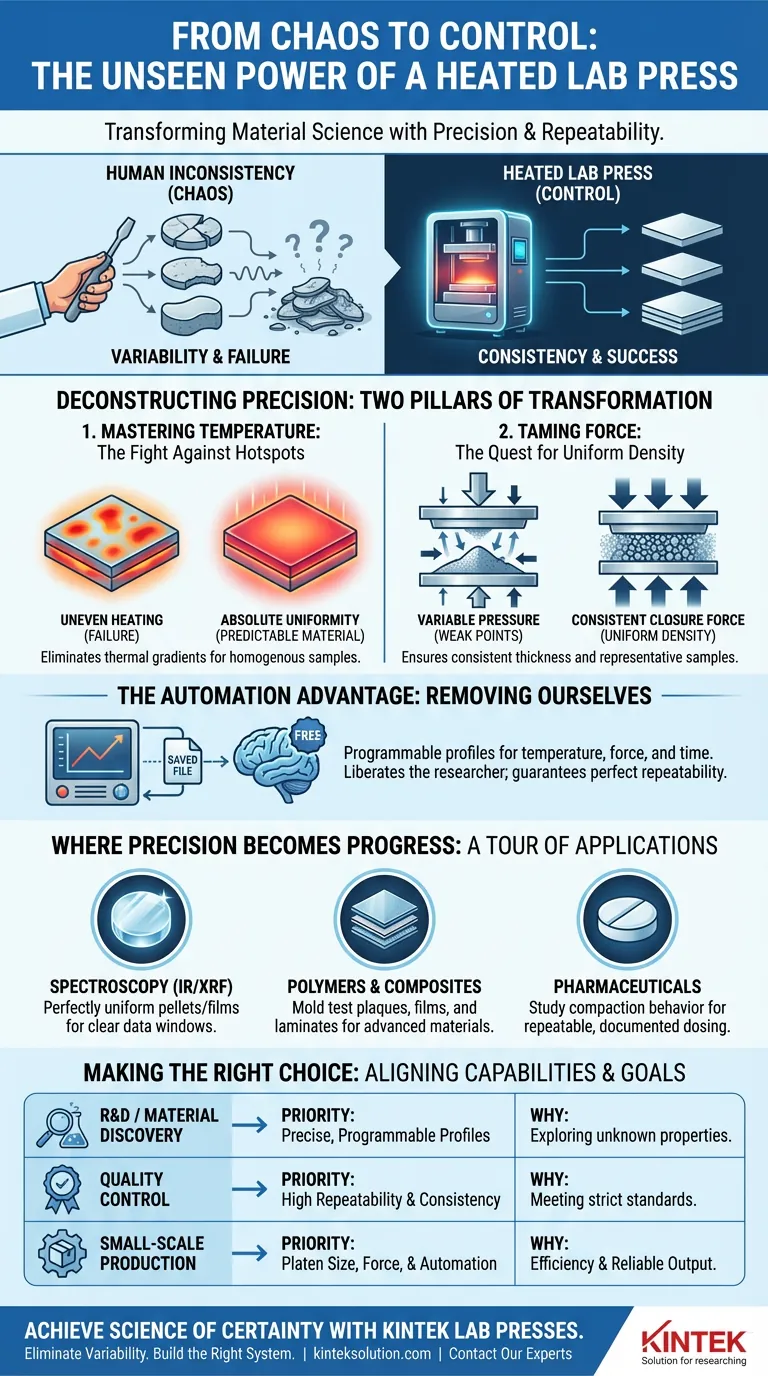
At its core, a heated lab press masters the two fundamental forces of material transformation: temperature and pressure. It’s not just about applying heat and force; it's about applying them with inhuman precision.
Mastering Temperature: The Fight Against Hotspots
Uneven heating is the silent killer of consistency. A single cold spot on a platen means one part of your material cures differently than another, creating internal stresses that lead to failure.
Modern heated platens are engineered for absolute thermal uniformity. They ensure every square millimeter of a sample experiences the exact same temperature profile. This isn't just a feature; it's the foundation of creating a homogenous, predictable material, whether you're curing a composite or preparing a pharmaceutical tablet.
Taming Force: The Quest for Uniform Density
The robust hydraulic systems in a lab press deliver a consistent closure force that is impossible to replicate manually. The goal isn't just strength, but uniform distribution.
This ensures every particle in a powder is compacted with the same pressure as its neighbor, resulting in a sample with consistent density and thickness. This eliminates weak points and guarantees that the sample you analyze is truly representative of the material.
The Automation Advantage: Removing Ourselves from the Equation
The true leap forward comes from integrated control systems. By allowing an operator to program precise temperature ramps, hold times, and pressure profiles, the machine takes over the procedure.
This has a profound psychological effect. It liberates the researcher from the mental burden of procedural execution and allows them to focus entirely on the experiment's design and results. The process becomes a saved file, perfectly repeatable today, tomorrow, or a year from now.
This is the essence of repeatability—a non-negotiable cornerstone of both scientific discovery and industrial quality assurance.
Where Precision Becomes Progress: A Tour of Applications
This level of control isn't an abstract benefit; it's what enables breakthroughs across disciplines.
For the Spectroscopist: A Perfect Window into the Material
Preparing a sample for IR or XRF spectroscopy is like cleaning a lens. A poorly prepared sample with cracks or uneven density is a "dirty lens" that obscures the data. A heated press creates a perfectly uniform pellet or thin film—a crystal-clear window into the material's chemical signature.
For the Polymer Scientist: Building the Future, Layer by Layer
Polymers and composites are the building blocks of modern engineering. A heated press is the architect's tool, allowing scientists to mold test plaques, create films of specific thicknesses, and laminate multiple layers to forge advanced materials with tailored properties.
For the Pharmaceutical Developer: Consistency Is the Cure
In pharmaceuticals, there is zero tolerance for inconsistency. Heated presses are used to study the compaction behavior of powders and produce test tablets under perfectly controlled, documented, and repeatable conditions, ensuring every dose is what it's meant to be.
The Discipline of Power: Making the Right Choice
A powerful tool demands a disciplined approach. Safety protocols and proper training are paramount. But just as important is aligning the machine's capabilities with your core objective.
| Goal | Key Feature to Prioritize | Why It Matters |
|---|---|---|
| R&D / Material Discovery | Precise, Programmable Temperature & Pressure Profiles | For exploring the unknown properties of new materials. |
| Quality Control | High Repeatability & Consistency | For ensuring every batch meets the same strict standard. |
| Small-Scale Production | Platen Size, Max Force, & Cycle Automation | For efficiency and reliable output. |
Ultimately, a heated lab press transforms your work from an art of approximation into a science of certainty.
Achieving this level of control requires equipment built for the task. KINTEK’s range of automatic and heated lab presses are engineered to provide the precise temperature and force management essential for turning material potential into repeatable reality. If your goal is to eliminate variability and achieve truly consistent outcomes, we can help you build the right system. Contact Our Experts
Visual Guide
Related Products
- 24T 30T 60T Heated Hydraulic Lab Press Machine with Hot Plates for Laboratory
- Manual Heated Hydraulic Lab Press with Integrated Hot Plates Hydraulic Press Machine
- Automatic High Temperature Heated Hydraulic Press Machine with Heated Plates for Lab
- Automatic Heated Hydraulic Press Machine with Hot Plates for Laboratory
- Heated Hydraulic Press Machine with Heated Plates for Vacuum Box Laboratory Hot Press
Related Articles
- The Invisible Forge: Why the Laboratory Press is the Soul of Nano-Composites
- The Architecture of Slow: Why Physical Precision Dictates Chemical Destiny
- The Architecture of Density: Why Pressure is the Silent Architect of Solid-State Batteries
- The Physics of Transparency: Why Pressure is the Silent Architect of Spectroscopic Clarity
- The Architecture of Certainty: Why the Laboratory Press is the Anchor of Material Science



















