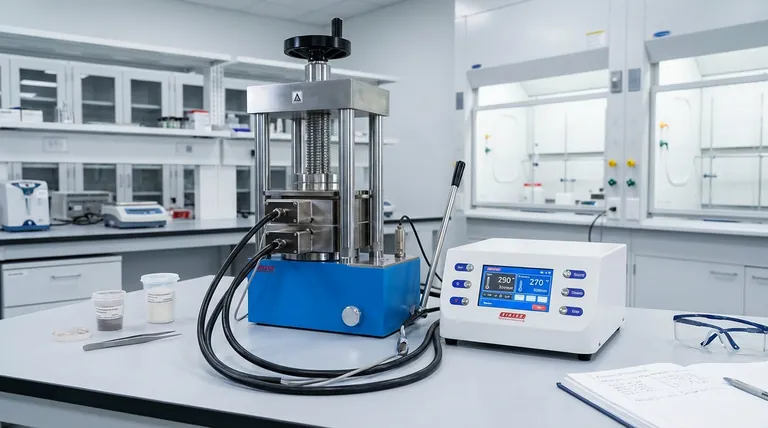
The Gap Between a Material and Its Potential
In a laboratory, we are often trying to close the gap between what a material is and what it could be. We have polymers that need to become flawless films, powders that must transform into solid, uniform pellets, and layers that need to bond into a single, inseparable composite.
The tools for this transformation are simple in principle: heat and pressure. But applying them crudely is the difference between alchemy and chemistry. The real challenge isn't just applying force and temperature; it's about mastering them with such precision that the process becomes predictable, repeatable, and perfect.
This is the psychological core of material science: the deep-seated need to eliminate variables, control outcomes, and turn an art into a science. A heated lab press is not merely a machine for squeezing and heating; it's an instrument for imposing order on a molecular level.
The Physics of Predictability
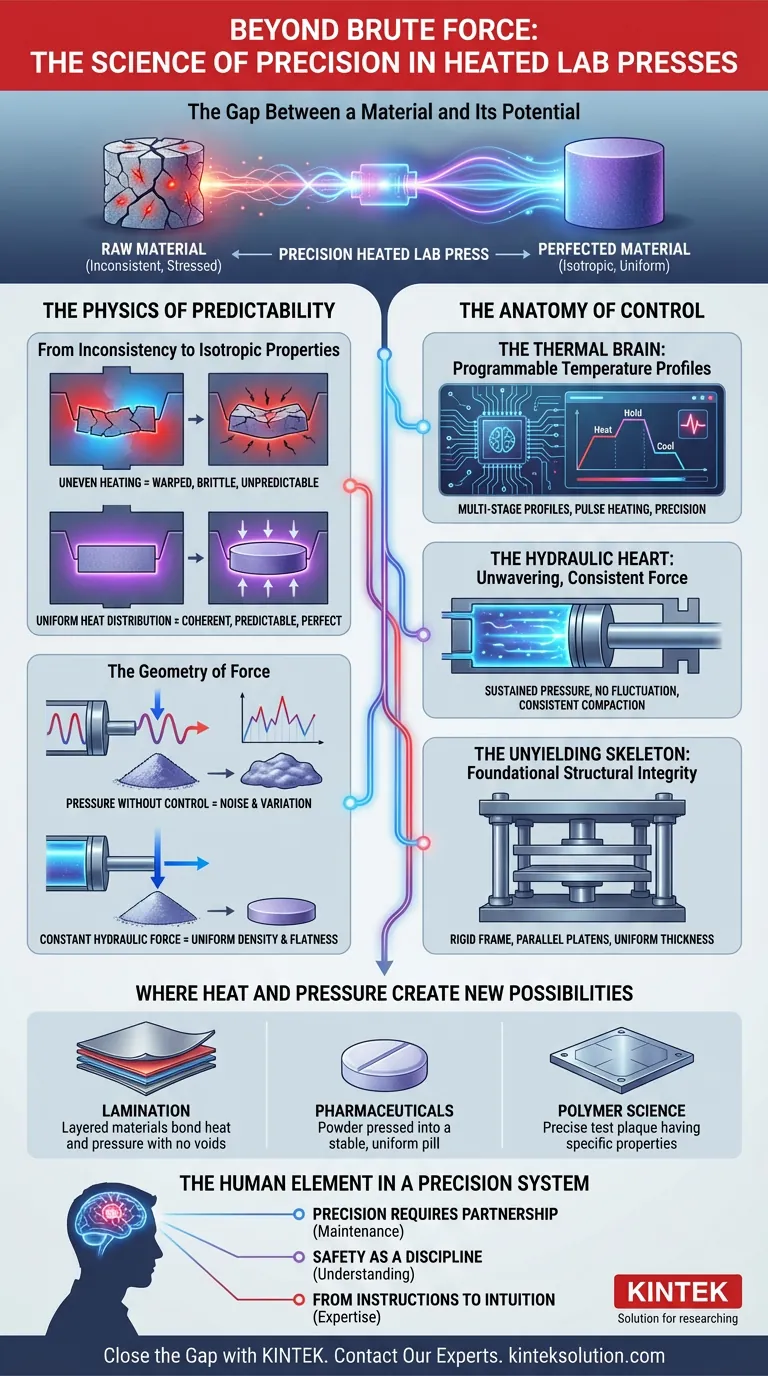
The true value of a heated lab press is measured in its consistency. It’s the quiet confidence that the 100th sample will be physically and structurally identical to the first. This is achieved by mastering two fundamental forces.
From Inconsistency to Isotropic Properties
Imagine a polymer curing in a mold. Uneven heating creates "hot spots" and "cold spots." The material in one area cures faster than another, building internal stresses. The result is a workpiece at war with itself—brittle, weak, and unpredictable.
A precision heated press eliminates this chaos. By ensuring perfectly uniform heat distribution across the entire platen, it ensures every part of the material undergoes the same thermal journey at the same time. The molecules align, the bonds form evenly, and the final product is a single, coherent whole, not a collection of stressed parts.
The Geometry of Force
Pressure without control is just a hammer. But pressure applied with hydraulic consistency is a sculptor's tool. When preparing a sample for X-Ray Fluorescence (XRF) spectroscopy, for instance, the surface finish and density must be absolutely uniform. Any variation is noise that corrupts the data.
The hydraulic system in a lab press provides a constant, unwavering closure force. It compacts loose powders into a solid with uniform density and a perfectly flat surface. This isn't just about making the material smaller; it's about controlling its final geometry and internal structure with absolute certainty.
Where Heat and Pressure Create New Possibilities
Some materials only reveal their potential when coaxed by both forces simultaneously.
- Lamination: Bonding multiple layers of material requires heat to activate the adhesive and pressure to ensure a complete, void-free bond.
- Pharmaceuticals: Forming stable, consistently dosed pills depends on pressing powders into a uniform tablet that won't crumble.
- Polymer Science: Creating specialized test plaques or films with specific mechanical properties is only possible through a precisely choreographed dance of temperature ramps and sustained pressure.
The Anatomy of Control
This level of precision doesn't happen by accident. It is the result of deliberate engineering choices—a system where every component serves the goal of absolute control.
The Thermal Brain: Programmable Temperature Profiles
Modern presses function like a thermal programmer. Instead of just "on" or "off," operators can design multi-stage temperature profiles. A material can be heated to a specific temperature, held there to cure, and then cooled at a controlled rate. Features like pulse heating technology make micro-adjustments to maintain the setpoint with incredible accuracy. This is like giving the machine a detailed recipe for the material's transformation.
The Hydraulic Heart: Unwavering, Consistent Force
The hydraulic system is the quiet, steadfast heart of the machine. It is designed to generate and hold immense pressure for extended periods without fluctuation. This ensures that every sample, whether processed for minutes or hours, experiences the exact same compressive force, guaranteeing consistent compaction and density.
The Unyielding Skeleton: Foundational Structural Integrity
All this precision is lost if the machine itself flexes under load. The core of a high-quality lab press is a rigid, unyielding frame and platens machined from hardened steel. This robust construction ensures the platens remain perfectly parallel even under tons of force. This structural integrity is the foundation upon which uniform thickness and quality are built.
The Human Element in a Precision System
A precision instrument requires a skilled operator. The machine provides the potential for control, but the human provides the insight and responsibility.
-
Precision Requires Partnership: The machine's performance depends on diligent maintenance. Regular inspection of hydraulic lines, cleaning of components, and replacing fluids is not a chore; it's part of the partnership that sustains repeatability.
-
Safety as a Discipline: Closed molding areas and safety interlocks are critical features, but safety is an active discipline. Understanding the immense forces at play is essential for operating the equipment responsibly.
-
From Instructions to Intuition: A powerful machine with multi-stage programming is only as good as the instructions it's given. The operator's understanding of material science transforms the press from a tool into a solution, allowing them to develop the ideal thermal and pressure profiles for their specific goal.
Achieving repeatable, high-quality results is the ultimate goal in any laboratory setting. The right heated lab press is a critical instrument in this pursuit, providing the control needed to master material transformation. For laboratories seeking to elevate their material processing capabilities, partnering with a specialist who understands the nuances of precision engineering is key. KINTEK's range of automatic, isostatic, and heated lab presses is designed to deliver the uniform heating, consistent pressure, and reliable performance required for demanding R&D and quality control applications.
If you're ready to close the gap between your material's potential and its performance, Contact Our Experts.
Visual Guide
Related Products
- 24T 30T 60T Heated Hydraulic Lab Press Machine with Hot Plates for Laboratory
- Manual Heated Hydraulic Lab Press with Integrated Hot Plates Hydraulic Press Machine
- Automatic High Temperature Heated Hydraulic Press Machine with Heated Plates for Lab
- Automatic Heated Hydraulic Press Machine with Hot Plates for Laboratory
- Heated Hydraulic Press Machine with Heated Plates for Vacuum Box Laboratory Hot Press
Related Articles
- The Invisible Forge: Why the Laboratory Press is the Soul of Nano-Composites
- The Architecture of Slow: Why Physical Precision Dictates Chemical Destiny
- The Architecture of Density: Why Pressure is the Silent Architect of Solid-State Batteries
- The Physics of Transparency: Why Pressure is the Silent Architect of Spectroscopic Clarity
- The Architecture of Certainty: Why the Laboratory Press is the Anchor of Material Science



















