The Illusion of Simplicity
A pharmaceutical pill looks simple. Inert, small, and uniform, it’s easy to take its existence for granted.
But this simplicity is an illusion. Each tablet is a highly engineered delivery system, designed to solve a complex biological problem with precision. The core challenge is not just manufacturing millions of pills, but ensuring every single one is functionally identical.
This isn't merely a logistical goal. It's a fundamental problem of physics and trust. A patient must trust that the pill they take today will work exactly like the one they took yesterday. A scientist must trust that their test results reflect the drug's properties, not random variations in their samples.
This trust is built on a microscopic foundation.
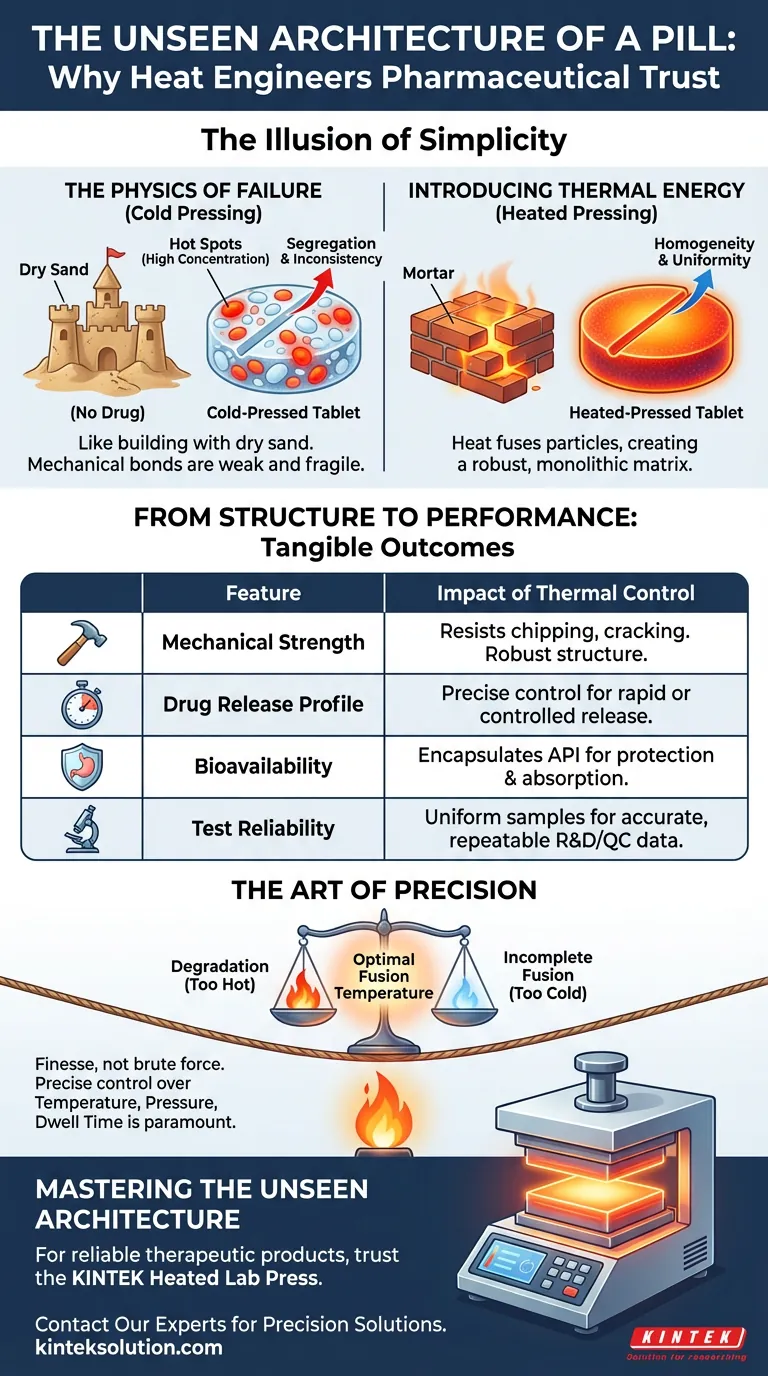
The Physics of Failure: Why Pressure Alone Is Not Enough
Traditionally, tablets are made by compressing a powder. This process, known as cold pressing, relies on immense mechanical force to lock particles of the active drug and its binding agents (excipients) together.
Think of it like building a sandcastle with dry sand. You can pack it tightly, but the structure is fragile. The bonds are purely mechanical, weak, and prone to failure.
At the microscopic level, this leads to a critical problem: segregation. The finer particles of the active pharmaceutical ingredient (API) can separate from the larger excipient particles. The result is a tablet with "hot spots" of high drug concentration and "cold spots" with almost none.
The consequence is a catastrophic loss of control. One pill might be ineffective, the next dangerously potent. The promise of a consistent dose is broken.
Introducing Thermal Energy: The Architect's Tool
This is where heat transforms the process from simple compression to sophisticated engineering. A heated lab press doesn't just squeeze powder; it uses thermal energy to fundamentally re-architect the material at a molecular level.
It’s the difference between stacking bricks and fusing them together with mortar.
Forging Bonds, Not Just Forcing Contact
Heat gently softens the API and excipient particles. As pressure is applied, these softened materials don't just get pushed together—they deform and fuse, creating strong, intermolecular bonds.
The result is a solid, monolithic tablet matrix. The individual particles cease to exist as separate entities and become part of a single, integrated whole. The structure is no longer a fragile collection of parts but a robust, unified object.
Locking in Homogeneity
This fusion process solves the problem of segregation permanently. By locking every particle in place, a heated press ensures the API is perfectly and homogeneously distributed throughout the tablet.
This isn't just an improvement; it's a guarantee. It engineers predictability into every single tablet, ensuring the dose is exactly what it's designed to be.
From Structure to Performance: The Tangible Outcomes
The superior microscopic architecture created by a heated press has direct, measurable impacts on a drug's performance, safety, and reliability.
| Feature | Impact of Thermal Control |
|---|---|
| Mechanical Strength | Fused particles create a tablet that resists chipping, cracking, or breaking during manufacturing, shipping, and handling. |
| Drug Release Profile | Precise control over density and porosity allows formulators to design tablets for rapid, immediate, or slow, controlled release. |
| Bioavailability | The process can encapsulate the API, protecting it from degradation and enhancing its absorption in the body. |
| Test Reliability | Produces perfectly uniform samples for R&D and QC, ensuring that stability and dissolution data is accurate and repeatable. |
In research and quality control, this repeatability is non-negotiable. When testing a new formulation, you must be certain that your results are caused by the drug's chemistry, not by inconsistencies in your sample pellets. A heated press provides that certainty.
The Art of Precision
The power of a heated press is not in the brute application of heat, but in its precise control. This is a process of finesse.
-
The Thermal Tightrope: Every compound has a thermal limit. Too much heat can degrade a sensitive drug, rendering it useless or even harmful. The key is applying the exact temperature needed to achieve fusion without causing degradation.
-
The Dialectic of Control: The remarkable benefits described are only achievable with precise, repeatable, and documented control over temperature, pressure, and dwell time. An inconsistent machine produces inconsistent results, defeating the entire purpose.
This is why the quality of the equipment is paramount. A professional instrument like a KINTEK Heated Lab Press isn't just a machine that gets hot and squeezes. It is a precision tool designed for tablet engineering, providing the rigorous control necessary to translate pharmaceutical science into a reliable therapeutic product.
Whether for groundbreaking R&D, rigorous quality control, or specialized production, achieving this level of control is fundamental. For those looking to master the unseen architecture of their formulations, Contact Our Experts.
Visual Guide
Related Products
- 24T 30T 60T Heated Hydraulic Lab Press Machine with Hot Plates for Laboratory
- Manual Heated Hydraulic Lab Press with Integrated Hot Plates Hydraulic Press Machine
- Automatic High Temperature Heated Hydraulic Press Machine with Heated Plates for Lab
- Automatic Heated Hydraulic Press Machine with Hot Plates for Laboratory
- Heated Hydraulic Press Machine with Heated Plates for Vacuum Box Laboratory Hot Press
Related Articles
- The Invisible Forge: Why the Laboratory Press is the Soul of Nano-Composites
- The Architecture of Slow: Why Physical Precision Dictates Chemical Destiny
- The Architecture of Density: Why Pressure is the Silent Architect of Solid-State Batteries
- The Physics of Transparency: Why Pressure is the Silent Architect of Spectroscopic Clarity
- The Architecture of Certainty: Why the Laboratory Press is the Anchor of Material Science



















