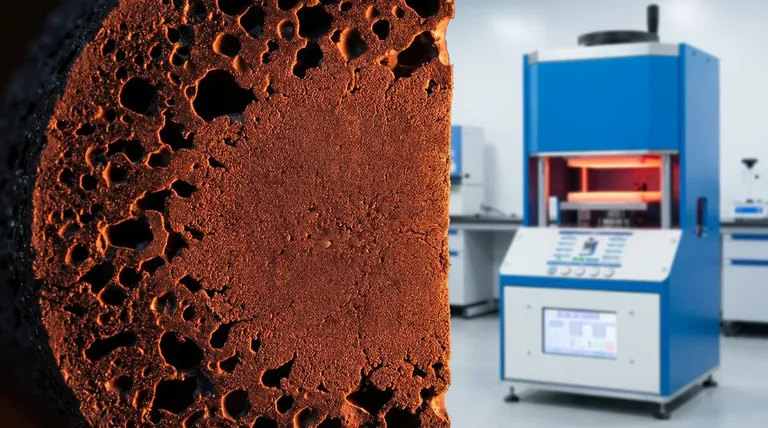
The Anatomy of a Failure
Imagine a critical component—a high-stress bearing in an engine or a ceramic plate in body armor. It passes every visual inspection. It meets all dimensional specifications. Yet, under load, it fails catastrophically.
The culprit is often invisible: microscopic voids, tiny pockets of nothingness trapped between material particles.
From a psychological standpoint, this is the engineer's nightmare. It’s not a visible error or a miscalculation, but a hidden, inherent weakness. These voids act as stress concentrators, the starting points for cracks that silently grow until the part gives way. Conventional manufacturing methods can leave these tiny saboteurs behind.
More Than Just Empty Space
Porosity is not a benign flaw. It's an active threat to mechanical integrity.
Every void is a discontinuity in the material's structure. When a load is applied, the stress must flow around these gaps, concentrating at their edges. This dramatically lowers the material's actual strength, hardness, and fracture toughness, making its performance unpredictable.
The challenge isn't just to form a shape; it's to create a truly solid, monolithic structure, free from the tyranny of these internal voids.
Squeezing the Void Out of Existence
This is where hot pressing emerges not just as a technique, but as a philosophy. It operates on a simple, powerful principle: apply intense heat and immense pressure simultaneously.
- Heat softens the material particles, making them malleable and ready to bond.
- Pressure forces them together, physically closing the gaps and voids between them.
This synergy does what heat or pressure alone cannot. It fundamentally rearranges the material’s internal architecture, forcing particles to densify and bond in a way that approaches theoretical perfection.
Engineering from the Inside Out
The true power of hot pressing lies in the degree of control it offers over a material's most fundamental properties.
Achieving Near-Theoretical Density
The primary goal is the near-total elimination of porosity. By achieving densities greater than 99% of the theoretical maximum, hot pressing produces components with drastically enhanced mechanical properties. The strength and reliability aren't just improved; they become predictable.
Sculpting the Microstructure
Beyond density, the process allows for exquisite control over the material’s microstructure—the size, shape, and orientation of its crystalline grains. Like a master stonemason choosing how to cut a block of marble, an engineer can use precise temperature and pressure profiles to cultivate a fine, uniform grain structure that maximizes toughness and performance.
A Shield Against Contamination
Many advanced materials are highly reactive at elevated temperatures. Exposing them to oxygen is like inviting rust to a party. Hot pressing is typically performed in a vacuum or an inert gas atmosphere. This protective shield prevents oxidation and other chemical reactions, preserving the material’s intrinsic purity and properties.
The Pragmatist's View: Understanding the Trade-Offs
No technique is a silver bullet. The precision of hot pressing comes with practical considerations.
- Cycle Time: Heating and cooling the entire die assembly for each part takes time. This makes it less suitable for mass-producing millions of simple, low-cost items compared to methods like cold pressing.
- Tooling & Geometry: The dies must withstand extreme conditions, which can be costly. The typically uniaxial pressure also limits the complexity of shapes that can be produced.
- Investment: While more accessible than techniques like Hot Isostatic Pressing (HIP), a laboratory hot press is a significant piece of capital equipment. Its value is realized when material performance is non-negotiable.
The decision to use hot pressing is a conscious choice to prioritize ultimate quality over sheer volume.
| When to Choose Hot Pressing | When to Consider Alternatives |
|---|---|
| Goal: Maximum Performance (Aerospace, medical, defense) | Goal: High Volume, Low Cost (Simple consumer goods) |
| Material: Difficult-to-densify powders (Ceramics, composites) | Material: Standard, easily processed metals |
| Shape: Large, relatively simple geometries | Shape: Small, highly complex parts with undercuts |
From Principle to Practice
Understanding the theory of hot pressing is one thing. Harnessing its power in a controlled, repeatable way is another. This is where the quality of the equipment becomes paramount.
Achieving the perfect balance of temperature uniformity, precise pressure application, and atmospheric control isn't accidental. It requires a machine engineered for that exact purpose. For researchers and engineers in a laboratory setting, this means using a tool that provides the fine-grained control necessary to push the boundaries of material science.
Equipment like KINTEK's heated lab presses are designed to be the bridge between theoretical models and tangible, high-performance materials. They provide the stable, automated, and precise environment needed to systematically eliminate voids and perfect microstructures.
Hot pressing empowers you to move beyond simply manufacturing a part and begin truly engineering the material itself. If you're ready to eliminate the hidden flaws in your components and unlock their true potential, we can help you find the right tools for the job. Contact Our Experts
Visual Guide

Related Products
- Automatic High Temperature Heated Hydraulic Press Machine with Heated Plates for Lab
- Heated Hydraulic Press Machine with Heated Plates for Vacuum Box Laboratory Hot Press
- Heated Hydraulic Press Machine With Heated Plates For Vacuum Box Laboratory Hot Press
- Automatic Heated Hydraulic Press Machine with Hot Plates for Laboratory
- Laboratory Split Manual Heated Hydraulic Press Machine with Hot Plates
Related Articles
- The Architecture of Slow: Why Physical Precision Dictates Chemical Destiny
- The Architecture of Certainty: Why the Laboratory Press is the Anchor of Material Science
- The Vanishing Boundary: The Hidden Thermodynamics of LTCC Lamination
- The Alchemy of 160°C: Why Precision Pressing is the Silent Backbone of Rubber Science
- The Invisible Forge: Why the Laboratory Press is the Soul of Nano-Composites



















