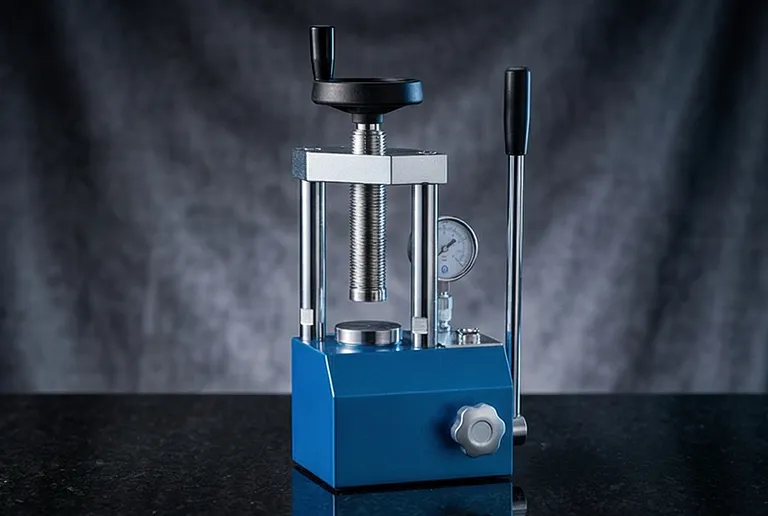
The Invisible Flaw in the Green Body
In material science, we often talk about the "sintering stage" as the moment of truth. We imagine the furnace as the place where strength is born.
But for high-performance ceramics, the outcome is usually decided long before the heat is turned on. It is decided in the press.
Traditional uniaxial dry pressing—the industry workhorse—carries a fundamental, physical "tax": friction. When you press powder in a rigid steel die, the force doesn't travel far. It drags against the walls. It creates "pressure shadows."
The result is a green body that looks solid but is internally chaotic. It has density gradients—microscopic cities of tightly packed particles neighboring rural zones of loose powder. When this piece hits 1500°C, those zones shrink at different rates. The material doesn't just sinter; it fights itself.
Pascal’s Principle: The Fluid Embrace
Cold Isostatic Pressing (CIP) solves this by changing the geometry of the force. Instead of a single-axis hammer, it uses a three-dimensional embrace.
By sealing powder in a flexible elastomer mold and submerging it in a fluid medium, CIP leverages Pascal’s Principle. Pressure is applied equally, from every direction, simultaneously.
Why Isotropic Pressure Changes Everything
- Zero Wall Friction: Because the mold is flexible and surrounded by fluid, there are no rigid walls to "steal" pressure.
- The End of Pressure Shadows: Force reaches the center of the part with the same intensity as the surface.
- Efficient Rearrangement: Particles are nudged into the most stable configuration from all sides, overcoming internal friction barriers that uniaxial pressing simply cannot bypass.
In a laboratory environment, reaching 300 MPa of uniform pressure is the difference between a ceramic that survives a stress test and one that defines a new standard.
The 35% Dividend: Quantifying Integrity
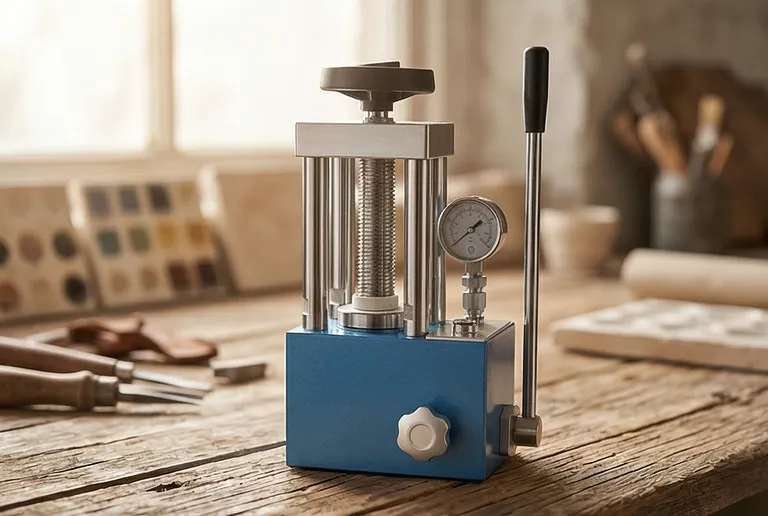
Uniformity isn't just a theoretical preference; it is a mechanical mandate. When the internal structure of a ceramic is homogeneous, the "weakest link" theory of material failure is mitigated.
Data shows that ceramics formed via isostatic pressing can exhibit a flexural strength increase of over 35% compared to those produced by axial pressing. For a material like Alumina, this might mean a jump from 367 MPa to 493 MPa—simply by changing how the pressure was delivered.
The Macro Impact of Micro Uniformity
- Dimensional Fidelity: Because the density is uniform, the linear shrinkage during sintering is predictable. You avoid the "hourglassing" effect common in dry-pressed parts.
- Optical Clarity: For materials like Yb:YAG, even a minor density gradient scatters light. Isotropic pressing is the only way to achieve the transparency required for high-end optics.
- Thermal Diffusivity: Heat moves through a uniform lattice more efficiently. In battery research, where thermal management is everything, a uniform microstructure is a prerequisite.
Choosing Your Path: A Strategic Comparison
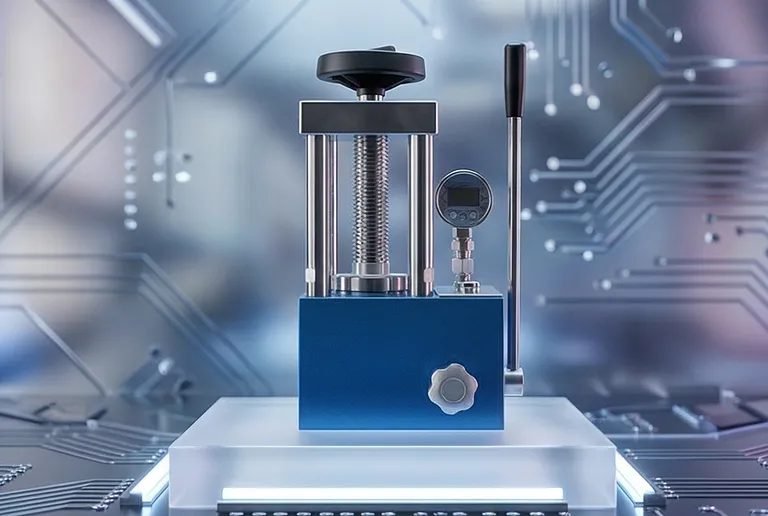
While CIP offers the highest physical performance, the choice of equipment depends on your specific research or production "bottleneck."
| Feature | Traditional Dry Pressing | Cold Isostatic Pressing (CIP) |
|---|---|---|
| Pressure Direction | Uniaxial (Linear) | Isotropic (360°) |
| Density Uniformity | Low (Friction gradients) | High (Homogeneous) |
| Mechanical Strength | Standard Baseline | >35% Improvement |
| Complexity of Shape | Simple / Shallow | Complex / Large / Thick |
| Cycle Speed | Very High | Moderate |
| Best For | Commodity parts, high volume | High-performance, structural ceramics |
Engineering the Future of Materials
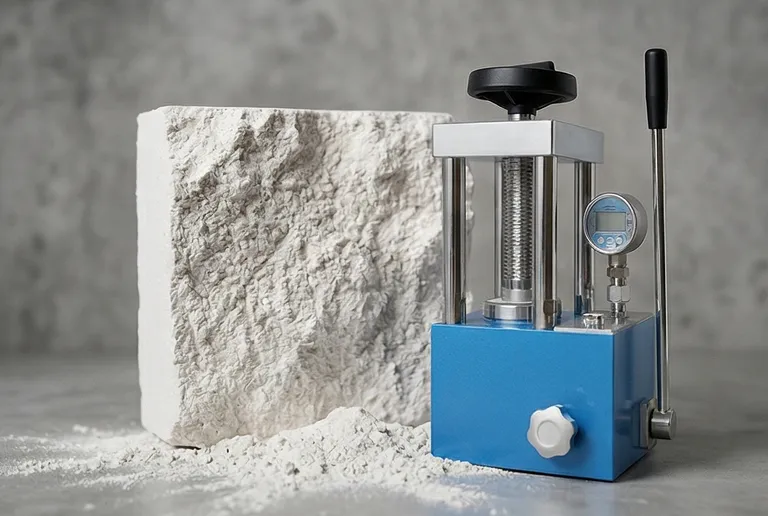
At KINTEK, we understand that a lab press is more than a piece of hardware; it is the tool that defines the structural honesty of your material. Whether you are developing solid-state batteries or aerospace-grade structural ceramics, the physics of the press must work in your favor.
Our suite of solutions is designed to match the specific rigor of your application:
- Cold & Warm Isostatic Presses: Designed for maximum isotropic density and battery research.
- High-Pressure Automatic Units: For consistency across hundreds of test cycles.
- Glovebox-Compatible Models: Ensuring the integrity of moisture-sensitive materials.
The difference between a breakthrough and a failure often lies in the microns. Don't let density gradients be the silent killer of your research.
Related Products
- Automatic Lab Cold Isostatic Pressing CIP Machine
- Electric Split Lab Cold Isostatic Pressing CIP Machine
- Electric Lab Cold Isostatic Press CIP Machine
- Manual Cold Isostatic Pressing CIP Machine Pellet Press
- Lab Isostatic Pressing Molds for Isostatic Molding
Related Articles
- Shaping vs. Perfecting: The Strategic Divide Between Cold and Hot Isostatic Pressing
- The Isotropic Imperative: Why Uniform Pressure Defines the Life of a Superconductor
- Beyond Brute Force: The Elegant Physics of Cold Isostatic Pressing
- The Architecture of Uniformity: Why Omnidirectional Pressure Defines Ceramic Destiny
- The Silent Geometry of Density: Why Isotropic Pressure is the Soul of Advanced Ceramics










