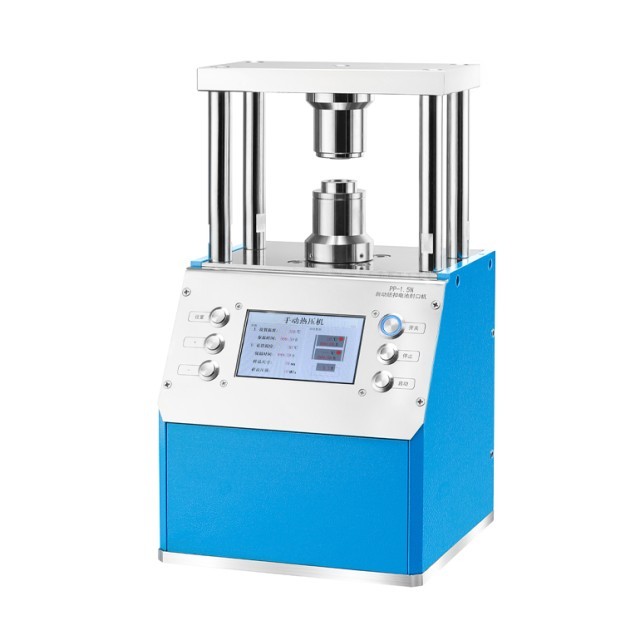
Automatic Heated Lab Press
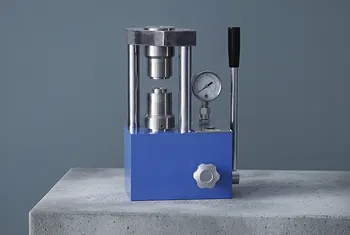
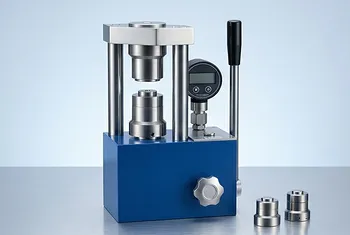
Button Battery Sealing Press Machine for Lab
Item Number : PP2N
Price varies based on specs and customizations
- Pressure range
- 50-1500kg
- Sealing mold
- Optional CR16, CR20, CR24, CR30, etc.
- Pressure-holding time
- 0-999 seconds

Shipping:
Contact us to get shipping details Enjoy On-time Dispatch Guarantee.
Why Choose Us
Easy ordering process, quality products, and dedicated support for your business success.
Introduction
At KINTEK, we specialize in advanced lab press machines designed to meet diverse laboratory needs. Our Electric Button Battery Sealer is engineered to elevate your button battery production, delivering unparalleled precision, efficiency, and reliability. Ideal for medium to large-scale battery manufacturers, OEM factories, new energy R&D facilities, and high-end laboratories, this high-performance machine automates the critical sealing process for various button batteries (such as CR series, LR series, SR series, etc.). Powered by an electric servo system, intelligent pressure control, and precision molds, it ensures superior airtightness, leak prevention, and long-term battery stability, ultimately boosting your production capacity and yield.
Why Choose KINTEK's Electric Button Battery Sealer?
Unlock significant improvements in your button battery manufacturing and research:
- Maximize Production Output: Dramatically increase your throughput with automated sealing capable of 300-600 pieces per hour. This is 5-8 times more efficient than manual sealing methods, freeing up valuable operator time.
- Ensure Uncompromising Quality & Consistency: Achieve ultra-high yield rates. Our intelligent pressure feedback system (error range ≤±1%) and precision-engineered molds eliminate overpressure or underpressure issues, ensuring consistent, high-integrity seals and significantly reducing rework and material waste.
- Flexible & Adaptable to Your Needs: Whether for standalone operation or integration into automated assembly lines (with optional modules), this sealer adapts to your workflow. We support non-standard mold customization for various battery diameters (5-30mm) and rapid mold replacement to meet diverse project requirements.
- Reduce Operational Costs & Enhance ROI: Benefit from a robust design built for longevity (theoretical service life >500,000 cycles). The energy-efficient servo motor consumes 40% less power than traditional pneumatic equipment, and low maintenance needs (only 1/3 of industry average) contribute to a high long-term return on investment.
- Prioritize Operator Safety: Work with confidence. The machine features a photoelectric sensing system, emergency brake switch, and a fully enclosed protective cover to prevent metal debris splashing, complying with CE/UL industrial safety certifications.
Ready to optimize your button battery sealing process? Contact us today to discuss your requirements or request a quote.
Key Features
- Fully Automatic Electric Servo System:
- One-touch start completes the entire process of feeding, positioning, and pressing.
- Intuitive touch screen or CNC panel allows visual adjustment of parameters (pressure, time, stroke), minimizing manual intervention.
- Precision Pressure Control Technology & High-Quality Molds:
- Built-in high-precision pressure sensor supports 0.1-10kN stepless adjustment, ensuring uniform force.
- Molds are crafted from imported alloy steel (hardness ≥HRC60) for durability and compatibility with various button batteries.
- Intelligent Safety Protections:
- Equipped with photoelectric sensing and emergency brake for automatic stoppage during abnormalities.
- Fully enclosed design enhances operator safety.
- Energy-Efficient & Durable Design:
- Servo motor offers significant energy savings.
- Core components are wear-resistant, designed for extended operational life and minimal maintenance.
Detail & Parts


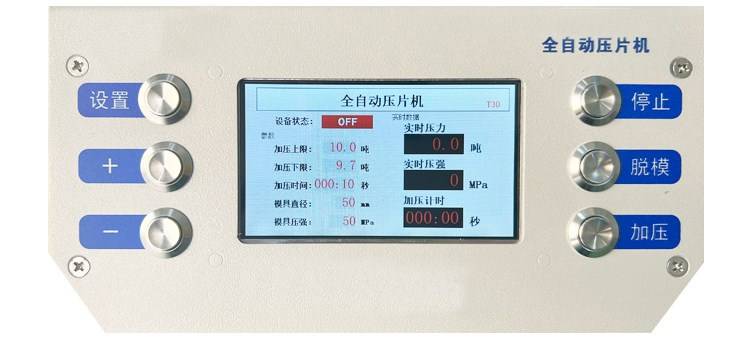
- Setting: Easily navigate the settings interface. Press the 'Setting' button to cycle through parameters like mold diameter. Return to the operation interface by pressing 'Setting' again after selection. (Note: A time setting of "0" indicates infinite duration.)
- +/-: Incrementally increase (+) or decrease (-) numerical settings directly from the operation interface.
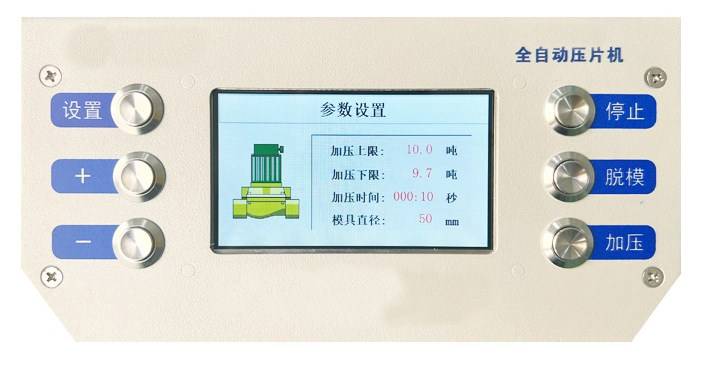
- Stop: Instantly halts equipment operation; the motor stops, and the pressure relief valve opens to release pressure.
- Demolding: Initiates the demolding process. The equipment operates until pressure exceeds the specified limit or a limit switch is contacted, then automatically stops and releases pressure. Manual stop is also possible.
- Sample Preparation: Starts the automated sealing cycle. The equipment pressurizes to the set pressure, maintains it for the timed duration (auto-correcting if pressure drops below the lower limit), and then automatically releases pressure upon completion.
Application
Our Electric Button Battery Sealing Machines are vital across various industries:
- Consumer Electronics: Mass production and packaging of button batteries for smartwatches, Bluetooth headsets, calculators, and other portable devices.
- Medical Health: Manufacturing micro batteries for hearing aids, portable monitors, implantable medical devices, and more.
- Industrial Internet of Things (IIoT): Battery assembly for low-power devices such as wireless sensors, RFID tags, and smart cards.
- New Energy Research & Development: Pilot testing and large-scale production of emerging button battery technologies, including lithium-manganese and zinc-air batteries.
Technical specifications
| Instrument model | PP2N |
|---|---|
| Pressure range | 50-1500kg |
| Pressure-adding process | Program pressurization - program pressure maintenance - timed pressure release |
| Pressure-holding time | 0-999 seconds |
| Pressure conversion | Program automatically converts the pressure that the mold can withstand |
| LCD display | 4.3-inch LCD screen |
| Sealing mold | Optional CR16, CR20, CR24, CR30, etc. |
| Shell removal mold | Optional CR16, CR20, CR24, CR30, etc. |
| Standard mold | Standard CR20 series packaging mold |
| Dimensions | 220*240*380(L*W*H) |
| Equipment power supply | 220V(50Hz/60Hz) |
| Equipment weight | 35kg |
| Machine size diagram |  |
Operation steps
Follow these simple steps for efficient battery sealing:
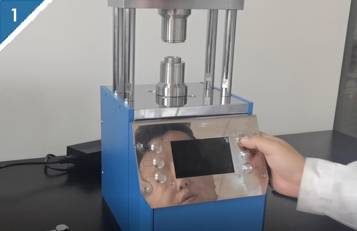
1. Turn on the power of the automatic sealing machine.
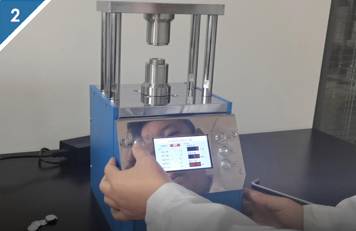
2. Press the setting button to enter the setting menu.
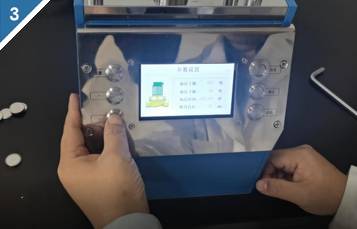
3. Adjust parameters like maximum pressure and holding time.
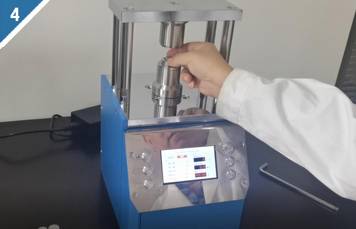
4. Place the button battery shell into the mold.
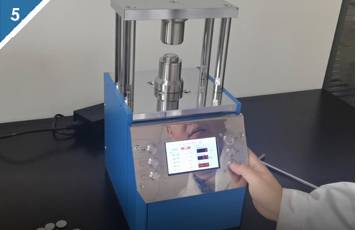
5. Press the 'Sample Preparation' or start button to begin sealing.
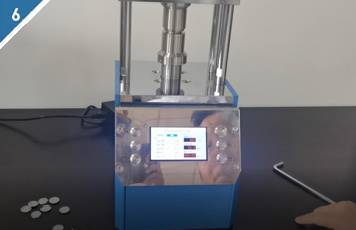
6. The system pressurizes to the set pressure and maintains it.
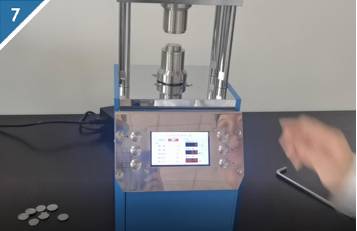
7. Upon completion, the equipment automatically releases pressure.

8. Remove the perfectly sealed battery shell.
Interested in learning how KINTEK's Electric Button Battery Sealer can transform your operations? Our experts are ready to help you find the perfect solution for your laboratory needs. Click here to fill out our contact form, and we'll get back to you promptly with detailed information, a personalized quote, or to schedule a consultation.
Trusted by Industry Leaders

FAQ
What Is A Laboratory Hot Press Machine Used For?
What Are The Key Features Of A Laboratory Hot Press Machine?
What Are The Main Components Of A Laboratory Hot Press Machine?
How Does A Laboratory Hot Press Machine Work?
What Are The Advantages Of Using A Laboratory Hot Press Machine?
REQUEST A QUOTE
Our professional team will reply to you within one business day. Please feel free to contact us!
Related Products

Lab Button Battery Tablet Press Sealing Mold
Precision Sealing Die for button battery assembly & analysis. Durable hardened steel, CR16-CR30 compatible. Enhance battery integrity & performance. Get yours now!
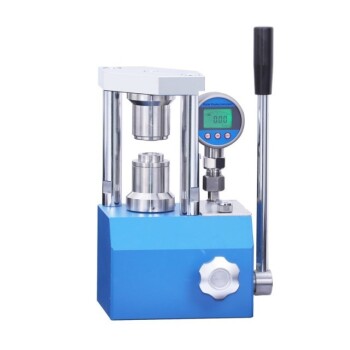
Button Battery Sealing Machine for Button Batteries
KINTEK's Manual Button Battery Sealer ensures precise, airtight sealing for CR2032, LR44 batteries. Ideal for labs, R&D, and small production. Boost efficiency now!

Laboratory Hydraulic Press Lab Pellet Press Button Battery Press
KINTEK Lab Press Machines: Precision hydraulic presses for material research, pharmacy, and electronics. Compact, durable, and low maintenance. Get expert advice today!
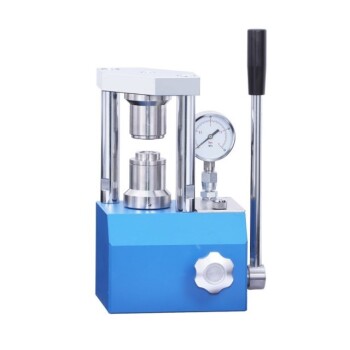
Manual Button Battery Sealing Machine for Battery Sealing
Manual Button Battery Sealer for precise, affordable lab sealing. Ideal for CR2032, LR44 batteries. Enhances safety & extends battery life. Get yours now!

Lab Button Battery Disassembly and Sealing Mold
KINTEK's precision button battery sealing molds ensure airtight, contamination-free results for labs and production. Boost efficiency with durable, high-performance solutions.

Warm Isostatic Press for Solid State Battery Research Warm Isostatic Press
KINTEK Warm Isostatic Press (WIP) for precision lamination in semiconductors & solid-state batteries. ASME-certified, 50-100°C control, high-pressure capabilities. Enhance material performance now!

Lab Infrared Press Mold for Laboratory Applications
KINTEK's lab press molds ensure precise sample preparation with durable tungsten carbide construction. Ideal for FTIR, XRF, and battery research. Custom sizes available.

Lab Cylindrical Press Mold for Laboratory Use
Precision cylindrical press molds for lab sample prep. Durable, high-performance, and customizable for XRF, battery research, and material testing. Get yours today!

Manual Cold Isostatic Pressing CIP Machine Pellet Press
KINTEK Lab Manual Isostatic Press ensures superior sample uniformity & density. Precision control, durable construction, and versatile forming for advanced lab needs. Explore now!

Electric Lab Cold Isostatic Press CIP Machine
KINTEK's Lab Electric Isostatic Cold Press delivers precision, efficiency, and superior sample quality for advanced research. Explore customizable models today!

Laboratory Hydraulic Press Lab Pellet Press Machine for Glove Box
Precision lab press for glove boxes: Compact, leak-proof design with digital pressure control. Ideal for inert atmosphere material processing. Explore now!

Laboratory Hydraulic Pellet Press for XRF KBR FTIR Lab Press
KINTEK Lab Press Machines: Precision hydraulic presses for sample prep. Automatic, heated, and isostatic models for research labs. Get expert advice now!

Automatic Laboratory Hydraulic Press Lab Pellet Press Machine
Upgrade your lab with KINTEK's Automatic Lab Press – precision, efficiency, and versatility for superior sample preparation. Explore models now!

Manual Laboratory Hydraulic Press Lab Pellet Press
KINTEK's Protective Manual Lab Hydraulic Press ensures safe, precise sample preparation with durable construction, versatile applications, and advanced safety features. Ideal for labs.

Automatic Laboratory Hydraulic Press for XRF and KBR Pellet Pressing
KinTek XRF Pellet Press: Automated sample prep for precise XRF/IR analysis. High-quality pellets, programmable pressure, durable design. Boost lab efficiency today!

Split Automatic Heated Hydraulic Press Machine with Heated Plates
KINTEK Split Automatic Heated Lab Press: Precision hydraulic press with 300°C heating for efficient sample preparation. Ideal for research labs.

Laboratory Hydraulic Split Electric Lab Pellet Press
KINTEK Split Electric Lab Press: Precision sample preparation for research. Compact, versatile, with advanced pressure control. Ideal for material studies.

XRF KBR Plastic Ring Lab Powder Pellet Pressing Mold for FTIR
XRF Powder Pellet Pressing Mold with Plastic Rings for precise sample preparation. Achieve uniform pellets with durable alloy tool steel construction. Custom sizes available.

Lab Ring Press Mold for Sample Preparation
High-precision Ring Press Dies for uniform pellets in labs & industry. Durable Cr12MoV alloy, sizes Φ3-80mm. Boost efficiency & accuracy today!

Cylindrical Lab Electric Heating Press Mold for Laboratory Use
KINTEK's Cylindrical Electric Heating Press Mold offers rapid heating (up to 500°C), precise control, and customizable sizes for lab sample preparation. Ideal for battery, ceramic, and material research.
Related Articles
The Discipline of the Form Factor: Why Precision Assembly Dictates the Fate of Cellulose Membranes
An exploration of how standardized CR2032 assembly isolates the electrochemical performance of cellulose composite membranes (CCM) from mechanical noise.
The Last Millimeter: Why Physical Constraints Define Material Integrity
Explore how metal spacers act as mechanical governors in hot pressing, ensuring density gradients and thickness precision for high-performance composites.
The Architecture of Ions: Why Precision Pressure is the Silent Partner in Battery Research
Discover why precise pressure control is the fundamental variable in transforming MONC(Li) powder into high-performance solid-state electrolytes.
The Conscience of the Lab: Precision, Pressure, and the Invisible Architecture of Rubber
Discover how electrically heated laboratory presses master vulcanization and geometric precision to transform raw rubber into standardized, high-performance specimens.

The Geometry of Energy: Why Precision Pressing Dictates Radiation Outcomes
Discover how electric heated laboratory presses eliminate physical variables in rubber specimens to ensure uniform radiation cross-linking and repeatable results.
The Invisible Bridge: Why Material Science Fails Without Precision Pressing
Discover how laboratory electric heating hot presses transform PA12/POE blends from chaotic melts into standardized specimens by mastering thermal history and density.
The Alchemy of Pressure and Heat: How Hot Presses Forge the Materials of Tomorrow
Discover how hot press machines use controlled heat and pressure to bond, mold, and densify materials, enabling innovations from plywood to aerospace composites.
The Art of Forging Certainty: A Deep Dive into Hot Pressing Technology
Explore how hot pressing uses heat and pressure to eliminate material imperfections, creating ultra-reliable components for aerospace, electronics, and more.
How KBr Press Components Work Together for Flawless Sample Preparation
Learn how KBr press components work together for flawless sample preparation, ensuring accurate spectroscopic results with proper die alignment, hydraulic calibration, and base plate design.
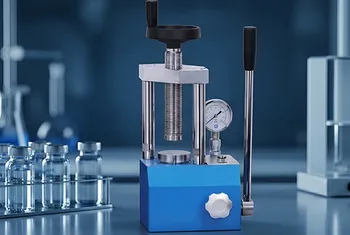
The Thin Line of Efficiency: Why Precision Pressing Dictates Thermal Performance
Discover how laboratory pressing optimizes thermal interface thickness and filler orientation to maximize the COP of TEC and PCM composite systems.
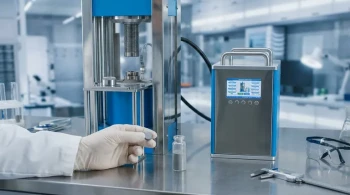
From Powder to Power: The Physics and Psychology of Electrode Pressing
Electrode performance hinges on the pellet press. Explore how controlled pressure transforms powder into a dense, high-performance component.
The Geometry of Resilience: Why the Electric Press is the Soul of Vulcanization
Discover how the electric heating press synchronizes thermal energy and mechanical force to transform raw rubber into high-performance industrial materials.