The Invisible Variable in the Crucible
In the world of high-precision material science, we often obsess over the purity of the reagent or the sensitivity of the detector. We forget the specimen itself.
A loose pile of powder is a chaotic system. Its surface area is unpredictable; its internal air pockets are random. When heat is applied, the gas release is turbulent. For a scientist attempting to map thermal decomposition, this randomness is the enemy.
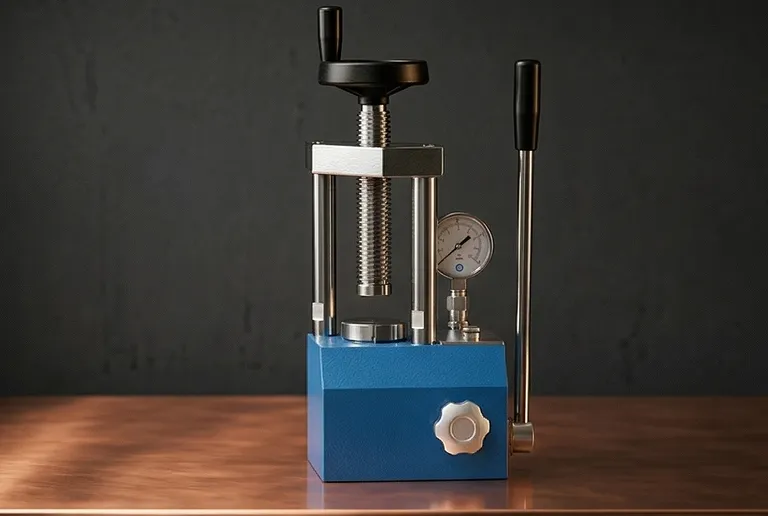
The laboratory uniaxial press is the tool that imposes order. It transforms a heap of potential into a "green body"—a standardized geometric entity that allows the physics of the experiment to remain consistent.
The Geometry of Repeatability
Precision in thermal analysis is not just about temperature; it is about the path of least resistance. When a material decomposes, the resulting gases must travel from the core of the specimen to the detector.
Standardizing the Gas Path
By using high-tolerance molds to apply pressures often exceeding 80 MPa, a uniaxial press creates a perfect cylinder. This standardization ensures:
- Uniform Surface Area: Every specimen reacts with the environment at the same rate.
- Predictable Diffusion: Gas release paths become stable, preventing the "stagnation zones" that skew gas chromatography results.
- Symmetrical Flow: Laminar flow replaces turbulence, leading to cleaner data peaks.
The Thermal Center
Quantitative analysis requires the specimen to sit exactly in the "thermal center" of an alumina tube furnace. An irregular shape cannot be centered reliably. A standardized cylinder, however, ensures symmetrical heat distribution, making kinetic modeling a matter of science rather than guesswork.
The Physics of the "Green Body"
Before a material becomes a ceramic or a high-performance battery component, it is a "green body." This is the fragile moment where loose particles are first forced into a collective.
The uniaxial press reduces the air gaps between particles, establishing a consistent internal structure. This is the foundation of thermal conductivity. Without this mechanical compaction, heat would move through the sample in fits and starts, creating "hot spots" that trigger premature decomposition.
| Feature | Technical Function | Analytical Impact |
|---|---|---|
| High-Tolerance Molds | Mechanical force >80 MPa | Eliminates geometric variance in gas flow. |
| Particle Rearrangement | Reduces interstitial air gaps | Ensures uniform thermal conductivity. |
| Green Body Formation | Structural integrity | Allows for handling and precise furnace placement. |
| Uniaxial Alignment | Defined pressure axis | Creates a foundation for Isostatic Pressing (CIP). |
The Friction of Reality
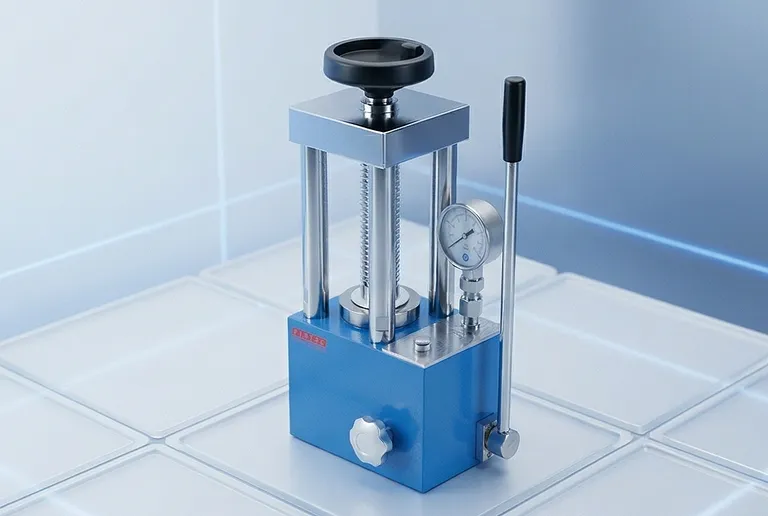
Engineers know that perfection is a moving target. In uniaxial pressing, the primary adversary is friction. As the punch descends, friction between the powder and the mold walls creates "density gradients."
The top of the specimen may be slightly denser than the bottom. In highly sensitive decomposition studies, this gradient can cause subtle variations in reaction rates.
This is where the system must evolve. For many advanced materials, the uniaxial press serves as a critical first step—creating the basic shape at lower pressures (around 20 MPa)—before the specimen is moved to a Cold Isostatic Press (CIP) to achieve ultimate, multi-directional density.
Designing the System for the Result
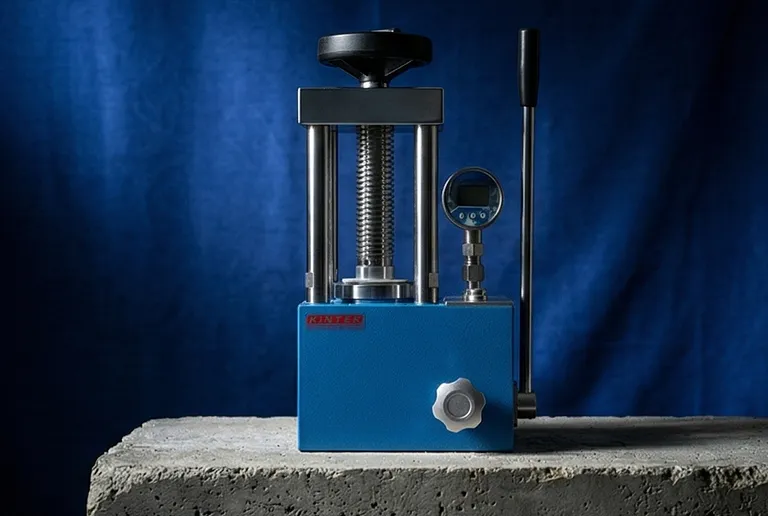
Choosing the right pressing strategy requires aligning your equipment with your analytical goals:
- For Quantitative Gas Analysis: Focus on mold tolerance and automatic pressing to ensure every cylinder is identical.
- For Kinetic Modeling: Prioritize green body strength to prevent the specimen from crumbling as it loses mass during decomposition.
- For Battery Research: Utilize glovebox-compatible presses to maintain material integrity in air-sensitive environments.
Precision is not an accident; it is the result of a system that refuses to leave geometry to chance. By standardizing the specimen, you remove the noise, leaving only the truth of the material.
Elevate Your Analytical Precision with KINTEK
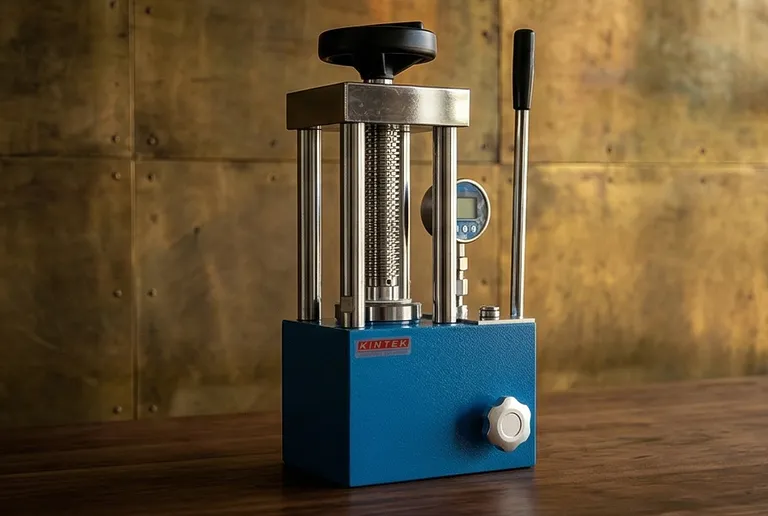
At KINTEK, we understand that the quality of your data begins long before the furnace is turned on. Our comprehensive pressing solutions are designed for the rigorous demands of modern laboratory research:
- Manual & Automatic Presses: Precision control for repeatable green body formation.
- Isostatic Solutions (CIP/WIP): Eliminating density gradients for advanced material densification.
- Specialized Systems: Heated, multifunctional, and glovebox-compatible models tailored for battery and ceramic research.
Ensure your specimens reflect the quality of your science. Contact Our Experts
Related Products
- Lab Round Bidirectional Press Mold
- Lab Polygon Press Mold
- Lab Cylindrical Press Mold with Scale
- Split Automatic Heated Hydraulic Press Machine with Heated Plates
- Lab Cylindrical Press Mold for Laboratory Use
Related Articles
- The Physics of Trust: A Disciplined Approach to Laboratory Press Safety and Reliability
- The Anatomy of Repeatability: Deconstructing the Modern Laboratory Press
- The Unseen Variable: Why Your Lab Press Dictates Your Data's Integrity
- The First Principle: Why Lab Press Installation Governs a Decade of Data
- From Powder to Proof: The Unseen Force in Material Science



















