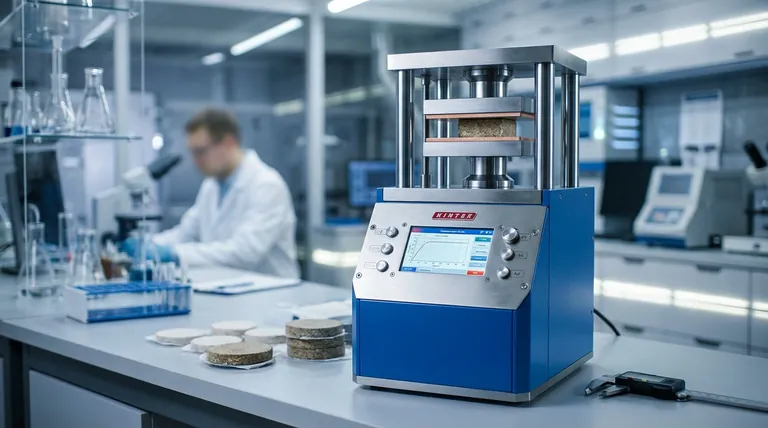
The Ghost in the Machine
A researcher prepares five identical samples. The goal is simple: compact each one under the exact same pressure, for the exact same duration. Yet, the results are frustratingly inconsistent. One sample is perfect, two are brittle, and two are denser on one side than the other.
Is the raw material flawed? Is it a subtle variation in the process?
More often than not, the culprit is the silent partner in the experiment: the laboratory press. We tend to judge a press by its most obvious metric—its maximum tonnage. But this is like judging a surgeon by the sharpness of their scalpel alone. The real value lies not in brute force, but in the intricate, synchronized dance of its core systems.
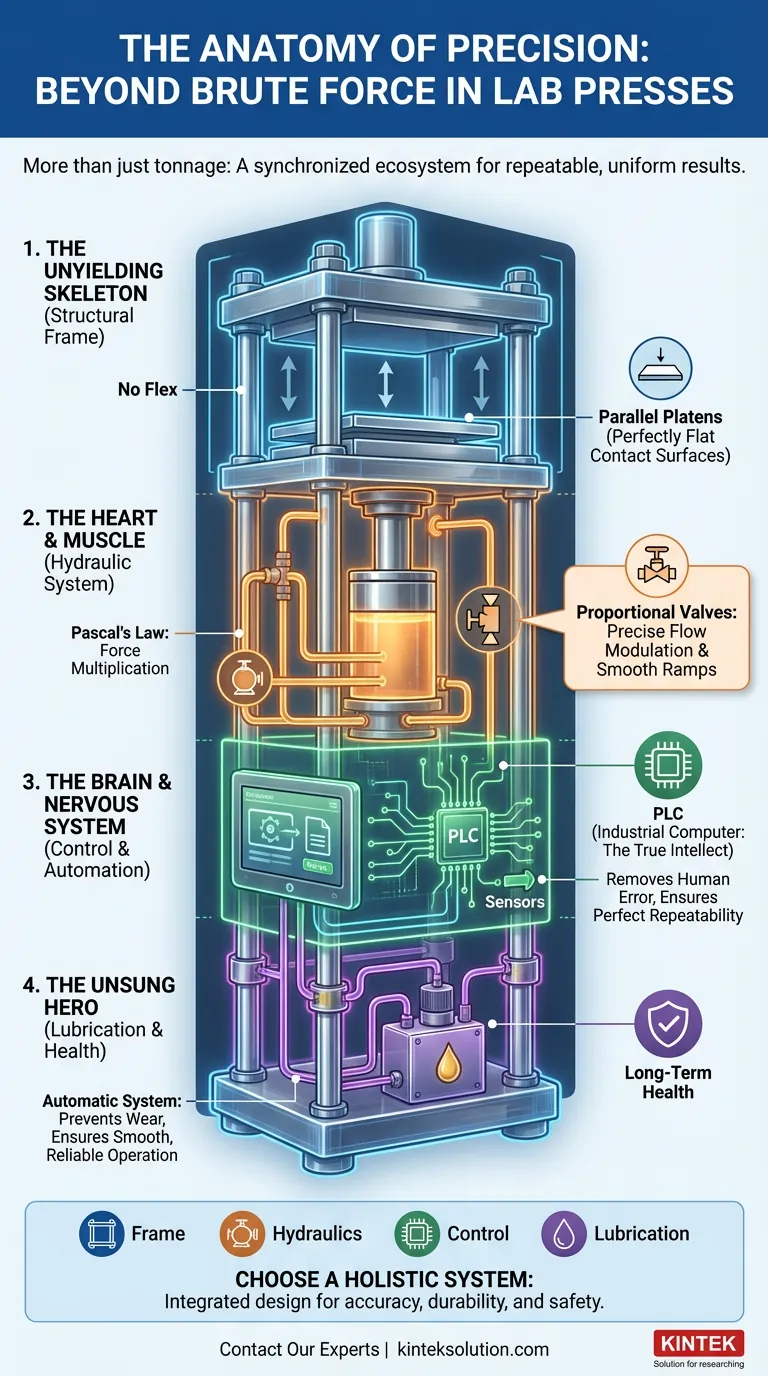
A laboratory press is an ecosystem. Its ability to deliver repeatable, uniform results is born from the harmony between its skeleton, its muscle, its brain, and its long-term health regimen.
The Unyielding Skeleton: The Structural Frame
The foundation of precision is rigidity. When a press applies 30 tons of force, the machine itself is under immense stress. If the frame flexes, even fractionally, the pressing surfaces become non-parallel. The experiment is compromised before it even begins.
The Four Pillars of Stability
This is why high-precision laboratory presses, like those from KINTEK, are built on a pillar-type structure. Four thick, solid steel columns form a monolithic cage. This design isn't just for strength; it's engineered to resist deformation, ensuring the top and bottom sections remain perfectly parallel under extreme load.
This structural integrity is the bedrock of sample uniformity.
The Point of Contact: Platens
The platens are the final arbiters of force. These heavy steel plates must be perfectly flat and perfectly aligned. For advanced applications like polymer science, these platens become more complex, incorporating intricate internal channels for precise heating and cooling. The quality of the platens directly translates to the quality of your work.
The Heart of the Operation: The Hydraulic System
If the frame is the skeleton, the hydraulic system is the muscle. It’s what generates the immense force needed for compaction and molding.
Pascal's Elegant Law
The system operates on a beautifully simple principle. A pump applies pressure to a confined fluid, which then acts on a large piston. This elegant force multiplication allows a relatively small motor to generate incredible power with a high degree of finesse.
The Quality of Control
But raw power is useless without control. The true mark of a superior hydraulic system lies in its components: a high-quality pump, a precisely machined main cylinder, and, most importantly, a network of proportional valves. These valves don't just open and close; they modulate the flow of hydraulic fluid, allowing for smooth pressure ramps, precise holds, and controlled decompression.
The Nervous System: Control and Automation
The control system is the brain that choreographs the entire operation, translating a researcher's intent into flawless mechanical execution.
The Interface vs. The Intellect
We often interact with the Human-Machine Interface (HMI)—a modern touchscreen. This is the friendly face of the machine. But the true intellect is the Programmable Logic Controller (PLC) working behind the scene.
The PLC is an industrial computer that runs the pressing "recipe" with digital perfection. It takes commands from the HMI and data from pressure and temperature sensors, then orchestrates the hydraulic valves and heaters with tireless precision.
This removes the most significant variable in any manual process: human error. The PLC ensures the 100th cycle is identical to the first.
The Unsung Hero: Lubrication and Long-Term Health
There's a psychological bias to overlook the mundane. We are drawn to the impressive tonnage and the bright touchscreen, but we forget the components that ensure the machine works reliably for a decade.
An automatic lubrication system is perhaps the most critical, yet underappreciated, feature of a production-grade lab press. It consistently lubricates the guide bushings on the pillars, preventing wear and tear that leads to jerky movement and misalignment.
Manual lubrication relies on human memory and diligence. An automatic system enforces it. It is a design choice that acknowledges human nature and engineers a solution for it, guaranteeing long-term health and consistent performance.
Choosing Your Instrument: A Systems Approach
When selecting a lab press, you aren't just buying specifications; you're investing in an integrated system. The right choice depends on understanding how these components align with your goals.
- For High Precision and Repeatability: Prioritize a rigid four-pillar frame and an advanced PLC control system.
- For Long-Term Reliability: Insist on high-quality hydraulic components and an automatic lubrication system.
- For Operator Safety and Usability: Demand full CE/OSHA safety integration and an intuitive touchscreen HMI.
The true quality of an instrument like KINTEK's automatic and heated lab presses is found in this holistic approach. They are designed not as a collection of parts, but as a single, coherent system engineered for accuracy, durability, and safety.
Understanding this anatomy of precision empowers you to look beyond the tonnage and choose a machine that will be a reliable partner in your work for years to come. To ensure your results are defined by your science, not by the limitations of your equipment, Contact Our Experts.
Summary: The Four Core Systems
| Component System | Key Parts | Primary Function |
|---|---|---|
| Structural Frame | Pillars, Platens | Provides rigidity and parallel surfaces for uniform force application. |
| Hydraulic System | Pump, Cylinder, Valves | Generates and controls high compressive force using Pascal's principle. |
| Control System | HMI, PLC, Sensors | Enables precise setting and monitoring of pressure, time, and temperature. |
| Lubrication System | Automatic Lubricators | Ensures smooth operation and reduces wear for long-term reliability. |
Visual Guide
Related Products
- 24T 30T 60T Heated Hydraulic Lab Press Machine with Hot Plates for Laboratory
- Laboratory Hydraulic Press 2T Lab Pellet Press for KBR FTIR
- Manual Heated Hydraulic Lab Press with Integrated Hot Plates Hydraulic Press Machine
- Laboratory Hydraulic Pellet Press for XRF KBR FTIR Lab Press
- Lab Infrared Press Mold for Laboratory Applications
Related Articles
- The Invisible Forge: Why the Laboratory Press is the Soul of Nano-Composites
- The Architecture of Slow: Why Physical Precision Dictates Chemical Destiny
- The Architecture of Density: Why Pressure is the Silent Architect of Solid-State Batteries
- The Physics of Transparency: Why Pressure is the Silent Architect of Spectroscopic Clarity
- The Architecture of Certainty: Why the Laboratory Press is the Anchor of Material Science



















