The Thrill of the New, The Agony of the Unseen
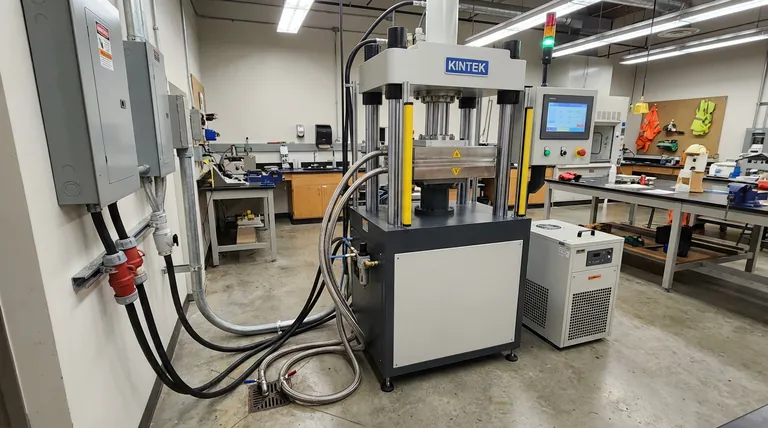
There's a unique excitement in uncrating a new piece of laboratory equipment. It represents potential—new research, higher throughput, better results. But the silent killer of that potential isn't a failed experiment; it's a 460V three-phase power requirement in a lab wired only for standard 115V outlets.
This is a common story. We are psychologically wired to focus on the tangible object: the gleaming steel, the digital controller, the impressive tonnage figures. We fall in love with the machine's capabilities. We often forget to ask a more fundamental question: what ecosystem does this machine need to survive?
The utility requirements of a laboratory press are not footnotes on a spec sheet. They are the foundation upon which its performance and safety are built. Overlooking them is like designing a skyscraper but forgetting the bedrock.
The Triad of Energy: Power, Heat, and Cooling
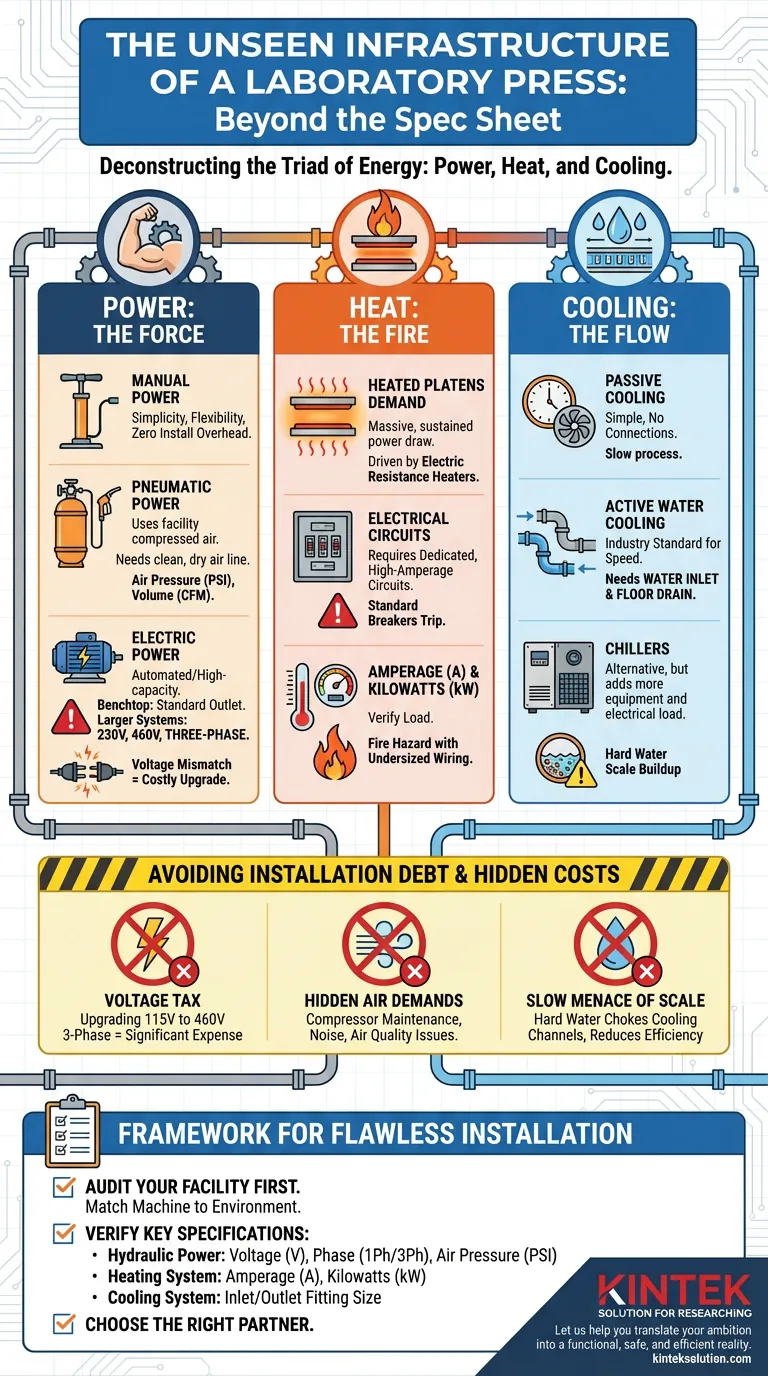
To understand your lab press's needs, you must deconstruct it into three core energy systems. Every special connection—every wire and pipe—serves one of these functions.
1. The Force: Generating Hydraulic Pressure
How does the press create force? The answer dictates the first, most basic utility connection.
- Manual Power: A hand pump requires nothing but human effort. These presses offer maximum placement flexibility and zero installation overhead. They are the essence of simplicity.
- Pneumatic Power: An air-powered press uses your facility's compressed air to drive the hydraulic pump. This requires a clean, dry air line, turning your compressor into part of the press's operational ecosystem.
- Electric Power: The most common system for automated and high-capacity presses. An electric motor drives the pump. While a small benchtop model might use a standard wall outlet, larger systems demand more. This is where you see requirements for 230V, 460V, and three-phase power—connections that are far from standard.
2. The Fire: The Demands of Heated Platens
If your work involves curing, molding, or laminating, you need heat. This heat is almost always generated by powerful electric resistance heaters embedded in the platens.
This is the single biggest driver for dedicated, high-amperage electrical circuits.
A standard circuit is designed for low, intermittent loads. The sustained, massive power draw of heated platens will constantly trip a standard breaker. More dangerously, it can overheat wiring, creating a significant fire hazard. An undersized circuit isn't an inconvenience; it's a liability.
3. The Flow: The Logic of Liquid Cooling
For processes requiring rapid temperature cycles, cooling is as important as heating. The most efficient method is to circulate a liquid through channels within the platens.
- Passive Cooling: Simply turning off the heaters and waiting. It requires no connections but can turn minutes of work into hours of waiting.
- Active Water Cooling: This is the industry standard for speed. It requires two simple but critical plumbing connections: a water inlet and a floor drain.
- Chillers: A closed-loop chiller can be used as an alternative, but the chiller itself is another piece of equipment with its own electrical demands.
The Psychology of Infrastructure: Avoiding "Installation Debt"
Why do we overlook these critical requirements? It's a cognitive bias. We see the press as the solution, so we focus all our attention on it. The wall socket and the water pipe are invisible, so they remain out of mind.
This creates "installation debt"—the unforeseen time and money spent on electricians and plumbers after the press has already arrived. This debt can delay projects by weeks or months.
The True Cost of a Mismatch
- The Voltage Tax: Upgrading a lab's electrical service from 115V to 460V three-phase isn't a simple task. It requires licensed professionals, new wiring, and often a new breaker panel. This is a significant, unplanned capital expense.
- The Hidden Demands of Air: A pneumatic press relies on a well-maintained air compressor system that can supply the required pressure (PSI) and volume (CFM). This system produces noise and requires its own maintenance.
- The Slow Menace of Scale: For water-cooled presses, water quality matters. Hard water can slowly build up mineral deposits inside the platen's cooling channels, silently choking its efficiency until it fails.
A Framework for a Flawless Installation
Before you decide on a press, audit your facility. Match the machine to your environment, not the other way around. Ask the manufacturer for a detailed specification sheet and look for these key values.
| Function | Connection Type | Key Specifications to Verify |
|---|---|---|
| Hydraulic Power | Electrical / Air | Voltage (V), Phase (1Ph/3Ph), or Air Pressure (PSI) |
| Heating System | Electrical | Amperage (A) or Kilowatts (kW) |
| Cooling System | Plumbing | Inlet/Outlet Fitting Size (e.g., 1/2" NPT) |
Choosing the right equipment means choosing a partner who understands this entire ecosystem. At KINTEK, we specialize in a full range of lab presses—from simple manual units to fully automated heated and cooled systems—but our expertise extends to the infrastructure that powers them. We help you see beyond the spec sheet to ensure the machine you choose is the perfect fit for the lab you have.
Let us help you translate your ambition into a functional, safe, and efficient reality. Contact Our Experts
Visual Guide
Related Products
- Laboratory Hydraulic Press Lab Pellet Press Button Battery Press
- Laboratory Hydraulic Press 2T Lab Pellet Press for KBR FTIR
- Laboratory Hydraulic Press Lab Pellet Press Machine for Glove Box
- Laboratory Split Manual Heated Hydraulic Press Machine with Hot Plates
- Laboratory Hydraulic Pellet Press for XRF KBR FTIR Lab Press
Related Articles
- The Architecture of Density: Why Pressure is the Silent Architect of Solid-State Batteries
- The Physics of Transparency: Why Pressure is the Silent Architect of Spectroscopic Clarity
- The Architecture of Heat: Why Sample Density Dictates the Truth in Metal Hydride Research
- The Geometry of Ionic Flow: Why Precision Pressing Dictates Material Truth
- The Geometry of Electrons: Why Surface Precision is the Silent Partner in SECM Research



















