The Unseen Architecture of a Perfect Installation
A laboratory press is a vessel of immense potential. It can compress powders into revolutionary materials or test the limits of new composites. But that potential is built on a foundation laid long before the first sample is run.
We often fall prey to a cognitive bias: viewing installation as a mere logistical hurdle before the "real work" begins. We see a heavy machine, a power cord, and a manual.
This perspective is flawed. The installation isn't a prelude to the experiment; it is the first and most critical experiment. It's a test of foresight, precision, and a commitment to process. Get it right, and you establish a bedrock of reliability. Get it wrong, and you introduce a ghost in the machine—an invisible variable that can haunt your data for years.
Phase 1: The Stability of the Groundwork
The most common point of failure occurs before the press is even unboxed. It begins with the environment itself.
The Gravity of the Situation
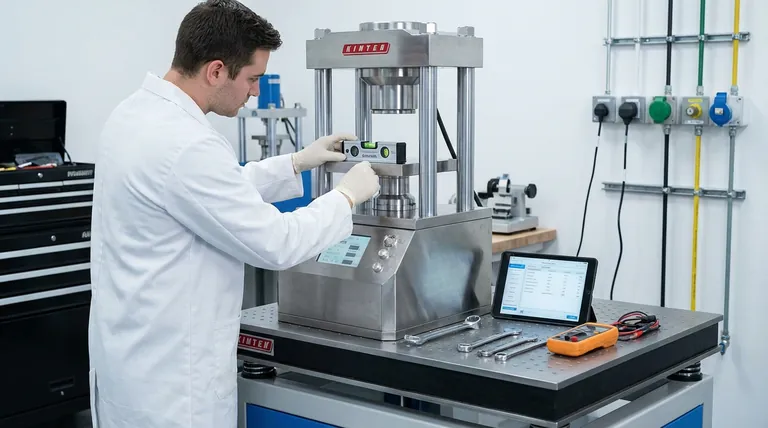
A laboratory press, with its heavy pillar-type structure, exerts immense, focused force. Its effectiveness depends on absolute stability. Placing it on a floor that is not perfectly level or cannot bear the load introduces subtle, yet persistent, error.
Imagine a tiny, imperceptible tilt. Over thousands of cycles, this slight imbalance can lead to uneven wear on guide bushings or premature seal failure in the hydraulic cylinder. More insidiously, it can translate into skewed pressure distribution on the platen, compromising the integrity of every sample produced. The ground beneath the machine is the first component of the machine.
The Machine's Lifeline
Utilities are not just connections; they are the machine's life support.
- Power: Unstable or "dirty" power is like a chronic illness for the press's sensitive electronics and control systems. It can cause phantom errors or, worse, gradual degradation of expensive components.
- Air/Water: If your press requires compressed air or cooling water, inconsistent pressure or flow is a direct threat to operational consistency.
Preparing the site is an act of foresight. It’s about anticipating the machine's needs to prevent problems that are otherwise difficult to diagnose later.
Phase 2: From Components to a Coherent System
With the press in position, the task shifts from the environment to the machine itself. This is where a collection of high-grade components becomes a single, operational system.
The Hydraulic Heartbeat
The hydraulic system is the heart of the press. Its initial setup is a delicate procedure. It's not just about filling a reservoir; it's about ensuring the hydraulic fluid is pristine and that every ounce of air is purged from the lines.
An air bubble in a hydraulic system is like an embolism. It compresses under pressure, causing spongy, inaccurate force application and jerky movements. A proper commissioning process cycles the system methodically, bleeding out this hidden flaw to ensure the machine’s response is immediate, smooth, and exact.
Building the Scientific Ecosystem
A modern lab press is rarely a standalone unit. It's the hub of a data-gathering ecosystem. Integrating heated platens, vacuum systems, or data acquisition hardware must be seamless.
A clumsy integration—a poorly calibrated temperature controller or a vacuum line that leaks—creates a bottleneck. The system is only as strong as its weakest link. The goal is to make these ancillary parts a native extension of the core machine, all orchestrated through a single, intuitive control panel.
Phase 3: The Moment of Truth
Powering on the machine for the first time is not a celebration. It's a diagnostic procedure.
Verifying Every Safeguard
This is where human psychology can become a liability. We see a big red emergency stop button and we assume it works. This is a dangerous assumption.
In a professional installation, every single safety feature is tested empirically. The pressure relief valve is checked. The physical guards are confirmed to be secure. Light curtains are deliberately broken to ensure the machine halts instantly. Trust is not a substitute for verification. These systems protect your most valuable assets: your people and your investment.
Calibration: Teaching the Machine the Truth
An uncalibrated press produces beautifully precise, but utterly false, data.
Calibration aligns the machine's physical actions—the force it applies, the temperature it holds—with the abstract digital values displayed on the screen. It is the process of teaching the machine to speak the truth. This final step, a first run with a non-critical material, validates that all systems are not just working, but working together in perfect harmony.
The Psychology of Common Failures
A rushed installation undermines the very purpose of acquiring a precision instrument. The most common pitfalls are rooted less in technical inability and more in human psychology.
| Pitfall Category | The Psychological Trap | The Professional's Approach |
|---|---|---|
| Site Readiness | The Planning Fallacy: We chronically underestimate the time and detail required for preparation. | Meticulously verify power, space, and floor loading before the delivery is scheduled. |
| Safety Verification | Confirmation Bias: We see the machine move and assume all systems are fine. | Individually test every safety feature against the manufacturer's protocol. No exceptions. |
| Operator Handover | The Curse of Knowledge: An expert assumes a procedure is "obvious" and fails to explain it. | Conclude the installation with structured, hands-on training for all primary operators. |
A deliberate, thorough installation is the first and most important step in guaranteeing years of safe, accurate, and repeatable results. For complex systems like an automatic lab press or an isostatic press, this process is best guided by experience. It ensures that the engineering elegance of the machine is fully realized in its application.
At KINTEK, we understand that our responsibility doesn't end at delivery. We provide robust solutions, from heated lab presses to fully automated systems, built for the rigorous demands of the modern laboratory. Ensuring that foundation is set perfectly from day one is part of that commitment. Contact Our Experts
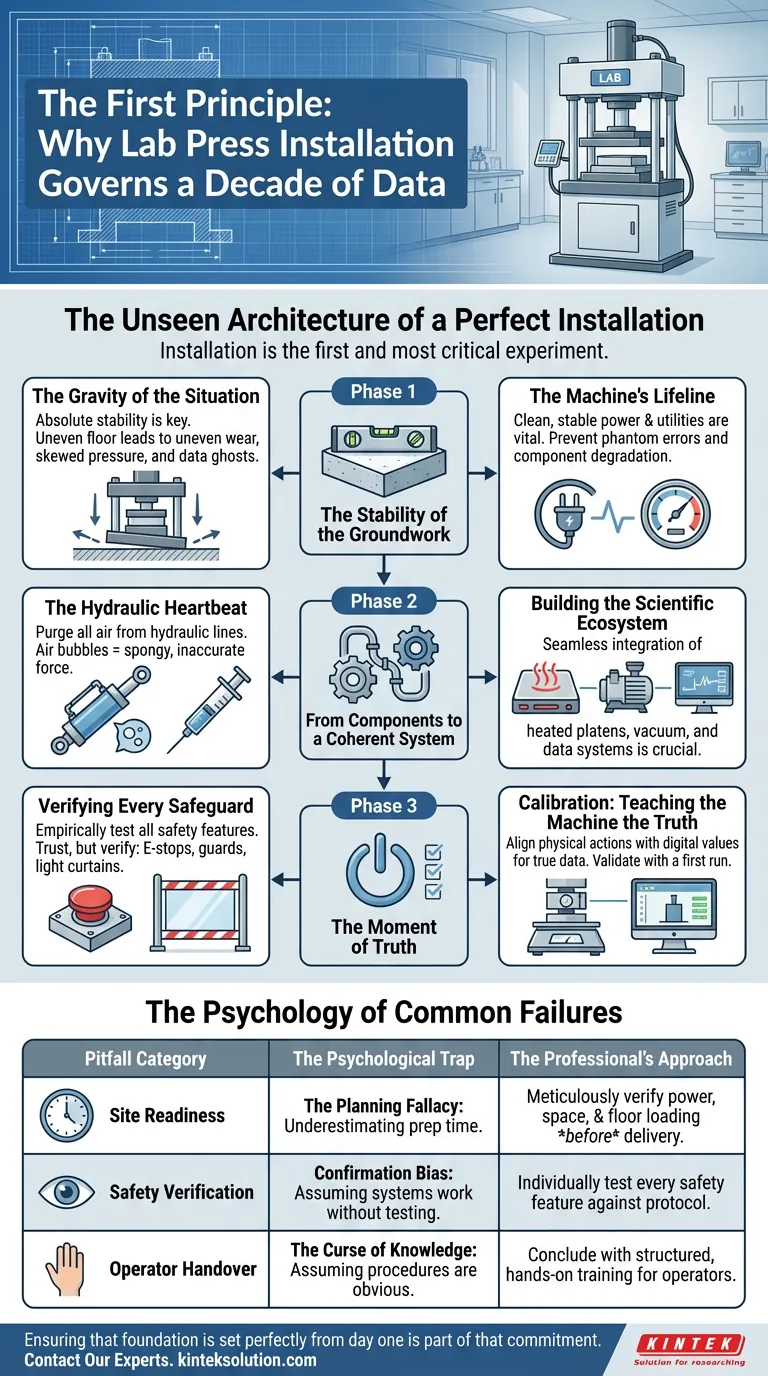
Visual Guide
Related Products
- 24T 30T 60T Heated Hydraulic Lab Press Machine with Hot Plates for Laboratory
- Manual Heated Hydraulic Lab Press with Integrated Hot Plates Hydraulic Press Machine
- Laboratory Hydraulic Pellet Press for XRF KBR FTIR Lab Press
- Lab Infrared Press Mold for Laboratory Applications
- Laboratory Hydraulic Press Lab Pellet Press Machine for Glove Box
Related Articles
- The Invisible Forge: Why the Laboratory Press is the Soul of Nano-Composites
- The Architecture of Slow: Why Physical Precision Dictates Chemical Destiny
- The Architecture of Density: Why Pressure is the Silent Architect of Solid-State Batteries
- The Physics of Transparency: Why Pressure is the Silent Architect of Spectroscopic Clarity
- The Architecture of Certainty: Why the Laboratory Press is the Anchor of Material Science



















