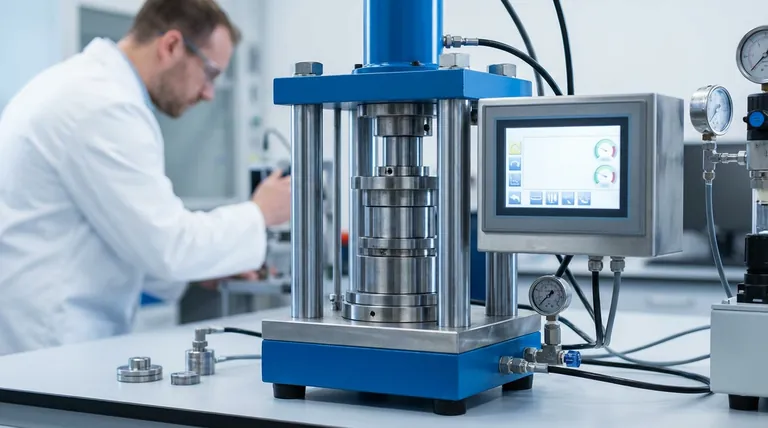
The Moment of Truth
Imagine this: months of preparation, a one-of-a-kind sample, and a critical deadline. The lab press hums to life, pressure building steadily. Then, with a flicker on the screen, the pressure drops. The cycle aborts. The sample is compromised.
This isn't just a mechanical failure. It's a system failure. And it often starts not with a catastrophic breakdown, but with a single, inexpensive component reaching its operational limit.
The reliability of a laboratory press isn't defined by its strongest part, but by the integrity of its most vulnerable one.
A Machine is Not an Object; It's an Ecosystem
To truly understand maintenance, we must stop seeing a lab press as a single entity. It’s a delicate ecosystem of interconnected systems, each depending on the others to function with precision.
Knowing which spare parts are available is one thing. Understanding how they prevent a cascade of failure is everything.
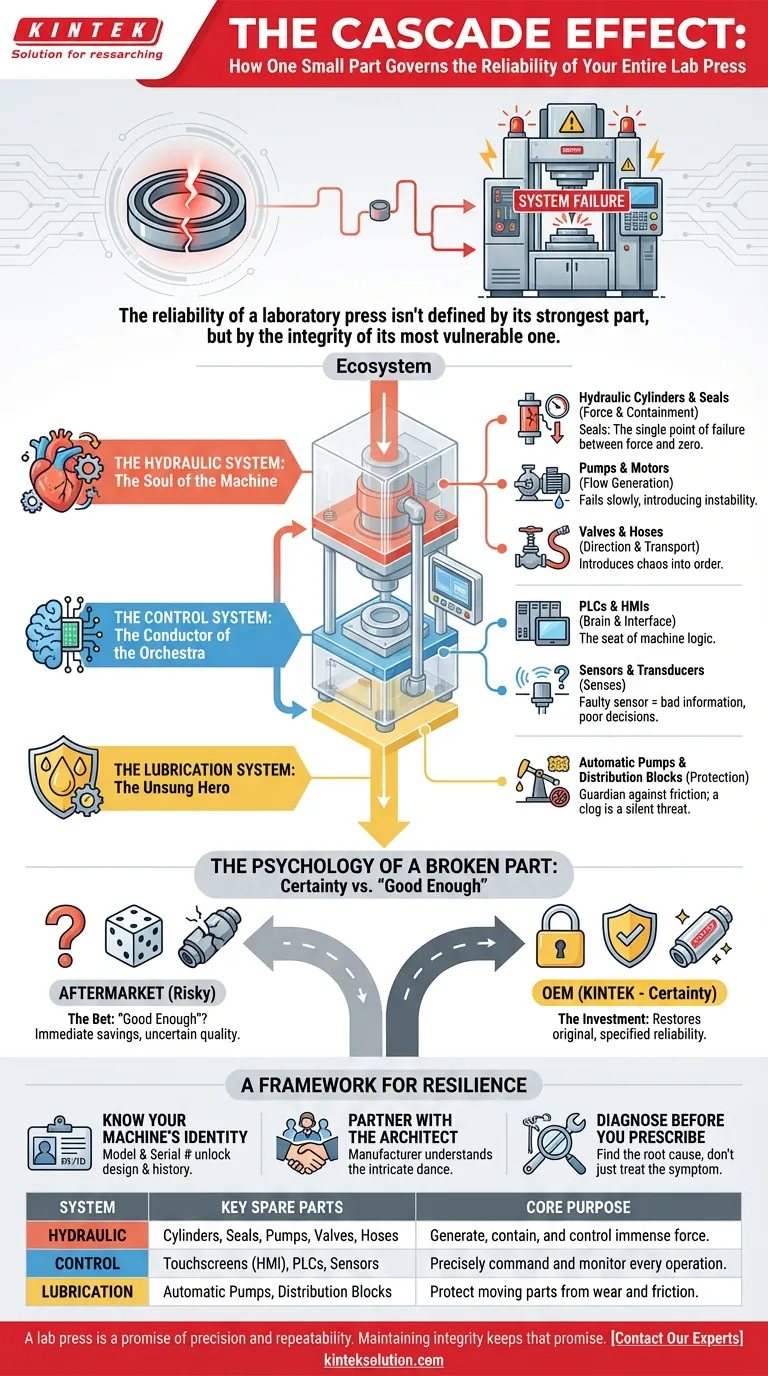
The Hydraulic System: The Soul of the Machine
The hydraulic system is where raw electrical power is converted into immense, controllable force. It's the heart and muscle of the press, but its power is entirely dependent on containment.
- Hydraulic Cylinders and Seals: The cylinder provides the force, but the seal, often a component costing just a few dollars, is what contains the pressure. When a seal fails, the system loses its integrity. It’s the single point of failure between kilotons of force and zero.
- Pumps and Motors: These generate the flow of hydraulic fluid. A weakening pump doesn't just fail; it fails slowly, introducing instability and unpredictability into your results long before it stops working entirely.
- Valves and Hoses: Valves are the logical gates directing the flow of immense pressure, while hoses are the arteries. A sticking valve or a degrading hose introduces chaos into a system that demands absolute order.
The Control System: The Conductor of the Orchestra
If the hydraulics are the muscle, the control system is the brain. It coordinates every action with microsecond precision, but it's only as good as the information it receives.
- PLCs and HMIs: The Programmable Logic Controller (PLC) is the silent conductor, executing precise commands from the Human-Machine Interface (HMI). While incredibly robust, these components are the seat of the machine's logic.
- Sensors and Transducers: These are the machine's senses. They tell the PLC what is actually happening with pressure, temperature, and position. A faulty sensor gives the brain bad information, leading it to make poor decisions that can ruin a sample or, worse, damage the machine.
The Lubrication System: The Unsung Hero
Often overlooked, the lubrication system is the guardian against the slow, inexorable march of friction and wear. It’s the system that ensures the press will live a long, productive life. A clog in a distribution block is a silent threat, slowly starving a critical component of oil until it grinds to a premature halt.
The Psychology of a Broken Part: Certainty vs. "Good Enough"
When a part fails, you face a critical decision: Original Equipment Manufacturer (OEM) or aftermarket?
This isn't just a financial choice; it's a psychological one. The aftermarket part whispers the alluring promise of immediate cost savings. It feels like a smart, frugal move.
But it’s a bet. A bet that a component made by a third party has the exact same material composition, the same thermal expansion properties, and the same dimensional tolerances as the original.
An OEM part, by contrast, is an investment in certainty. Manufacturers like KINTEK design their lab presses as a complete system. An OEM seal isn't just a piece of rubber; it's the exact piece of rubber engineered to work within that specific hydraulic ecosystem under specific operational stresses. Choosing OEM is choosing to restore the system to its original, specified state of reliability.
A Framework for Resilience
Effective maintenance isn't about reacting to failures. It's about building a framework that anticipates and minimizes them.
-
Know Your Machine's Identity: Your press's model and serial number are not just for inventory. They are the key to its entire bill of materials, its specific design, and its history. Always have this information ready.
-
Partner with the Architect: The manufacturer is not just a vendor; they are the architect of your machine. Their technical support team understands the intricate dance between the components better than anyone.
-
Diagnose Before You Prescribe: Before ordering a part, talk to the experts. A pressure drop might seem like a pump failure, but it could be caused by a faulty sensor or a simple leak. Treating the symptom without finding the root cause is a recipe for repeated downtime.
The table below breaks down the key systems and their critical components.
| System | Key Spare Parts | Core Purpose |
|---|---|---|
| Hydraulic | Cylinders, Seals, Pumps, Valves, Hoses | To generate, contain, and control immense force. |
| Control | Touchscreens (HMI), PLCs, Sensors | To precisely command and monitor every operation. |
| Lubrication | Automatic Pumps, Distribution Blocks | To protect moving parts from wear and friction. |
A lab press is a promise of precision and repeatability. Maintaining the integrity of its internal systems is how you keep that promise. For precision-engineered components designed for your specific automatic, isostatic, or heated lab press, our team is ready to help you maintain the reliability your research demands. Contact Our Experts
Visual Guide
Related Products
- 24T 30T 60T Heated Hydraulic Lab Press Machine with Hot Plates for Laboratory
- Manual Heated Hydraulic Lab Press with Integrated Hot Plates Hydraulic Press Machine
- Laboratory Hydraulic Pellet Press for XRF KBR FTIR Lab Press
- Lab Infrared Press Mold for Laboratory Applications
- Laboratory Hydraulic Press Lab Pellet Press Machine for Glove Box
Related Articles
- The Invisible Forge: Why the Laboratory Press is the Soul of Nano-Composites
- The Architecture of Slow: Why Physical Precision Dictates Chemical Destiny
- The Architecture of Density: Why Pressure is the Silent Architect of Solid-State Batteries
- The Physics of Transparency: Why Pressure is the Silent Architect of Spectroscopic Clarity
- The Architecture of Certainty: Why the Laboratory Press is the Anchor of Material Science



















