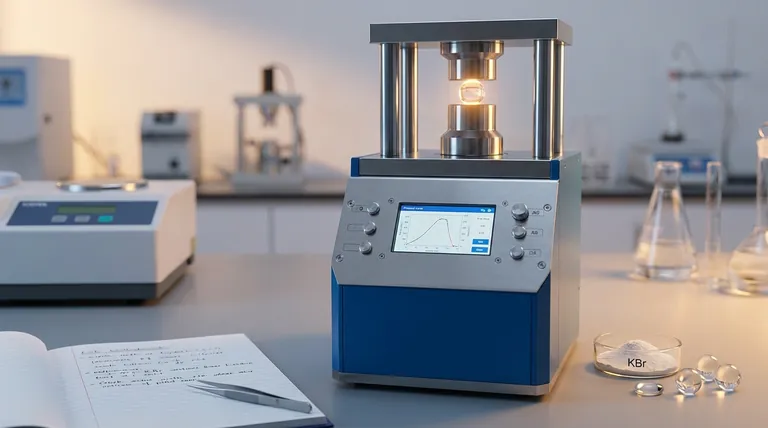
The Invisible Variable
A researcher stares at two spectroscopy readouts from what should be identical samples. The peaks are maddeningly different. The chemistry is sound, the spectrometer is calibrated, yet the data tells two different stories.
The error isn't in the high-level science. It's in the foundation. It’s in the physical preparation of the sample—a step so fundamental it's often overlooked.
The true challenge in much of modern research isn't just generating force, but applying it with unwavering consistency. This is where the quiet, deliberate power of a hydraulic press becomes less of a tool and more of a partner in discovery.
The Physics of Trust
At its heart, a laboratory press is a tool for control. It’s designed to eliminate one of the most unpredictable variables in any lab: human effort.
Pascal's Principle: An Elegant Promise
A hydraulic system operates on a simple, beautiful principle. A small force applied to a small piston generates a proportionally massive force in a larger piston.
This isn't just clever engineering; it's a promise. It promises that tons of pressure can be generated smoothly and without the physical strain or inconsistency of a manual crank or lever. It democratizes force, making it accessible and repeatable for any operator.
From Force to Fidelity
The real value of a hydraulic press, however, isn't the force itself, but the ability to measure and control it. The pressure gauge is the most important part of the machine.
It transforms an abstract action—pressing—into a concrete, quantifiable parameter. Applying "2 tons of pressure" is no longer a guess. It is a precise, repeatable input. This removes the cognitive load and doubt from the researcher. "Did I press it the same way I did yesterday?" The gauge answers with a confident "yes." This certainty is the bedrock of reproducible science.
Where Precision Creates Discovery
In the lab, consistency is currency. The ability to perfectly replicate conditions is what separates a one-off anomaly from a publishable finding.
The Art of the Perfect Pellet
Consider preparing a KBr pellet for FTIR spectroscopy. The goal is a glassy, transparent disc. Any imperfection—a crack, a cloudy spot, an uneven density—scatters light and introduces noise into the spectrum, obscuring the very signals you're trying to detect.
A manual press makes this an art form dependent on "feel." A hydraulic press turns it into a science. By applying a known, even pressure, it reliably creates homogenous pellets, ensuring the only variable being measured is the sample itself. The same logic applies to creating sample pucks for XRF analysis, where surface uniformity is paramount.
Mapping the Boundaries of Matter
In materials science, a lab press is used to ask a fundamental question: When will this break? Researchers apply compressive loads to test the strength, durability, and failure points of novel materials.
Here, precision is non-negotiable. The data isn't just "broken" or "not broken"; it's a curve of stress and strain. Advanced systems, like KINTEK's heated lab presses, allow researchers to ask even more complex questions, testing material resilience under specific thermal conditions, simulating real-world environments with remarkable fidelity.
The Human Factor: System vs. Effort
Choosing the right press is less a technical decision and more a strategic one about your laboratory's philosophy.
| Feature | Manual Press | Hydraulic Press (e.g., KINTEK Automatic) |
|---|---|---|
| Workflow | Best for occasional, low-volume tasks. | Ideal for high-throughput, repetitive work. |
| Consistency | Operator-dependent; prone to fatigue-based errors. | Machine-controlled; ensures identical samples. |
| Psychological Load | High. "Am I doing this right?" | Low. Set the force and trust the machine. |
| Data Integrity | Good for qualitative work, risky for quantitative. | Essential for reliable, publishable quantitative data. |
For a lab processing dozens of samples a day, a manual press is a recipe for fatigue and hidden errors. The inconsistency born from tired muscles can silently undermine an entire research project.
An automatic lab press removes this human variable entirely. It becomes a system, not just a tool. It executes the protocol perfectly every time, freeing the researcher to focus on analysis and interpretation, not on the physical act of preparation. The initial investment pays dividends in the form of reliable data and accelerated research.
Ultimately, the right press transforms your workflow from a series of manual efforts into a system for reliable discovery. If you're ready to build that system for your lab, Contact Our Experts.
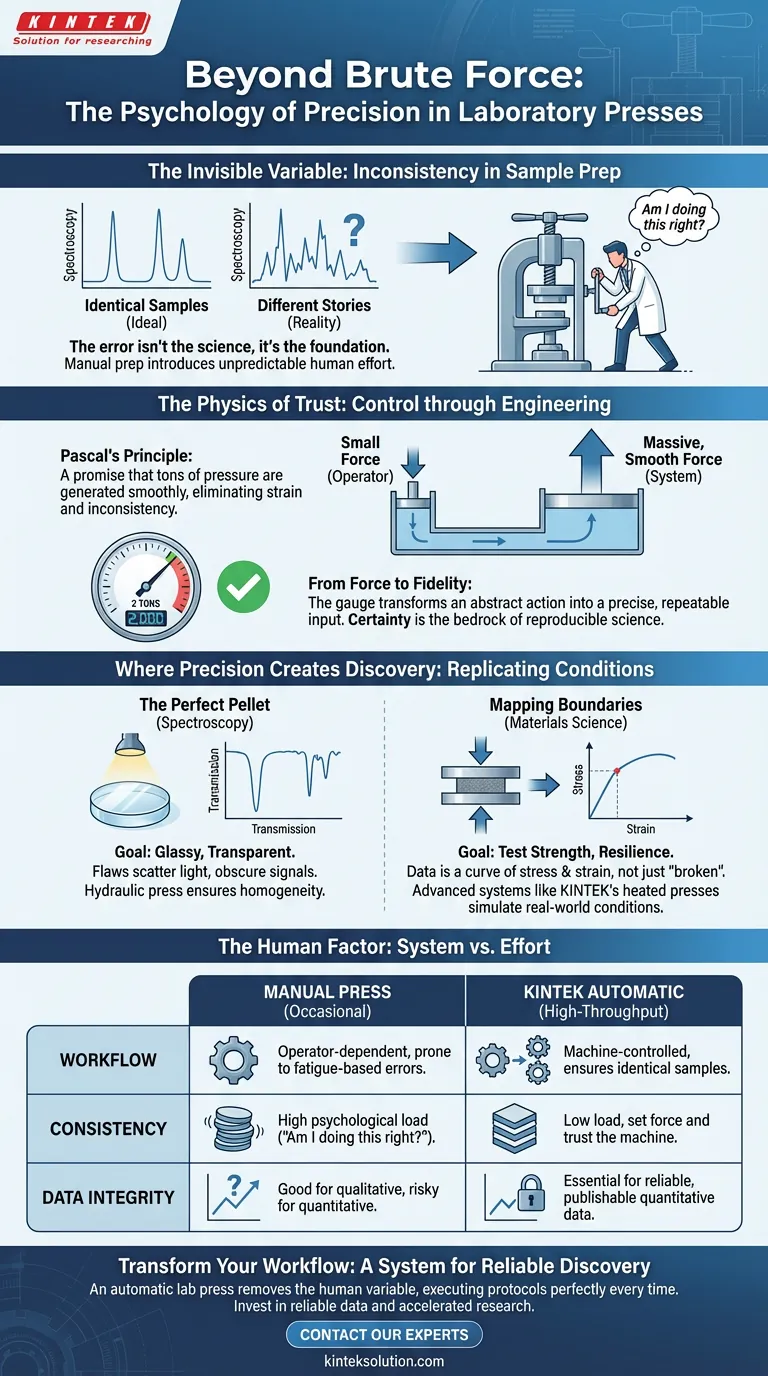
Visual Guide
Related Products
- 24T 30T 60T Heated Hydraulic Lab Press Machine with Hot Plates for Laboratory
- Laboratory Hydraulic Press 2T Lab Pellet Press for KBR FTIR
- Manual Heated Hydraulic Lab Press with Integrated Hot Plates Hydraulic Press Machine
- Laboratory Hydraulic Press Lab Pellet Press Machine for Glove Box
- Automatic High Temperature Heated Hydraulic Press Machine with Heated Plates for Lab
Related Articles
- The Invisible Forge: Why the Laboratory Press is the Soul of Nano-Composites
- The Architecture of Slow: Why Physical Precision Dictates Chemical Destiny
- The Architecture of Density: Why Pressure is the Silent Architect of Solid-State Batteries
- The Physics of Transparency: Why Pressure is the Silent Architect of Spectroscopic Clarity
- The Architecture of Certainty: Why the Laboratory Press is the Anchor of Material Science



















