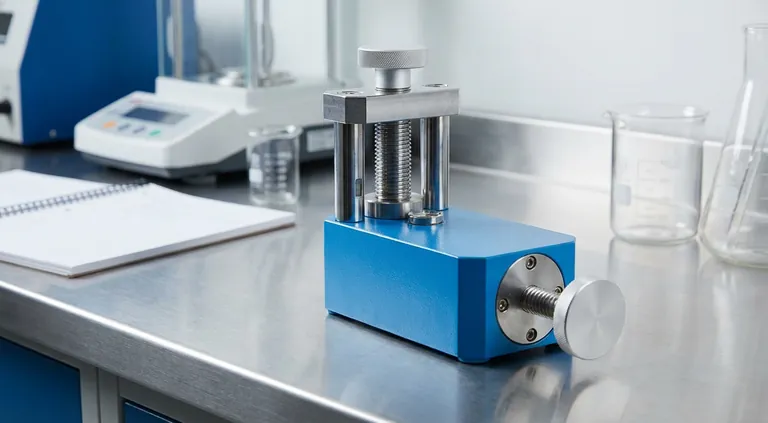
The Hidden Anxiety of Inconsistency
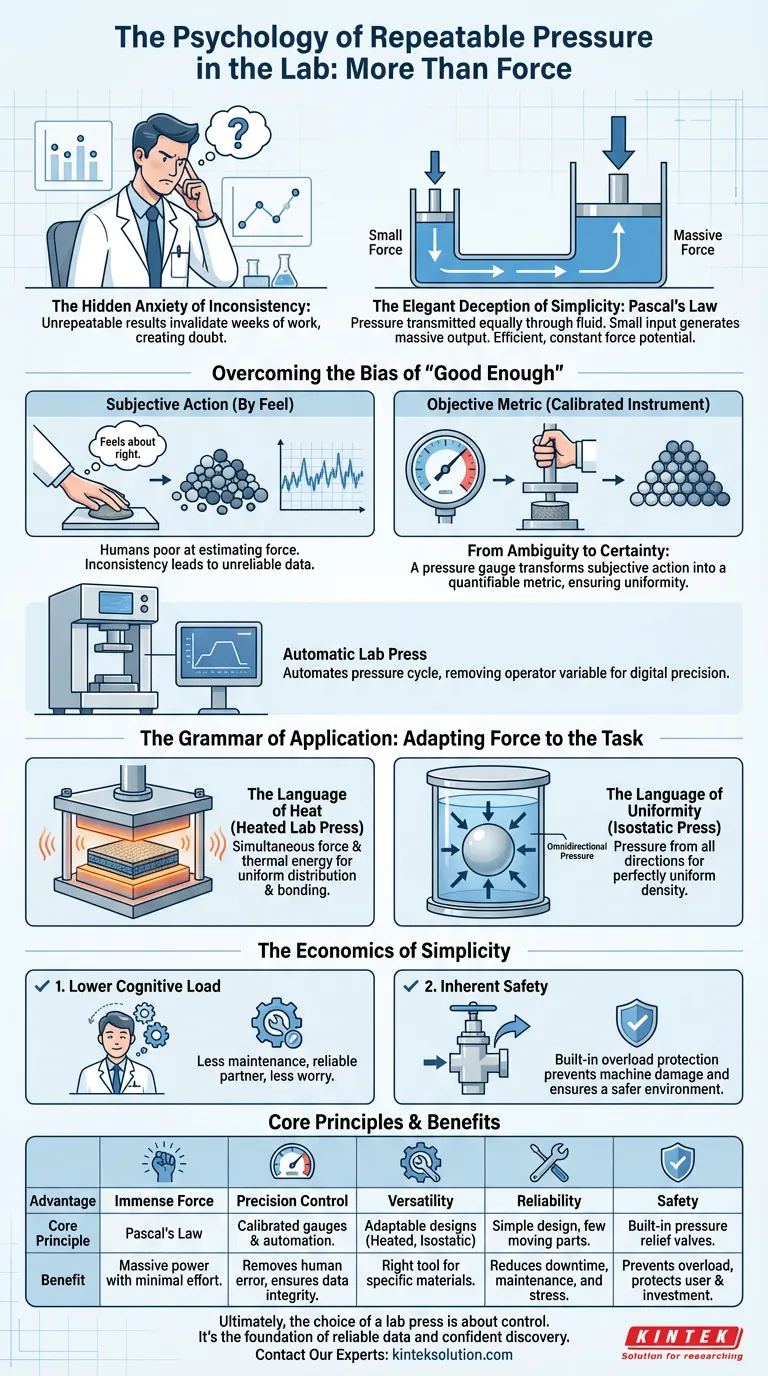
In a laboratory, the greatest enemy isn't a failed experiment—it's an unrepeatable one. An outlier can be dismissed, but inconsistent results plant a seed of doubt that can invalidate weeks of work. We search for variables in our materials or our methods, but often the culprit is more fundamental: the inconsistent application of force.
This is a psychological burden. We trust our instruments to be extensions of our will, translating intent into precise action. When that translation is flawed, trust erodes. The core value of a laboratory press, then, is not its capacity for brute force, but its ability to deliver certainty.
The Elegant Deception of Simplicity
At first glance, a hydraulic press seems almost too simple. It operates on Pascal's Law: pressure applied to an enclosed fluid is transmitted equally throughout. A small force on a small piston generates a massive, proportional force on a larger one.
This isn't just clever engineering; it's a principle of radical efficiency. It allows a small electric motor or a simple hand pump to generate tons of force. But unlike a mechanical press, which delivers peak force only at the bottom of its stroke, a hydraulic press delivers its full, calibrated force at any point. It can hold that force, patiently and silently, without consuming more power.
This quiet, constant potential is where the real work gets done.
Overcoming the Bias of "Good Enough"
Without a calibrated instrument, humans are remarkably poor at estimating and repeating force. Preparing a KBr pellet for FTIR spectroscopy "by feel" is a classic example of this cognitive bias. The operator might believe they are being consistent, but slight variations in pressure create pellets of different densities.
The result? Inconsistent spectral baselines, noisy data, and unreliable analysis. The problem isn't the sample or the spectrometer; it's the lack of repeatable pressure during preparation.
This is where the instrument's role shifts from a tool of force to a tool of truth.
From Ambiguity to Certainty
A simple pressure gauge is the first step toward control. It transforms a subjective action into an objective, quantifiable metric. An operator can now apply the exact same force, every single time.
This ensures uniformity from one sample to the next.
For labs seeking the highest level of consistency, an automatic lab press takes this principle to its logical conclusion. By automating the pressure cycle, it removes the operator variable entirely, guaranteeing that the protocol is followed with digital precision. It’s no longer about applying force; it’s about executing a program.
The Grammar of Application: Adapting Force to the Task
The true versatility of hydraulics lies in its ability to be adapted to highly specific tasks. The core principle remains the same, but its application changes to meet the unique demands of different materials.
The Language of Heat
Polymers, composites, and laminates often require more than just pressure; they need a combination of force and thermal energy applied simultaneously. A heated lab press accomplishes this by integrating precision-controlled heating platens.
This simultaneous application ensures uniform temperature distribution and bonding, reducing processing times and dramatically improving the quality and consistency of the final product.
The Language of Uniformity
For advanced materials and ceramics, even pressure from two sides isn't enough. An isostatic press applies pressure from all directions simultaneously using a fluid medium. This eliminates internal stresses and produces a sample with perfectly uniform density—a level of quality unattainable with conventional pressing.
The Economics of Simplicity
Hydraulic systems possess an inherent robustness. With fewer moving parts than their mechanical counterparts, they are less prone to wear and require minimal maintenance. This simple design has two powerful psychological benefits for any lab manager:
- Lower Cognitive Load: Less maintenance means less to worry about. The machine is a reliable partner, not another problem to be solved.
- Inherent Safety: Hydraulic systems have built-in overload protection via relief valves. It's physically impossible to apply a force that would damage the machine, creating a safer environment and preventing costly mistakes.
This combination of reliability and safety leads to a lower total cost of ownership, but more importantly, it fosters a more productive and less stressful research environment.
| Advantage | Core Principle | Psychological & Practical Benefit |
|---|---|---|
| Immense Force | Pascal's Law of force multiplication | Generates massive power with minimal effort and a small footprint. |
| Precision Control | Calibrated pressure gauges and automation | Removes human error and guesswork, ensuring data integrity. |
| Versatility | Adaptable designs (Heated, Isostatic) | Provides the right tool for specific material challenges. |
| Reliability | Simple design with few moving parts | Reduces downtime, maintenance costs, and operational stress. |
| Safety | Built-in pressure relief valves | Prevents overload, protecting both the user and the investment. |
Ultimately, the choice of a lab press is a choice about control. It's about ensuring that every sample you prepare and every material you test is subjected to the exact conditions you intended. This is the foundation of reliable data and confident discovery. To achieve that level of precision and repeatability, you need the right instrument. Contact Our Experts
Visual Guide
Related Products
- Automatic High Temperature Heated Hydraulic Press Machine with Heated Plates for Lab
- Manual Heated Hydraulic Lab Press with Integrated Hot Plates Hydraulic Press Machine
- Heated Hydraulic Press Machine with Heated Plates for Vacuum Box Laboratory Hot Press
- Laboratory Hydraulic Press 2T Lab Pellet Press for KBR FTIR
- Laboratory Hydraulic Press Lab Pellet Press Machine for Glove Box
Related Articles
- The Architecture of Slow: Why Physical Precision Dictates Chemical Destiny
- The Architecture of Certainty: Why the Laboratory Press is the Anchor of Material Science
- The Vanishing Boundary: The Hidden Thermodynamics of LTCC Lamination
- The Alchemy of 160°C: Why Precision Pressing is the Silent Backbone of Rubber Science
- The Invisible Forge: Why the Laboratory Press is the Soul of Nano-Composites



















