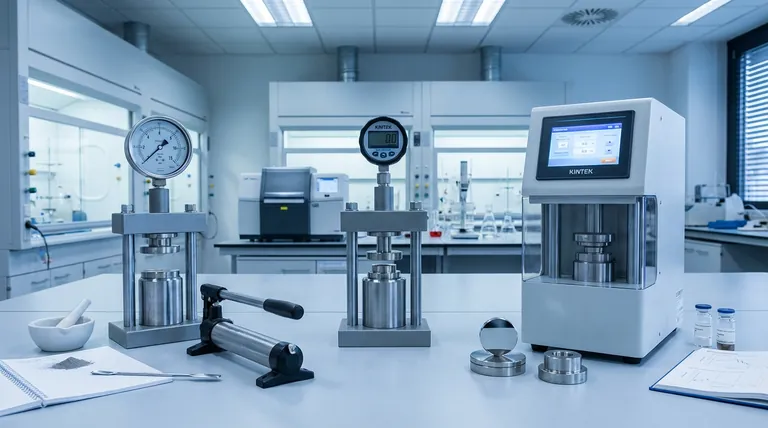
The Illusion of a Single Metric
A researcher prepares ten identical samples for X-Ray Fluorescence (XRF) analysis. The spectrometer is calibrated, the environment is controlled, but the results are inexplicably scattered. The data tells a story of inconsistency.
The culprit isn't the sample or the multi-thousand-dollar analyzer. It's the silent partner in the process: the lab press. Micro-fractures, uneven density, and a slightly imperfect surface—all born from a press that wasn't right for the job—have rendered the data unreliable.
The most common cognitive error when buying a lab press is focusing on a single, dominant metric—usually maximum pressure (tonnage) or price. But the goal isn't to acquire the most powerful or the cheapest machine. It's to invest in a system that produces the exact pellet quality your application demands, every single time.
First, Define the Outcome, Not the Tool
Before looking at a single spec sheet, you must step back. The press is a means to an end. What is that end?
What Story Must Your Pellet Tell?
The purpose of the pellet dictates its required physical properties.
- For Spectroscopy (XRF/FTIR): The pellet is a window into the material's composition. It demands a flawless, mirror-like surface and uniform density to prevent analytical errors. Repeatability is king.
- For Material Testing: The pellet is the subject itself. Its structural integrity, breaking strength, and density are the data points. Here, the pressing process directly simulates real-world conditions.
- For R&D: The pellet is an experiment. You need the flexibility to work with a wide range of materials, from soft polymers to hard ceramics, demanding a versatile machine.
The Material's Quiet Resistance
Every material responds to pressure differently. A soft organic powder compacts easily. A brittle ceramic is prone to cracking. A polymer may require thermal energy to bind correctly.
This is why specialized machines exist. Forcing a polymer into a pellet without heat is a recipe for a weak, crumbly sample. A heated lab press, which applies both force and temperature, is not an optional luxury in this context; it's a fundamental requirement for a valid result.
Translating Purpose into Precision Machinery
Once the desired outcome is clear, you can translate that need into the language of engineering.
Force Is Not the Same as Control
Tonnage is simply the brute force potential. True precision comes from the control system.
- Manual Presses: A hand pump and a pressure gauge. They are simple and cost-effective but introduce a significant human variable. How fast is the pressure applied? How long is it held? How gently is it released? The consistency between two operators—or even the same operator on a Monday vs. a Friday—can vary.
- Automatic Presses: An electro-hydraulic system governed by a controller. An automatic lab press allows you to program the entire pressure cycle: the ramp rate, the hold time, and the decompression speed. It removes the human variable, ensuring every pellet is born from the exact same process. This is the foundation of repeatable data.
The Die: The Mold of Your Final Truth
The die set shapes your sample. Its diameter is critical, but so is its material and the availability of interchangeable sizes. An R&D lab working on diverse projects needs the flexibility to switch from a 10mm die to a 40mm die. A quality control lab running the same test daily needs a hardened steel die that can withstand thousands of cycles without wear.
The Unsung Hero: The Mainframe
The frame of the press bears the immense forces at play. A robust, overbuilt frame doesn't just ensure longevity; it's a critical safety component. Under pressure, a poorly constructed frame can fail catastrophically.
The Psychology of a Long-Term Investment
Choosing a press is a decision that balances ideal features with real-world constraints. Understanding the cognitive traps here is crucial.
The True Cost of "Cheap"
A low upfront price is seductive. But a press is a long-term asset. The "cheapest" machine can become the most expensive through:
- Wasted Time: Inconsistent pellets mean re-running analyses.
- Wasted Materials: Failed pellets mean discarded samples.
- Downtime: A failure in a critical component can halt a project for days or weeks.
Reputation matters. A manufacturer known for durable components and reliable support is providing a lower total cost of ownership, not just a lower initial price.
Designing for Human Error
A lab is a busy place. Distractions happen. Safety features like a thick polycarbonate shield and clearly marked emergency stop buttons are not just for compliance; they are systems designed to accommodate the reality of human fallibility. Never compromise on safety.
A System, Not Just a Machine
Your final choice should reflect your primary objective.
| If Your Goal Is... | Prioritize These Features... |
|---|---|
| Routine Lab Analysis | Repeatability. An automatic lab press is a game-changer. |
| Diverse R&D | Versatility. A wide pressure range & interchangeable dies. |
| Polymer/Composite Work | A heated lab press for thermal bonding. |
| High Throughput | Automation for speed and durability for continuous use. |
Ultimately, you are not just buying a press; you are investing in the reliability of your future results. The machine is an integral part of your data generation system. Choosing the right one requires a partner who understands these nuances. If you're ready to build a process that delivers reliable results every time, Contact Our Experts.
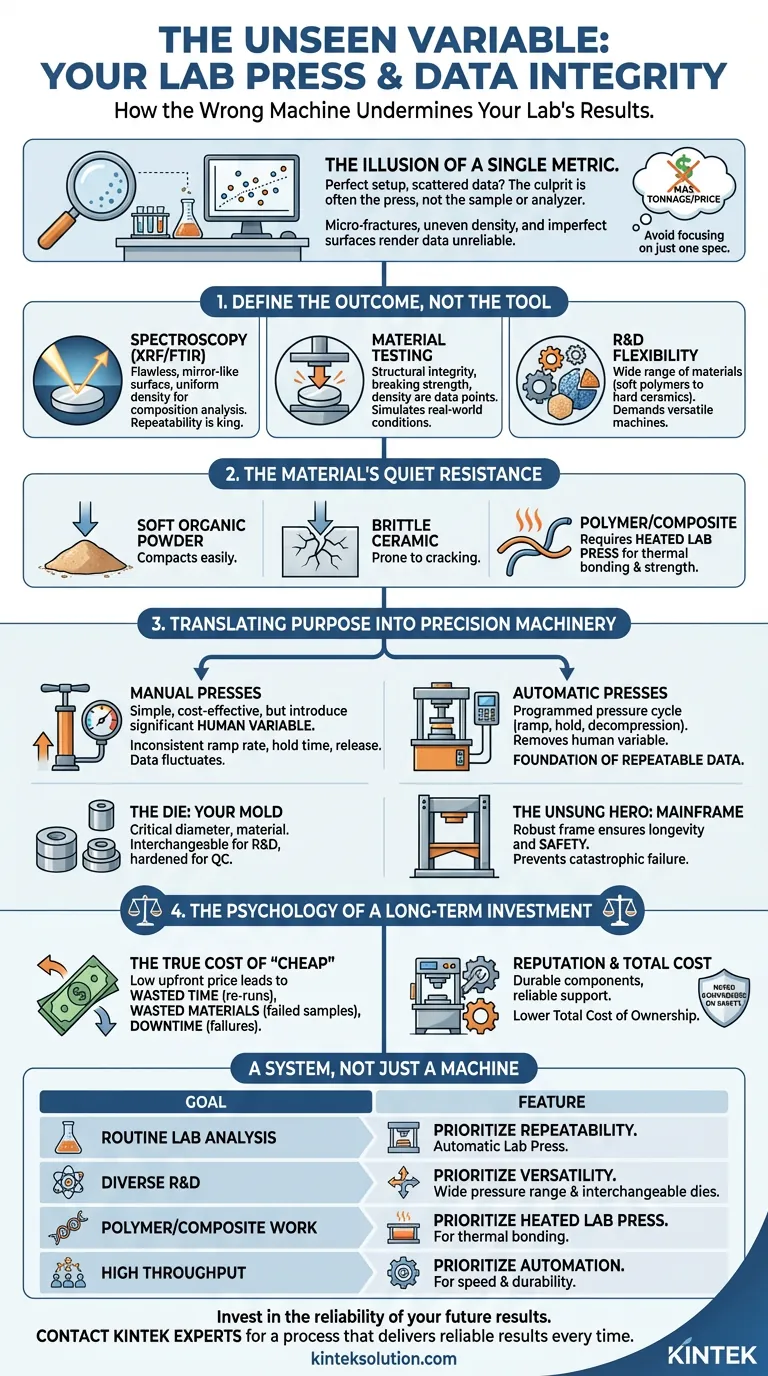
Visual Guide
Related Products
- Laboratory Hydraulic Press 2T Lab Pellet Press for KBR FTIR
- 24T 30T 60T Heated Hydraulic Lab Press Machine with Hot Plates for Laboratory
- Manual Heated Hydraulic Lab Press with Integrated Hot Plates Hydraulic Press Machine
- Laboratory Hydraulic Press Lab Pellet Press Button Battery Press
- Laboratory Hydraulic Pellet Press for XRF KBR FTIR Lab Press
Related Articles
- The Physics of Transparency: Why Pressure is the Silent Architect of Spectroscopic Clarity
- The Architecture of Density: Why Pressure is the Silent Architect of Solid-State Batteries
- The Architecture of Heat: Why Sample Density Dictates the Truth in Metal Hydride Research
- The Geometry of Electrons: Why Surface Precision is the Silent Partner in SECM Research
- The Geometry of Ionic Flow: Why Precision Pressing Dictates Material Truth



















