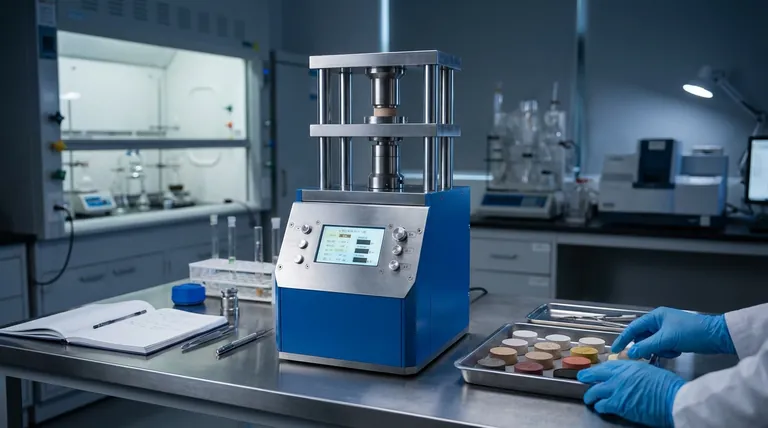
The Illusion of Sameness
Humans are famously bad at consistency.
We try to follow a recipe the same way twice. We attempt to tighten every bolt with the same torque. We strive to repeat an experimental procedure identically. Yet, subtle, unconscious variations creep in. Our focus wanes, our muscles tire, our perception shifts.
In a laboratory, this human variability isn't just a quirk; it's a critical flaw that can invalidate years of research. When preparing a sample, "about the same" is never good enough. We need exactly the same. Every single time.
This is the central problem that a hydraulic press solves. It’s not just a tool for applying force; it’s a system for achieving an almost inhuman level of repeatability.
An Unseen Guarantee: The Law Inside the Fluid
The simple genius of a hydraulic press is that its consistency isn't an optional feature added on top. It's baked into its very core by a fundamental law of physics: Pascal's Law.
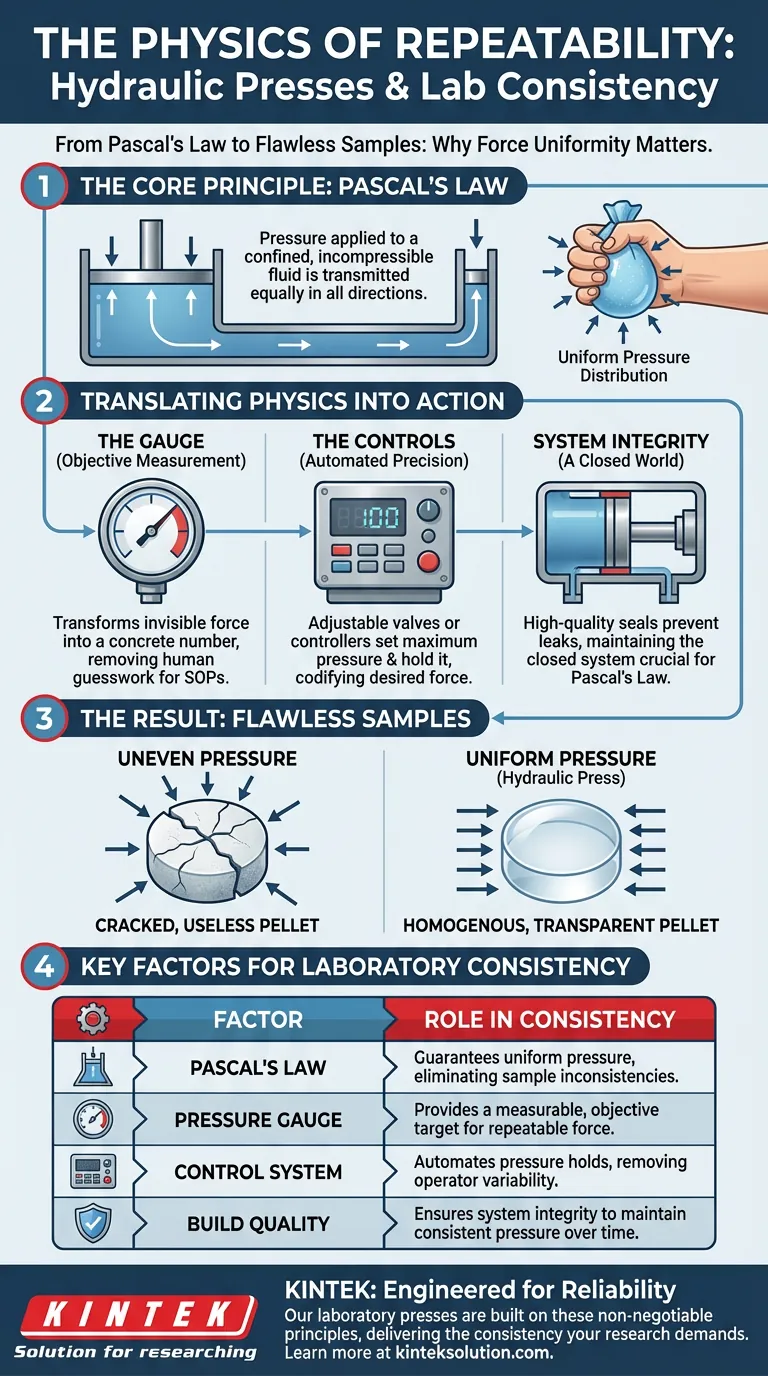
This principle is elegant and absolute. It states that pressure applied to a confined, incompressible fluid is transmitted equally in all directions.
The Water Balloon Principle
Imagine holding a water balloon. When you squeeze one spot, the entire balloon becomes taught. The pressure isn’t just under your fingers; it’s distributed uniformly across the entire inner surface.
A hydraulic press is just a highly engineered, powerful version of this. When the pump pressurizes the hydraulic oil, that pressure pushes on the master piston with perfect uniformity. There are no hot spots, no weak points. Just an even, monolithic wall of force.
From Even Pressure to Flawless Samples
Consider a researcher creating a KBr pellet for FTIR spectroscopy. The sample must be perfectly homogenous and transparent. If the pressure is uneven—stronger in the center than at the edges—the pellet will crack or develop imperfections, rendering the spectral data useless.
The hydraulic press, guided by Pascal's Law, ensures the force applied by the platen is identical across every square millimeter of the die. It’s not trying to be consistent; it cannot be otherwise. Physics guarantees it.
Translating Physics into Repeatable Action
While Pascal's Law provides the potential for perfect uniformity, it’s the engineering controls that allow us to harness it with precision, cycle after cycle.
The Gauge: A Dialogue with Pressure
The pressure gauge is the most critical interface between the operator and the machine. It transforms the invisible, abstract force within the fluid into a concrete, measurable number.
This simple dial removes human guesswork entirely. An operator doesn't need to feel for the right pressure. They simply press until the needle hits a pre-defined mark. This act turns a subjective art into an objective, repeatable science, forming the basis of any Standard Operating Procedure (SOP).
The Controls: Setting Boundaries on Force
Modern laboratory presses, like the automatic models from KINTEK, take this a step further. Adjustable relief valves or electronic controllers allow an operator to set a maximum pressure. The system applies force until it reaches this exact target and then holds it, preventing accidental over-pressurization.
This isn't just a safety feature; it's a guarantee of consistency. It codifies the desired force into the machine itself.
The Integrity of a Closed World
The entire system relies on one crucial condition: it must be a perfectly closed system. High-quality seals, durable hoses, and precisely machined cylinders prevent leaks.
Any leak, no matter how small, is a betrayal of Pascal's Law. It creates a drop in pressure and destroys consistency. The build quality of a press is therefore a direct reflection of its ability to be a reliable scientific instrument.
The Honest Limits of a Physical System
Even a system grounded in physical law has operational boundaries. Understanding them is the mark of a true professional.
- Gauge Calibration: A gauge can be perfectly repeatable but still be inaccurate. For high-stakes research, regular calibration against a known standard is essential. It ensures your repeatable results are also true.
- Thermal Drift: The viscosity of hydraulic fluid can change slightly with temperature. While negligible in most labs, in environments with extreme temperature swings, this can be a factor in ultra-sensitive work.
- Frame Integrity: Under immense tonnage, the steel frame of the press itself can flex on a microscopic level. Premium presses are engineered with extreme rigidity to minimize this, but it’s a factor to consider in applications demanding absolute planarity under high loads.
From Principles to Practice: Choosing Certainty
The challenge in a modern lab is not simply applying force, but eliminating variables. You need a tool that doesn’t add to the noise, but instead provides a stable, repeatable foundation for your work.
This is where understanding the core principles leads to the right choice. Whether you need an automatic lab press for high-throughput quality control, an isostatic press for uniform compaction, or a heated lab press for advanced material science, the underlying demand is the same: absolute control over pressure.
| Key Factor | Role in Laboratory Consistency |
|---|---|
| Pascal's Law | Guarantees uniform pressure, eliminating sample inconsistencies. |
| Pressure Gauge | Provides a measurable, objective target for repeatable force. |
| Control System | Automates pressure holds, removing operator variability. |
| Build Quality | Ensures system integrity to maintain consistent pressure over time. |
At KINTEK, we build our laboratory presses around these non-negotiable principles. Our machines are designed to be a reliable extension of your scientific method, delivering the consistency physics promises and your research demands.
If your work depends on turning variables into constants, we can help you find the right instrument to achieve it. Contact Our Experts
Visual Guide
Related Products
- Automatic High Temperature Heated Hydraulic Press Machine with Heated Plates for Lab
- Manual Heated Hydraulic Lab Press with Integrated Hot Plates Hydraulic Press Machine
- Heated Hydraulic Press Machine with Heated Plates for Vacuum Box Laboratory Hot Press
- Laboratory Hydraulic Press 2T Lab Pellet Press for KBR FTIR
- Laboratory Hydraulic Press Lab Pellet Press Machine for Glove Box
Related Articles
- The Architecture of Slow: Why Physical Precision Dictates Chemical Destiny
- The Architecture of Certainty: Why the Laboratory Press is the Anchor of Material Science
- The Vanishing Boundary: The Hidden Thermodynamics of LTCC Lamination
- The Alchemy of 160°C: Why Precision Pressing is the Silent Backbone of Rubber Science
- The Invisible Forge: Why the Laboratory Press is the Soul of Nano-Composites



















