
The Signal in the Noise
Every lab technician recognizes the feeling. A tray of pellets that are cracked, crumbly, or inconsistent. A machine that hums differently, groans under load, or suddenly falls silent.
Our immediate instinct is to find a single culprit. A blocked die, a loose belt, a bad batch of material. We treat the symptom.
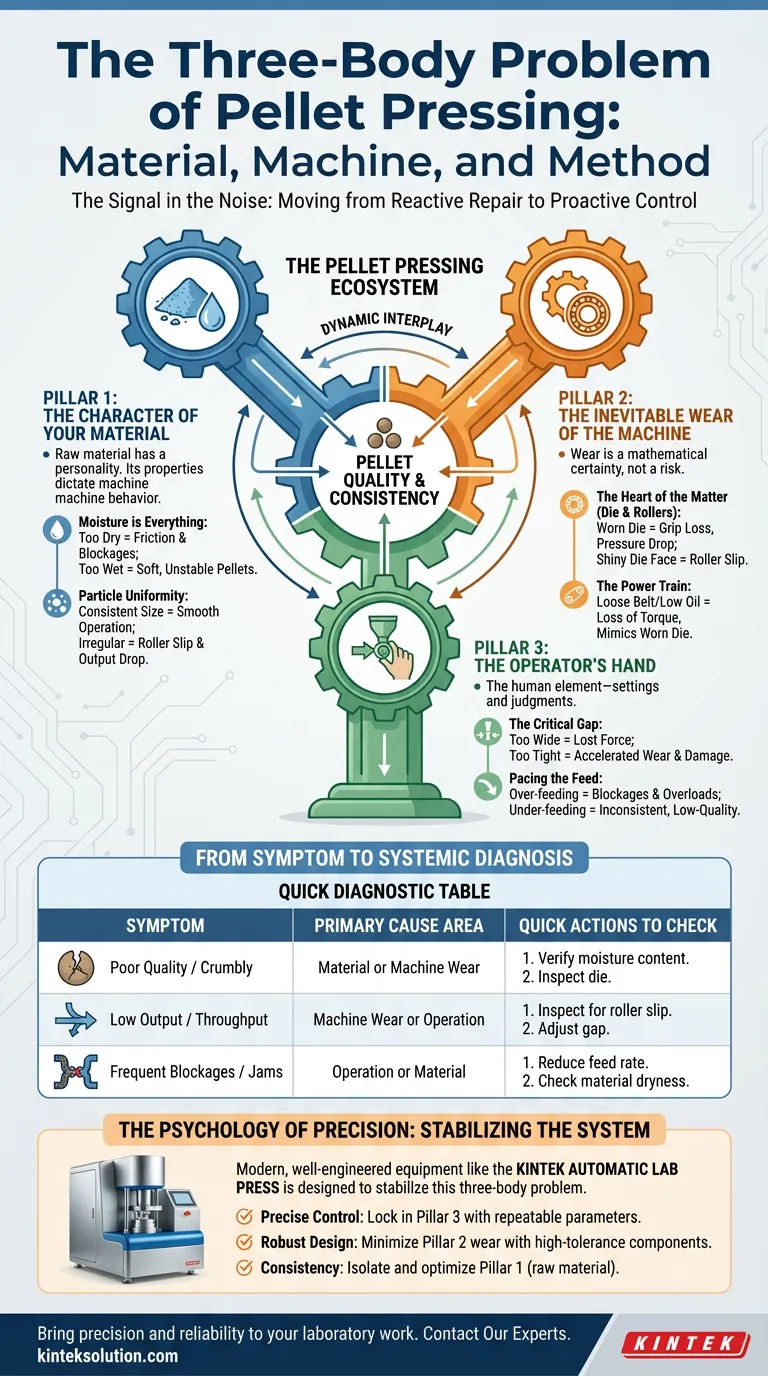
But most failures in a pellet press aren't isolated events. They are signals—the visible result of a deeper imbalance in the system. True mastery of the process comes not from fixing what's broken, but from understanding the constant, dynamic interplay between three core bodies: the material you use, the machine itself, and the method of its operation.
A Framework for Clarity: The Three Pillars
Viewing your press through this three-pillar framework shifts your perspective from reactive repair to proactive control. Nearly every problem can be traced back to an imbalance in one or more of these areas.
Pillar 1: The Character of Your Material
The raw material is not a passive ingredient; it has a personality. Its properties dictate how the machine must behave.
-
Moisture is Everything: This is the most common variable and the most influential. Too dry, and the material creates immense friction, causing blockages and accelerating wear on the die. Too wet, and it cannot form a proper bond, resulting in soft, unstable pellets that crumble under pressure.
-
Particle Uniformity: A consistent particle size is non-negotiable for a smooth operation. Large, irregular particles fail to flow evenly into the die holes. This causes the rollers to slip and slide over the material instead of gripping and extruding it, leading to a dramatic drop in output.
Pillar 2: The Inevitable Wear of the Machine
A laboratory press is a crucible of force. It concentrates immense energy into a very small space. In this environment, wear is not a risk; it is a mathematical certainty that must be managed.
-
The Heart of the Matter (Die & Rollers): The die and rollers are the primary points of contact. As they wear, their precise geometry degrades. The grip diminishes, pressure drops, and the machine begins to slip. A shiny, polished die face is a tell-tale sign that the rollers are sliding, not working.
-
The Power Train: The motor's power is useless if it doesn't reach the rollers. A loose drive belt or low gearbox oil can create a loss of torque that perfectly mimics the symptoms of a worn-out die, sending you on a diagnostic wild goose chase.
Pillar 3: The Operator's Hand
This pillar represents the human element—the settings and judgments you make during operation.
-
The Critical Gap: The gap between the rollers and the die is a game of microns. Too wide, and you lose the necessary compressive force. Too tight, and you create metal-on-metal contact that catastrophically accelerates wear and can destroy bearings.
-
Pacing the Feed: Over-feeding is the single most common cause of blockages. You are forcing more material into the system than it can physically process, leading to motor overloads and die plugs. Under-feeding is equally inefficient, starving the die and producing inconsistent, low-quality pellets.
From Symptom to Systemic Diagnosis
With this three-pillar model, we can diagnose common issues more intelligently.
Symptom: Crumbly or Poor-Quality Pellets
This is fundamentally a failure of compaction.
- First Suspect: Material moisture content. Always.
- Second Suspect: A "tired" die. Over time, the die holes enlarge, reducing the compression ratio. The die may need replacement.
Symptom: Low Output and Throughput
This indicates material isn't being efficiently extruded.
- First Suspect: Roller slip. Check for a polished die surface.
- Second Suspect: Worn-out roller shells or an incorrect roller-to-die gap.
- Third Suspect: Material that is too dry or poorly ground, preventing proper grip.
Symptom: Frequent Machine Blockages
This happens when the required extrusion force exceeds the machine's available force.
- First Suspect: An incorrect feed rate. You're trying to do too much, too fast.
- Second Suspect: Excessive friction in the die, usually from material that is too dry.
The Psychology of Precision
The challenge is that these three pillars are interconnected. A change in material moisture (Pillar 1) may require an adjustment to the feed rate (Pillar 3). A worn-out die (Pillar 2) can make the system far more sensitive to minor material inconsistencies (Pillar 1).
This is where equipment design makes a fundamental difference. Chasing consistency with an imprecise or unreliable machine is a recipe for frustration. You're constantly fighting the machine instead of focusing on the material and process.
Modern, well-engineered equipment like the KINTEK automatic lab press is designed to stabilize this three-body problem.
- Precise Control: They provide exact, repeatable control over operational parameters, effectively locking in Pillar 3.
- Robust Design: Built with high-tolerance components and durable materials, they minimize the variable of machine wear, reinforcing Pillar 2.
- Consistency: By providing a stable and reliable platform, they allow you to isolate and optimize the most important variable: your raw material.
This transforms troubleshooting from a chaotic art into a disciplined science.
Quick Diagnostic Table
| Symptom | Primary Cause Area | Quick Actions to Check |
|---|---|---|
| Poor Quality / Crumbly | Material or Machine Wear | 1. Verify moisture content. 2. Inspect die. |
| Low Output / Throughput | Machine Wear or Operation | 1. Inspect for roller slip. 2. Adjust gap. |
| Frequent Blockages / Jams | Operation or Material | 1. Reduce feed rate. 2. Check material dryness. |
Ultimately, achieving perfect pellets is about bringing a complex system into balance. It requires seeing beyond the immediate symptom and understanding the interconnected forces at play. By mastering the relationship between material, machine, and method, you move from simply operating a press to directing a precise and predictable process.
If you are looking to bring this level of precision and reliability to your laboratory work, we can help you specify the right equipment for your unique challenges. Contact Our Experts
Visual Guide
Related Products
- Laboratory Hydraulic Split Electric Lab Pellet Press
- Laboratory Hydraulic Pellet Press for XRF KBR FTIR Lab Press
- Manual Laboratory Hydraulic Pellet Press Lab Hydraulic Press
- Automatic Laboratory Hydraulic Press Lab Pellet Press Machine
- Automatic Laboratory Hydraulic Press for XRF and KBR Pellet Pressing
Related Articles
- The Physics of Transparency: Why Pressure is the Silent Architect of Spectroscopic Clarity
- The Architecture of Density: Why Pressure is the Silent Architect of Solid-State Batteries
- The Anatomy of Repeatability: Deconstructing the Modern Laboratory Press
- The Physics of Trust: A Disciplined Approach to Laboratory Press Safety and Reliability
- The Geometry of Electrons: Why Surface Precision is the Silent Partner in SECM Research



















