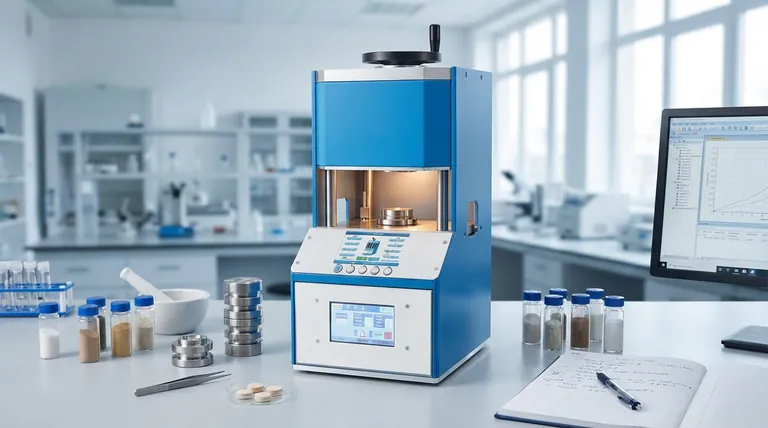
The Illusion of Effortless Force
Imagine a researcher preparing sample pellets for X-ray fluorescence (XRF) analysis. Using a manual screw press, the quality of each pellet depends on their physical state that day. A pellet made on a Monday morning might be perfectly compressed, while one made late on a Friday is subtly different. This isn't a failure of skill; it's a systemic problem rooted in human biology. We are not machines.
This is where the quiet genius of the hydraulic press reveals itself. It’s not just a tool for generating immense force with minimal effort. Its true value, especially in a laboratory, is its ability to eliminate the most unpredictable variable in any process: the human operator.
The press creates an illusion of effortless power by making a simple trade governed by physics: it exchanges a long travel distance for a massive, concentrated force. But more importantly, it makes that force quantifiable and repeatable.
Pascal's Law: The Elegant Engine of Force Multiplication
The entire system is built on a single, elegant scientific principle discovered in the 17th century. Understanding it reveals how simplicity can lead to extraordinary power.
The Principle of Shared Pressure
At its heart is Pascal's Law, which states that pressure applied to a confined, incompressible fluid is transmitted equally throughout that fluid. Think of a sealed water bottle. When you squeeze it, the pressure increases everywhere inside, not just where your fingers are. A hydraulic system harnesses this phenomenon with near-perfect efficiency.
The Anatomy of Amplification
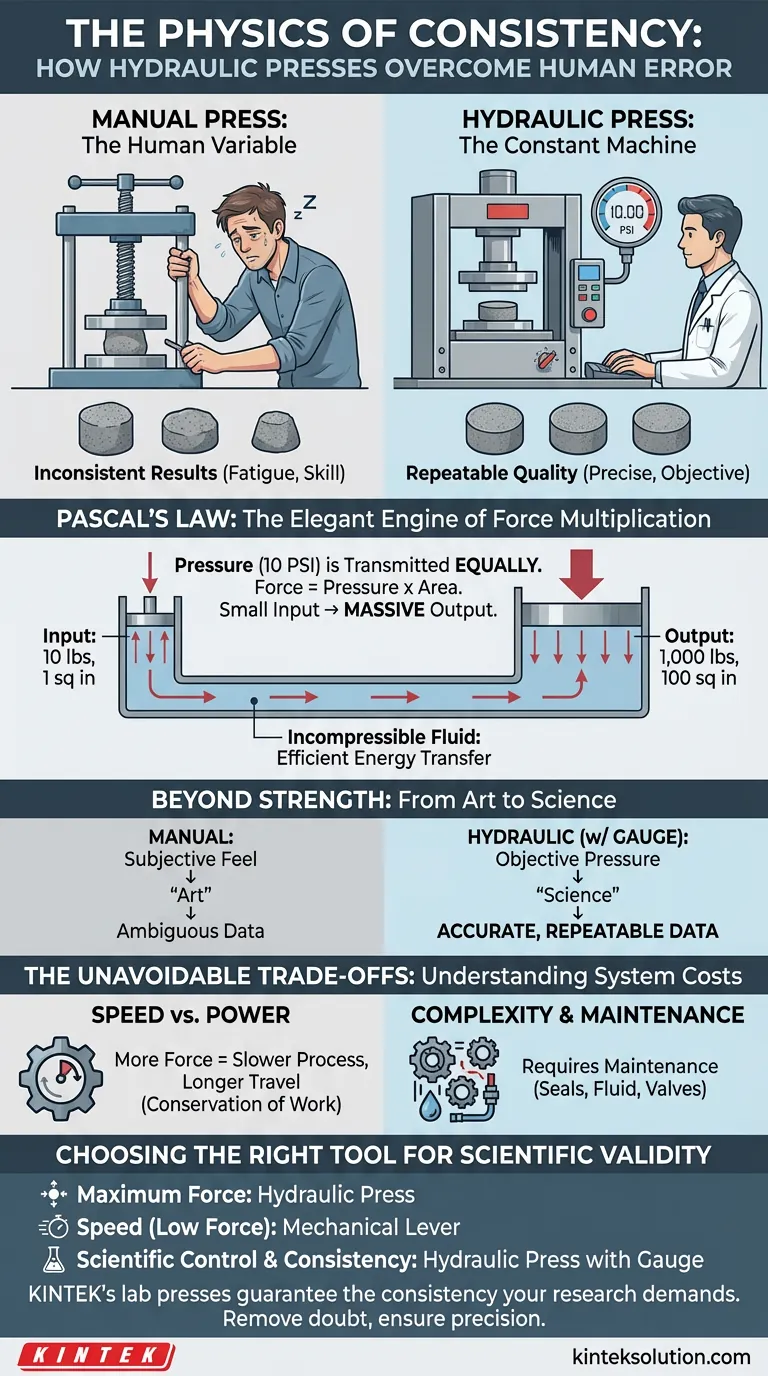
A hydraulic press uses two pistons—a small input piston and a large output piston—connected by a cylinder filled with fluid. Since Pressure = Force / Area, and the pressure is constant throughout the fluid, a small force on the small piston creates the same pressure that acts on the large piston.
Because the output piston has a much larger area, the force it exerts is multiplied proportionally.
- Input: A 10-pound push on a 1-square-inch piston.
- Pressure Created: 10 pounds per square inch (PSI).
- Output: That 10 PSI acts on a 100-square-inch piston.
- Resulting Force: 10 PSI * 100 sq. in. = 1,000 pounds of pressing force.
Your gentle push becomes a crushing force, all thanks to the simple geometry of two cylinders.
The Unsung Hero: An Incompressible Fluid
This elegant exchange only works because hydraulic systems use a fluid, typically oil, that is incompressible. It doesn't shrink or compress under pressure. This property ensures that virtually all the energy you apply to the input piston is transferred directly to the output piston, making the force multiplication incredibly efficient.
Beyond Strength: The Psychology of Repeatability
While the force multiplication is impressive, the most profound benefit in a scientific context is the removal of ambiguity.
Eliminating the "Human Factor"
A manual press doesn't just measure the material; it also measures the operator's strength, fatigue, and focus at that exact moment. A hydraulic press, equipped with a pressure gauge, measures only one thing: the precise, objective pressure being applied.
This transforms the process. It removes a major source of experimental error and the psychological burden of wondering, "Did I press this sample the same way I did yesterday?"
From Art to Science
This shift moves a critical lab procedure from an "art" dependent on individual feel to a "science" governed by measurable parameters. When preparing samples for analysis, consistency isn't just a goal; it's a prerequisite for accurate data. Ensuring every pellet is formed under the exact same pressure is fundamental to the validity of the results. This is where modern laboratory presses truly excel.
The Unavoidable Trade-Offs: Understanding the System's Costs
This powerful capability isn't magic. It adheres to the laws of physics, which always demand a trade-off.
The Conservation of Work: No Free Lunch
The amount of work performed on both pistons must remain the same (Work = Force x Distance). To generate a massive output force over a short distance, you must apply your small input force over a much greater distance. You might pump a lever dozens of time to move the pressing platen by a single inch.
The Deliberate Pace of Power
This relationship creates a direct trade-off between speed and power. A press engineered for extremely high forces will inherently be a slow, deliberate instrument. For applications where precision and control are paramount, this isn't a bug—it's a feature.
The Burden of Complexity
Unlike a simple screw press, a hydraulic system has more components: fluid, seals, lines, and valves. These parts require maintenance and can be points of failure, like fluid leaks or worn seals, that can sideline the equipment.
Choosing the Right Tool for the Scientific Mind
Understanding these principles allows you to choose a tool not just for its strength, but for its alignment with your goals.
- For Maximum Force: The hydraulic press is the undisputed solution.
- For Speed on Low-Force Tasks: A simple mechanical lever might be more efficient.
- For Scientific Validity and Control: A hydraulic press with a pressure gauge is non-negotiable.
Modern systems like KINTEK's automatic and heated lab presses are engineered specifically to solve this challenge, providing the force you need while guaranteeing the consistency your research demands.
The true value of a hydraulic press in the lab is not the effort it saves your body, but the doubt it removes from your mind. It provides a foundation of consistency upon which reliable, repeatable science can be built. If ensuring this level of precision and removing operational variability is critical for your work, it’s time to consider a system designed for that exact purpose. Contact Our Experts
Visual Guide
Related Products
- Automatic High Temperature Heated Hydraulic Press Machine with Heated Plates for Lab
- Manual Heated Hydraulic Lab Press with Integrated Hot Plates Hydraulic Press Machine
- Heated Hydraulic Press Machine with Heated Plates for Vacuum Box Laboratory Hot Press
- Laboratory Hydraulic Press 2T Lab Pellet Press for KBR FTIR
- Laboratory Hydraulic Press Lab Pellet Press Machine for Glove Box
Related Articles
- The Architecture of Slow: Why Physical Precision Dictates Chemical Destiny
- The Architecture of Certainty: Why the Laboratory Press is the Anchor of Material Science
- The Vanishing Boundary: The Hidden Thermodynamics of LTCC Lamination
- The Alchemy of 160°C: Why Precision Pressing is the Silent Backbone of Rubber Science
- The Invisible Forge: Why the Laboratory Press is the Soul of Nano-Composites



















