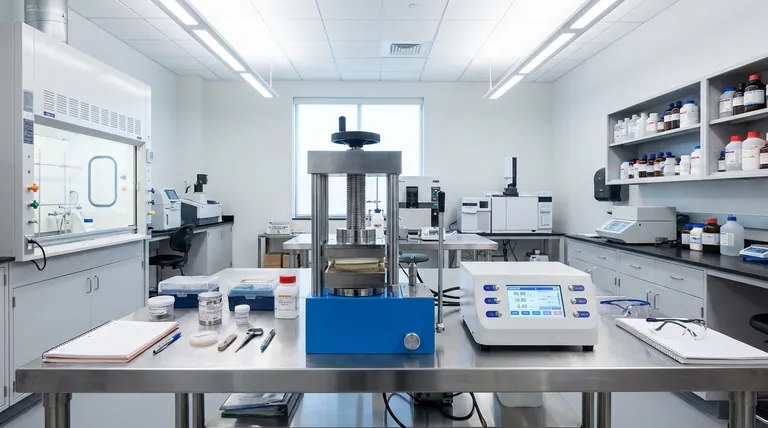
The Ghost in the Machine
Imagine a materials scientist developing a new polymer blend. Day after day, the results from the spectrometer are inconsistent. They re-calibrate the instrument, purify the reagents, and triple-check the protocol. Everything is perfect.
Yet, the data remains erratic.
The problem isn't in the complex chemistry they're studying. It's in the simple physics they're overlooking. Each sample film, prepared by hand, has minute, invisible differences in density and internal stress. The ghost in the machine isn't a flaw in the analyzer; it's the lack of consistency in the physical sample.
This scenario is a quiet crisis in labs everywhere. We are psychologically biased to hunt for complex chemical errors while often ignoring the foundational physical variables. The most crucial of these is force.
The Elegance of Amplified Force
A laboratory press is a device designed to tame this variable. At its heart is a beautifully simple principle: hydraulics.
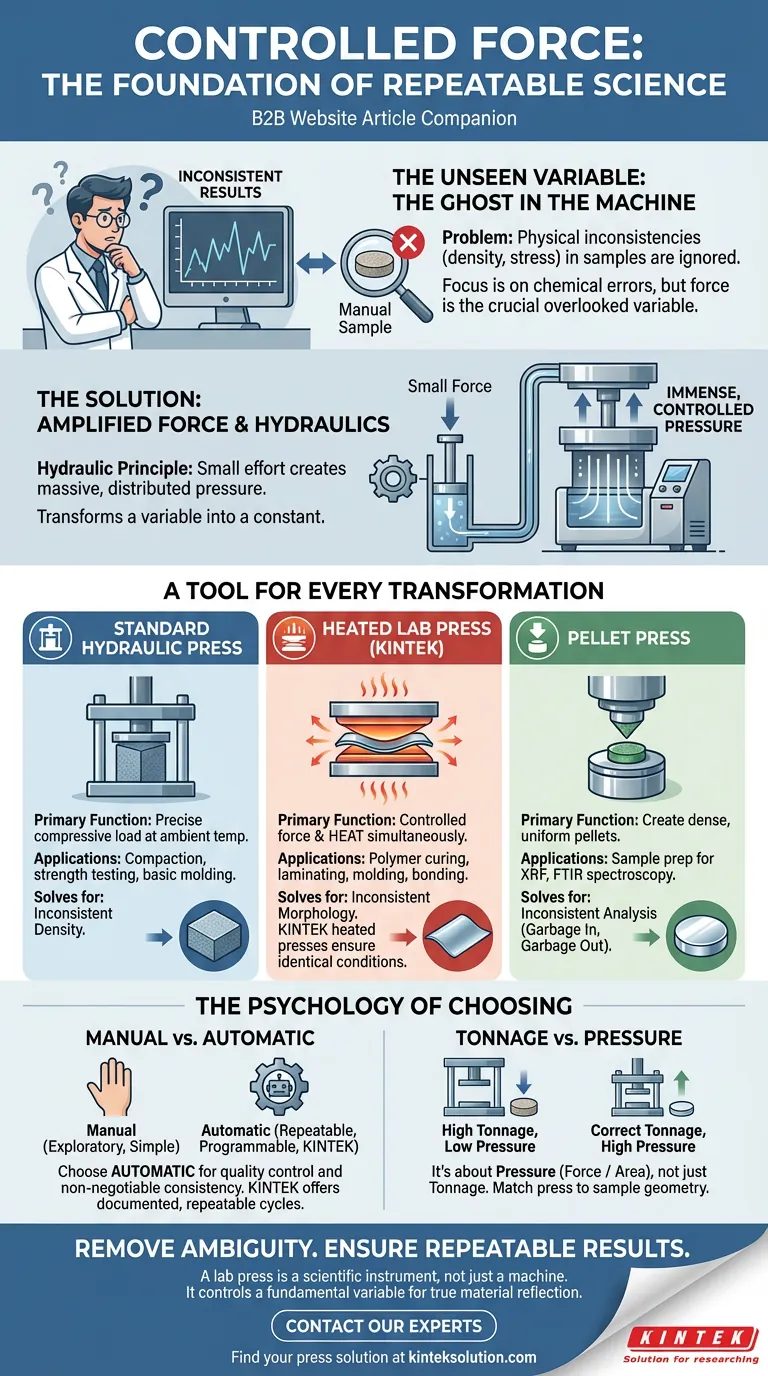
Using an incompressible fluid, a small force applied over a small area generates immense pressure. This pressure, distributed throughout the fluid, then acts on a much larger surface, amplifying the initial effort into tons of controlled, measurable force.
It's an engineer's dream—a simple, elegant solution to the brute-force problem of compressing matter. But its true value isn't just in applying force, but in making that force precise, repeatable, and programmable. It transforms a variable into a constant.
A Tool for Every Transformation
The term "lab press" is broad because the goals of material transformation are diverse. The right tool depends entirely on the problem you are trying to solve.
H2: The Architect of Pressure: The Standard Hydraulic Press
This is the foundational instrument. Its sole purpose is to apply a precise compressive load at ambient temperature. It's the go-to tool for basic compaction, strength testing, or simple molding where heat is not a factor. It is the first and most critical step away from the unreliability of manual preparation, ensuring every sample experiences the same consolidation force.
H2: When Heat is the Catalyst: The Heated Lab Press
For many materials, especially polymers and composites, pressure alone is not enough. Transformation requires energy. A heated press integrates high-precision heating elements into its platens, allowing for simultaneous control over both temperature and pressure.
This dual control is essential for:
- Curing thermosetting polymers.
- Laminating composite materials.
- Molding thermoplastics into thin films or complex shapes.
- Bonding materials with heat-activated adhesives.
For the scientist in our opening story, a heated press like those from KINTEK would be the solution. It allows for programmed cycles that ensure every polymer film is cured under identical conditions, eliminating the physical inconsistencies that plagued their results.
H2: The Pursuit of Analytical Purity: The Pellet Press
We trust our multi-million dollar analytical instruments, but their accuracy is entirely dependent on the quality of the sample we feed them. For techniques like X-Ray Fluorescence (XRF) and Infrared (FTIR) spectroscopy, this means creating a dense, uniform, and perfectly smooth pellet from a powder.
A specialized pellet press is designed for this single, critical task. It removes the human variable to create identical pellets every time, ensuring that the only thing the spectrometer measures is the material's true chemical signature. It's the embodiment of the "garbage in, garbage out" principle.
The Psychology of Choosing the Right Control
Selecting a press isn't just a technical decision; it's a choice about what variables you need to control.
H3: Repeatability vs. Manual Intervention: Automatic vs. Manual
- Manual Presses: Offer simplicity and a tactile connection to the process. They are excellent for exploratory work where parameters are still being discovered.
- Automatic Presses: Are built for repeatability. By programming the force, time, and temperature, you eliminate human error. They are essential for quality control, validation, and any R&D where process consistency is non-negotiable. KINTEK's automatic lab presses are engineered specifically for this need, providing documented, repeatable cycles you can trust.
H3: The Language of Force: Tonnage vs. Pressure
It's easy to be impressed by high tonnage (the total force). But what the sample actually experiences is pressure (force per unit area). A 25-ton press with large platens might deliver less pressure to your small sample die than a 10-ton press with smaller platens.
Understanding this distinction is critical. You must match the press's capabilities not just to the force you need, but to the pressure required by your sample's specific geometry.
| Press Type | Primary Function | Key Applications | Solves for... |
|---|---|---|---|
| Standard Hydraulic | Applies controlled force | Material compaction, strength testing | Inconsistent Density |
| Heated Press | Applies controlled force & heat | Polymer curing, composite lamination | Inconsistent Morphology |
| Pellet Press | Compresses powders into pellets | Sample prep for XRF, FTIR | Inconsistent Analysis |
Ultimately, a laboratory press is more than a machine for squishing things. It is a scientific instrument designed to control a fundamental physical variable. By doing so, it removes ambiguity and ensures that your results are a true reflection of your material, not an artifact of its preparation.
Whether you are battling inconsistency in polymer films or ensuring purity for spectroscopic analysis, having the right instrument is the first step. To find the press that matches your material transformation goals, Contact Our Experts.
Visual Guide
Related Products
- 24T 30T 60T Heated Hydraulic Lab Press Machine with Hot Plates for Laboratory
- Manual Heated Hydraulic Lab Press with Integrated Hot Plates Hydraulic Press Machine
- Laboratory Hydraulic Pellet Press for XRF KBR FTIR Lab Press
- Lab Infrared Press Mold for Laboratory Applications
- Laboratory Hydraulic Press Lab Pellet Press Machine for Glove Box
Related Articles
- The Invisible Forge: Why the Laboratory Press is the Soul of Nano-Composites
- The Architecture of Slow: Why Physical Precision Dictates Chemical Destiny
- The Architecture of Density: Why Pressure is the Silent Architect of Solid-State Batteries
- The Physics of Transparency: Why Pressure is the Silent Architect of Spectroscopic Clarity
- The Architecture of Certainty: Why the Laboratory Press is the Anchor of Material Science



















