The Variable Trap
In the laboratory, we often chase the "perfect" chemical formula. We obsess over nutrient ratios and polymer coatings. Yet, the most sophisticated chemistry will fail if the physical delivery system is erratic.
In the world of controlled-release fertilizers (CRFs), the enemy is inconsistency. A tablet that is too porous releases its payload in a flash-flood; one that is too dense might never release at all.
Without a heated hydraulic press, a researcher isn't just testing chemistry—they are testing the randomness of air pockets and structural defects.
Geometry as a Gatekeeper
The speed of nutrient release is governed by a fundamental law of physics: the surface area-to-volume ratio.
If two tablets have the same mass but one is 0.1mm thicker than the other, their release profiles will diverge. To isolate the effectiveness of a new fertilizer coating, every sample must be a twin.
The Precision Mandate
- Dimensional Accuracy: Achieving exact diameters (e.g., 9.4 mm) and thicknesses (e.g., 1.3 mm).
- Repeatability: Producing hundreds of identical samples to ensure data reflects the formula, not the forming process.
- Predictability: Allowing for mathematical modeling of how moisture will penetrate the pellet over weeks or months.
The Thermal Handshake
Pressure alone is a blunt instrument. When working with bio-polymers or wax-based binders, brute force often leads to "capping" or "lamination"—the tablet splitting into horizontal layers like a poorly made biscuit.
Heat changes the physics of the bond. By applying controlled temperatures between 60°C and 90°C, we soften the composite materials.
Why Heat is Non-Negotiable
- Molecular Interlocking: Thermal energy allows binders to flow into the microscopic crevices of the mineral nutrients.
- Air Elimination: Heat reduces the friction between particles, allowing the hydraulic force to push out residual air that causes structural failure.
- Cohesive Integrity: It transforms a loose powder into a monolithic solid that can survive handling and soil pressure.
Tuning the Kinetics of Density
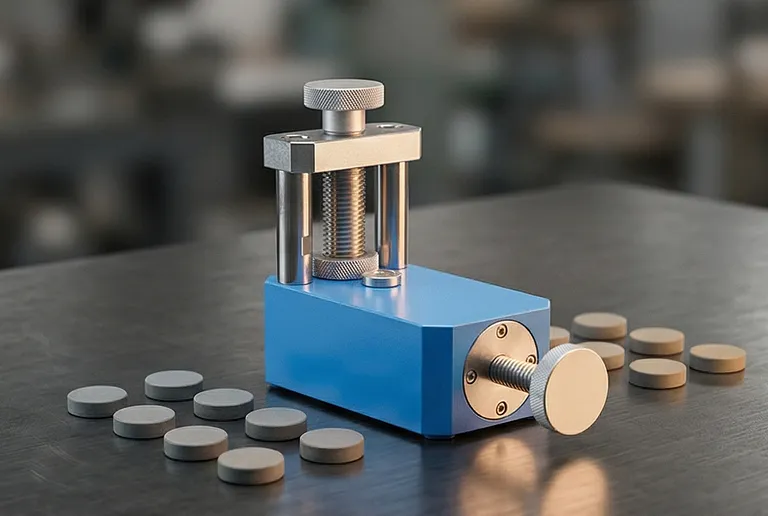
If geometry is the gatekeeper, density is the tuning fork. By adjusting the hydraulic pressure, a researcher can calibrate the internal porosity of the tablet.
Low Density invites water in quickly. It is the "fast-slow" release. High Density creates a fortress. It is the "extended-slow" release.
This level of control allows engineers to "tune" the fertilizer for specific environments—from the sandy soils of a coastal farm to the heavy clays of the interior.
The Engineer’s Balance: Risk vs. Result
Precision requires an awareness of the boundaries. Like any powerful system, the heated press involves trade-offs that require a disciplined approach.
| Key Feature | Impact on Fertilizer Tablets | Critical Parameters |
|---|---|---|
| Geometric Precision | Standardizes surface area-to-volume ratio | Diameter & Thickness |
| Controlled Heat | Softens binders for molecular bonding | 60–90 °C |
| High Pressure | Eliminates air pockets and prevents lamination | Compressive Force |
| Density Control | Regulates internal porosity for release tuning | Pressing Density |
Avoiding Performance Decay
- Thermal Limits: Exceeding the 90°C threshold can degrade organic binders or volatile nutrients.
- Brittleness: Excessive pressure can create a glass-like state, making the tablet prone to shattering during transport.
- Compressibility: Every material has a unique "recipe." Success depends on finding the specific intersection of force and heat.
Standardizing the Lab Environment
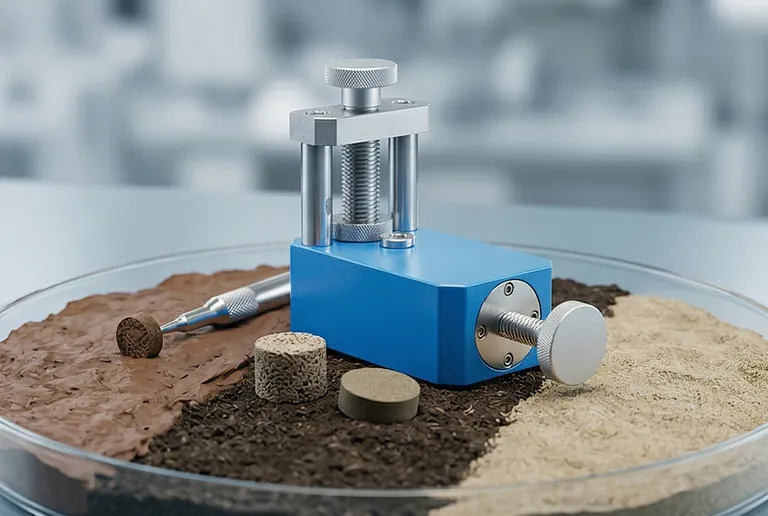
In research, the most valuable asset is "clean" data. Total control over the pressing environment ensures that when a nutrient release curve shifts, the researcher knows exactly why.
KINTEK provides the infrastructure for this level of certainty. From manual models for artisanal small-batch testing to fully automatic and isostatic systems for high-throughput battery and agricultural research, we eliminate the physical variables that compromise scientific integrity.
Whether your work requires the delicate touch of a heated press or the uniform density of an isostatic system, your results depend on the stability of your equipment.
Related Products
- Heated Hydraulic Press Machine with Heated Plates for Vacuum Box Laboratory Hot Press
- Automatic High Temperature Heated Hydraulic Press Machine with Heated Plates for Lab
- Heated Hydraulic Press Machine With Heated Plates For Vacuum Box Laboratory Hot Press
- 24T 30T 60T Heated Hydraulic Lab Press Machine with Hot Plates for Laboratory
- Automatic Heated Hydraulic Press Machine with Heated Plates for Laboratory
Related Articles
- The Architecture of Certainty: Why the Laboratory Press is the Anchor of Material Science
- The Vanishing Boundary: The Hidden Thermodynamics of LTCC Lamination
- The Alchemy of 160°C: Why Precision Pressing is the Silent Backbone of Rubber Science
- The Invisible Forge: Why the Laboratory Press is the Soul of Nano-Composites
- Beyond Tonnage: A First-Principles Guide to Selecting a Laboratory Hot Press



















