Automated Electric Lab Presses for Consistent XRF Pellet Preparation
Accurate XRF analysis begins before the sample enters the spectrometer. The quality, density, surface condition, thickness, and physical uniformity of a pressed pellet can all influence measurement repeatability and confidence in the reported composition. KINTEK electric lab presses are designed to bring greater control to this critical sample-preparation stage. By combining electrically managed hydraulic force with PLC-based automation, these systems help laboratories prepare reproducible pellets while reducing dependence on individual operating technique.
An electric lab press is especially valuable where many samples must be prepared under the same validated conditions. In manual pressing, even experienced users may apply different dwell times, vary the pressure ramp, release pressure too quickly, or demold samples inconsistently. These small differences can affect pellet integrity and analytical response. Automated pressing recipes make the workflow more stable: the laboratory can define the force, hold time, release behavior, and demolding cycle, then repeat that sequence from sample to sample. The result is a more dependable foundation for XRF sample preparation, method development, incoming-material inspection, production control, and research.
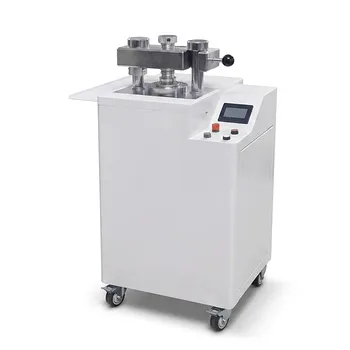
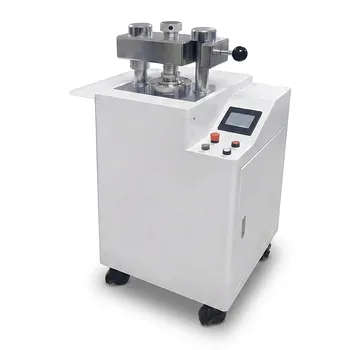
KINTEK's automatic XRF pellet presses are suited to laboratories that need a practical balance of high pressing force, repeatable operation, and straightforward control. The automatic fluorescence sample preparation press provides up to 40 tons of pressing capacity for producing compacted powder pellets with the density and mechanical strength needed for spectroscopic testing. For many routine XRF applications, this level of force supports the formation of robust pellets from mineral powders, industrial raw materials, cement-related materials, ceramics, metal powders, pigments, catalysts, battery powders, and other prepared samples. Actual pressing conditions should always be established for the material, particle-size distribution, moisture condition, binder system, and analytical method in use.
Why Pellet Consistency Matters in XRF Workflows
XRF is widely used because it provides rapid, non-destructive elemental analysis across a broad range of materials. However, the instrument measures the sample presented to it. A pellet with voids, edge fractures, surface defects, density gradients, or poor particle binding may introduce variation that is unrelated to the material's true composition. This can complicate calibration, increase replicate testing, and make it harder to distinguish actual process variation from sample-preparation variation.
A well-prepared pressed pellet offers several operational benefits:
- More uniform sample geometry: A flat, even pellet surface provides a stable presentation face for measurement and helps make sample positioning more repeatable.
- Improved compactness: Adequate compaction reduces loose powder and can improve handling strength, storage, and transfer between the press and spectrometer.
- Reduced cracking and lamination: A controlled pressure profile and gradual decompression can help minimize defects caused by trapped air, elastic recovery, moisture, unsuitable binder levels, or abrupt pressure release.
- Better repeatability between samples: Standardized recipes reduce operator-to-operator and shift-to-shift differences, which is essential for quality systems and routine production testing.
- Cleaner, more efficient workflows: Automatic demolding reduces manual handling steps and helps laboratories process series of samples more efficiently.
The purpose of pressing is not merely to create a pellet that looks acceptable. It is to create a specimen with physical properties that are sufficiently consistent for the analytical method. Pressing cannot correct an unrepresentative, contaminated, or poorly homogenized powder; sound sample preparation still requires appropriate drying, crushing, grinding, sieving or milling where needed, blending, and binder selection. What an automated electric press does is make the final compaction stage controlled, documented, and repeatable.
PLC Touchscreen Control for Repeatable Pressing Recipes
KINTEK automatic electric lab presses use PLC touchscreen control to simplify operation while retaining the precision needed in analytical laboratories. Rather than relying on subjective hydraulic adjustment, users can operate defined press programs and repeat established parameters. This is useful for facilities handling several material types, each of which may require its own pressing method.
A typical automated cycle can include sample loading, pressurization, a dwell or hold period, controlled pressure reduction, and demolding. The exact sequence is important. During initial compaction, powder particles rearrange and begin to form a dense structure. As pressure increases, particle contact grows and the binder, if used, helps develop pellet cohesion. Holding the target force for an appropriate period can support more uniform stress distribution and consolidation. A carefully managed release then reduces the risk that the pellet will crack, cap, laminate, or break apart as internal stresses relax.
The touchscreen interface also contributes to everyday laboratory usability. Operators can use the system with less reliance on manual force control, while supervisors can establish a common process for routine jobs. This is particularly beneficial when laboratories must maintain consistency across multiple technicians, operate through multiple shifts, or transfer a proven method from R&D to a quality-control environment. Clear, repeatable settings support training, help reduce avoidable setup errors, and make it easier to investigate a result when a sample falls outside expectations.
For high-throughput laboratories, automation improves more than convenience. It helps make cycle timing predictable. When pressing, pressure holding, slow release, and demolding follow a controlled program, laboratory personnel can organize sample batches more effectively and spend less time performing repetitive mechanical actions. This supports faster turnaround without treating sample integrity as an afterthought.
Controlled Pressure Release Helps Protect Fragile Pellets
Pressure application receives much of the attention in powder compaction, but decompression is equally important. Many analytical powders contain entrained air, have differing elastic recovery behavior, or form layered structures under load. Releasing pressure too quickly can cause the compact to expand unevenly, producing radial cracks, surface flaking, internal lamination, or complete pellet failure. A pellet may appear intact initially but develop defects that compromise handling or analysis.
KINTEK presses incorporate advanced slow pressure release as part of the automated process. By reducing pressure in a controlled manner, the system helps the compact equilibrate more gradually. This is especially valuable for powders that are difficult to bind, materials with a broad particle-size distribution, brittle mineral samples, and formulations with low or changing binder content. Controlled release does not replace correct process development, but it gives laboratories an important tool for improving yield and obtaining a more reliable pellet surface.
A successful pellet-preparation method usually considers the full sequence:
- Sample representativeness: Collect and reduce the material in a way that reflects the bulk sample.
- Powder conditioning: Control particle size, moisture, homogeneity, and contamination according to the analytical protocol.
- Binder and additive selection: Use a suitable binder or backing strategy where the method requires it, keeping ratios consistent.
- Die and tooling preparation: Select the correct die size and keep contact surfaces clean to support easy ejection and a sound pellet face.
- Press force and dwell: Apply sufficient force and time to create a mechanically stable compact without using arbitrary settings.
- Slow decompression and demolding: Release load and eject the pellet in a controlled sequence to reduce damage.
- Inspection and measurement: Check surface quality and pellet integrity before introducing the sample to the spectrometer.
This disciplined approach turns the press from a simple force-generating device into a repeatability tool within the laboratory's analytical workflow.
40-Ton Capacity for Dense, Reliable Laboratory Pellets
The 40-ton automatic fluorescence sample preparation press is built for laboratories that require substantial, consistent compression for XRF pellets. Ton-level force should be considered alongside pellet diameter and material behavior, because the relevant compaction parameter is pressure at the sample area rather than tonnage alone. A properly selected die and a validated force setting allow laboratories to create suitable pressure conditions for their specific powder and pellet dimensions.
High-force hydraulic pressing can promote particle rearrangement and packing, enhance mechanical interlocking, and support binder-assisted cohesion. With the right formulation and procedure, this helps create dense pellets that resist crumbling during removal, transport, and placement in analytical equipment. A stable pellet is easier to handle and more likely to present a consistent surface to the instrument. This can be particularly important in industrial environments where repeat analyses and delayed reporting create real operational costs.
At the same time, more force is not automatically better. Excessive pressure can damage some materials, accelerate tooling wear, complicate ejection, or create stress that emerges during release. The correct approach is method optimization: start from material-appropriate reference conditions, assess pellet quality and analytical repeatability, then refine force, dwell, binder ratio, and release parameters. KINTEK can support users in selecting a press configuration and operating approach that align with the nature of their samples and the requirements of their analytical workflow.
Applications Across Materials Research and Industrial Quality Control
Electric lab presses support a broad range of sample-preparation programs wherever powders must be transformed into repeatable analytical specimens. Common use cases include:
- Mining and geology: Preparation of ores, concentrates, rocks, soils, and mineral powders for elemental screening and grade-control analysis.
- Cement, lime, and construction materials: Routine XRF analysis of raw meal, clinker, kiln feed, additives, and finished products to support process control.
- Metallurgy and powder metals: Testing of alloys, metal powders, slags, refractories, and process residues in research and production environments.
- Ceramics and glass: Analysis of ceramic raw materials, pigments, glazes, oxides, and glass-forming compounds where compositional control affects final performance.
- Battery and advanced materials: Characterization of cathode and anode powders, conductive additives, recycled active materials, precursor materials, and other research samples requiring standardized preparation.
- Chemical and catalyst research: Screening of inorganic compounds, catalyst powders, process chemicals, and solid residues for elemental composition.
- Academic laboratories: Teaching and research programs that require accessible, repeatable compaction methods for materials characterization.
For battery-material researchers, reproducible powder preparation is especially relevant. Variations in precursor composition, active-material batches, recovered materials, and process residues can influence electrochemical performance and manufacturing decisions. XRF is often used as part of a wider characterization workflow, alongside particle-size analysis, phase identification, moisture measurement, and electrochemical testing. A dependable pellet press helps ensure that changes observed in the data are more likely to reflect the sample rather than inconsistent compaction.
Benchtop and Floor-Standing Press Considerations
Laboratory presses can be configured as benchtop or floor-standing systems depending on required capacity, facility layout, sample volume, and workflow integration. Compact benchtop equipment can be well suited to research laboratories and localized sample-preparation stations where available space is limited. Floor-standing systems are often considered when laboratories require higher force, a larger working envelope, or a dedicated high-volume preparation area.
Across lab press designs, force capacity may range from approximately 15 tons to more than 100 tons. Some press systems also use heated platens, with operating temperature ranges that can extend from about 600°F to 1200°F, for applications involving thermal consolidation, lamination, polymer processing, curing, or hot pressing. The automated XRF pellet presses in this category are focused on controlled powder compaction and sample preparation. When your process requires heating as well as pressing, KINTEK can help determine whether a heated press, a different platen arrangement, or a specialized tooling configuration is more appropriate.
Selection should be based on the actual analytical method and sample workflow, not force rating alone. Useful questions include: What pellet diameter and thickness are required? Which powders are being compacted? Is a binder used? How many pellets are prepared each day? Must several pressing recipes be stored or reproduced? Is automatic demolding needed to improve throughput? Does the laboratory need to accommodate unusual die geometries, heated pressing, or future expansion into other materials-processing work? Answering these questions early helps ensure that the chosen press supports both current testing needs and future laboratory development.
Designed for Reliable Laboratory Operation
A laboratory press is frequently used in repetitive, high-consequence work. Its value lies in the ability to deliver the same controlled mechanical cycle over and over while remaining practical for technicians to operate. KINTEK emphasizes hydraulic reliability, automated cycle control, and user-oriented operating interfaces so that the press can become a dependable part of routine sample preparation.
Automatic demolding is an important productivity feature. Manual removal can expose pellets to unnecessary handling and may become a bottleneck when many samples are processed. An integrated automatic demolding cycle improves workflow continuity and can make the process more consistent, particularly for users who are preparing similar pellet types repeatedly. It also allows technicians to focus on weighing, labeling, recording, and preparing the next sample rather than applying force manually at every stage.
Good operating practice remains essential. Users should follow established laboratory safety procedures, select tooling rated for the intended load, keep dies and press surfaces clean, use appropriate personal protective equipment, and inspect pellets before analysis. Pressing parameters should be validated with representative materials, especially when sample composition, moisture content, particle morphology, or binder type changes. These practices protect both data quality and equipment performance.
Custom Support for Your Sample-Preparation Method
No two laboratories have exactly the same specimens, sampling plans, throughput targets, or reporting requirements. A press that performs well for a finely ground oxide powder may need a different cycle for a ductile metal powder, a heterogeneous geological material, or a moisture-sensitive battery precursor. KINTEK provides professional laboratory equipment support with attention to the details that make a method work in practice.
Our team can help you assess pressing force, tooling size, automation requirements, sample dimensions, and the role of controlled decompression in your process. We can also discuss customized configurations for specialized workflows, including application-specific dies, pressing procedures, capacity requirements, integration needs, and equipment features that support your laboratory's operating standards. Whether you are establishing a new XRF sample-preparation line, replacing a manual press, expanding industrial quality control, or developing a material-specific compaction protocol, we can help define a solution around your real samples rather than a generic specification.
Contact KINTEK to discuss your electric lab press requirements and request a tailored recommendation. Share your sample type, pellet dimensions, target throughput, existing analytical method, and any challenges with cracking, inconsistent density, or manual processing. Our specialists will help you identify an automated XRF pellet press and suitable configuration that support repeatable results, efficient operation, and long-term laboratory productivity.