Improve Electrode Coating Quality with Controlled Battery Slurry Filtration
Battery electrode slurry is not simply a mixture of active material, conductive additive, binder, and solvent. It is the process medium that determines whether a carefully designed formulation can be converted into a uniform, reliable electrode. Even when mixing parameters, dispersion quality, solids loading, and rheology appear acceptable, the slurry may still contain hard particles, incompletely dispersed agglomerates, foreign debris, or metallic contaminants. If these materials reach the coating head, they can create streaks, scratches, pinholes, local thickness variation, blocked coating gaps, and defects that affect both process yield and electrochemical performance.
KINTEK battery slurry filtration systems are designed to provide a practical, controlled filtration stage before electrode coating. They support laboratory teams, battery developers, universities, materials research institutes, and pilot-line engineers who need clean, repeatable slurry preparation for lithium-ion battery electrodes and related advanced-material coatings. From compact batches used for formulation development to larger 5 L research and pilot batches, the systems in this category provide filtration and, where required, magnetic iron removal in durable stainless-steel processing assemblies.
Why filtration matters before battery electrode coating
The battery manufacturing workflow places increasing demands on slurry cleanliness. High-energy-density electrode formulations often use fine powders with high surface area, conductive carbon materials, polymeric binders, and carefully balanced solvent systems. These components must be dispersed without introducing contaminants or leaving large particles that may disrupt the coating process. In a research environment, the risk can be especially high because teams frequently change formulations, use different powders, evaluate new suppliers, and move between small-scale trials and pilot-scale batches.
A filtration step gives the process team a defined quality-control point between slurry mixing and coating. It can help remove particles larger than the selected mesh opening, capture hard agglomerates that remain after mixing, and protect downstream equipment. This is valuable for slot-die coating, doctor-blade coating, film casting, and other electrode fabrication methods where a smooth, consistent slurry feed is essential.
Typical reasons to filter battery slurry include:
- Removing oversized active-material particles or hard agglomerates before coating.
- Protecting coating heads, pumps, hoses, valves, and narrow process passages from blockage or abrasion.
- Reducing the chance of visible coating defects such as lines, scratches, drag marks, surface protrusions, and uncoated areas.
- Supporting a more uniform wet film and a more consistent dry electrode layer.
- Helping researchers compare formulations under more controlled processing conditions.
- Reducing the effect of accidental debris introduced during powder handling, mixing, transfer, or cleaning.
- Capturing ferromagnetic contaminants when magnetic separation is used alongside conventional filtration.
- Establishing a repeatable slurry-release procedure for laboratory and pilot production records.
Filtration does not replace appropriate powder selection, controlled mixing, dispersion development, or clean working practices. Instead, it complements them. A well-designed slurry process uses mixing to disperse materials, rheology control to achieve the required coating behavior, and filtration to provide a final barrier against particles or contaminants that could degrade the coated electrode.
Two filtration approaches for different laboratory workflows
KINTEK offers battery slurry filtration equipment suited to different batch volumes and contamination-control requirements. Selecting the appropriate system depends on the amount of slurry being processed, the selected filtration specification, whether magnetic contamination is a concern, and how the filter will fit into the existing mixing and coating workflow.
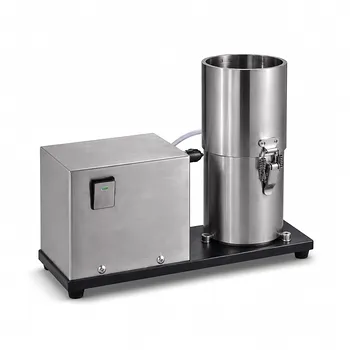
Compact laboratory battery slurry filter
The laboratory battery slurry filtration device is intended for smaller research samples and frequent formulation iterations. Its approximately 500 mL processing capacity makes it suitable for early-stage cathode or anode screening, process optimization, coin-cell research, and sample preparation before small-format coating trials.
This compact system uses a stainless-steel filtration structure and vacuum assistance to help move slurry through the selected mesh while maintaining a manageable laboratory setup. The listed 124-micron filtration capability is suitable for applications where the objective is to remove comparatively large hard particles and agglomerates before coating. Flexible mesh options allow users to select a filtration condition appropriate to the slurry formulation and process requirement.
For battery researchers, a compact filter can be particularly useful when many formulations must be evaluated in a limited time. Rather than treating filtration as an inconsistent manual step, the team can use a defined device, mesh condition, and operating method for each batch. This supports more meaningful comparison between samples because coating outcomes are less likely to be influenced by uncontrolled oversized particles.
The compact laboratory filter can support workflows such as:
- Cathode slurry preparation for lithium iron phosphate, layered oxide, manganese-based, or other electrode-material studies.
- Anode slurry preparation for graphite, silicon-containing, lithium titanate, and other negative-electrode formulations.
- Binder and conductive-additive dispersion trials.
- Coating trials for coin cells, pouch-cell development, and small electrode sheets.
- Incoming-material evaluation and formulation troubleshooting.
- Preparation of clean slurry samples for rheology, coating, or microscopy-related process studies.
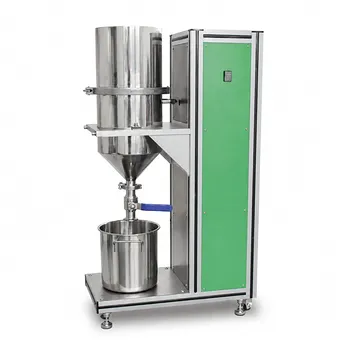
5 L laboratory slurry iron removal filtration system
For larger laboratory batches and pilot-scale electrode work, the 5 L slurry iron removal filtration system combines vacuum filtration with high-intensity magnetic separation. This configuration is designed for projects where both particle control and ferromagnetic contamination control are important before electrode coating.
The system is specified with magnetic separation strength in the 8000 to 10000 gauss range. High-intensity magnetic separation can help capture iron-containing or other ferromagnetic contaminants that may enter the slurry from raw materials, wear surfaces, mixing components, transfer tools, or the surrounding work environment. The magnetic stage works alongside the filter mesh: the mesh provides physical size-based separation, while the magnetic section targets magnetically responsive contamination. These are complementary mechanisms, not interchangeable ones.
A 5 L capacity is well suited to teams moving beyond very small samples and preparing sufficient slurry for broader coating studies, parameter optimization, pilot-line validation, or multiple electrode batches. The stainless-steel construction supports a robust processing environment and is designed with cleanability in mind, which is important when switching between chemistries or maintaining a documented laboratory process.
Potential uses include:
- Pilot-scale lithium-ion electrode slurry preparation before coating.
- Larger cathode and anode formulation batches for process-development studies.
- Slurry cleanup before coating trials that use longer electrode sheets or repeated coating runs.
- Investigation of contamination-related coating defects.
- Development of filtration and magnetic-cleaning procedures for transfer from R&D toward pilot production.
- Materials research requiring controlled removal of particulate and ferromagnetic impurities.
How battery slurry filtration works
Battery slurry filtration is based on controlled passage of the slurry through a filter medium with a defined opening size. Particles that are larger than the usable openings, or agglomerates that cannot deform or pass through them, are retained. The filtered slurry exits with a reduced population of large particles relative to the feed material.
In practice, filtration performance is influenced by more than the nominal mesh size. Slurry viscosity, solids content, particle-size distribution, particle shape, binder chemistry, conductive-carbon structure, temperature, applied vacuum, filter area, and accumulated filter cake can all affect flow rate and separation behavior. A mesh that works well for one cathode formulation may not be suitable for a high-viscosity silicon anode slurry or a slurry with a different solvent and binder system.
Vacuum assistance helps create a pressure differential across the filtration medium. This encourages slurry flow through the mesh and can make the filtration step more efficient than relying on gravity alone, particularly for viscous laboratory slurries. The objective is not simply maximum speed. Good operating practice balances throughput with the need to avoid excessive stress, uncontrolled solvent loss, foaming, or inconsistent filtration behavior.
Magnetic separation in the 5 L iron removal system uses a high-strength magnetic field to attract and retain ferromagnetic contaminants from the slurry flow. Iron-based particles can arise from several sources, including wear from mechanical equipment, contamination in source materials, or contact with unsuitable tools. Because these particles may be much smaller than a selected mesh opening, conventional size-based filtration alone may not capture them. Magnetic separation adds a distinct level of protection for workflows where iron contamination is a meaningful quality concern.
Key advantages for battery R&D and pilot processing
A laboratory slurry filtration system is an investment in process repeatability as much as in slurry cleanup. When teams use a defined filtration setup with documented mesh specifications and operating conditions, they can better understand how particle control affects coating quality, electrode morphology, and downstream cell behavior.
Cleaner slurry feed for coating equipment
Coating systems perform best when the slurry feed is free of hard particles and large agglomerates that can interfere with the coating gap or flow path. Filtering before coating helps protect sensitive components and supports smoother operation during laboratory trials. This is especially relevant when working with precision coating equipment, where a localized particle can create a defect along an otherwise valuable electrode sheet.
Better experimental repeatability
Battery R&D requires comparison across formulations, mixing conditions, coating settings, drying profiles, and calendering parameters. Uncontrolled particulate contamination can introduce variation that is difficult to identify later. A standard filtration stage helps reduce one source of process uncertainty, making experimental results easier to interpret.
Flexible mesh selection
Different slurry systems require different filtration conditions. KINTEK systems support flexible filter mesh selection so the user can match the mesh to the material system and process objective. A coarser mesh may be appropriate when the goal is to protect equipment from large debris with minimal restriction, while a finer option may be selected when the formulation and flow characteristics allow more stringent particle removal. The best selection should be validated with the actual slurry rather than assumed from nominal powder particle size alone.
Magnetic iron removal for contamination-sensitive work
The 5 L system's 8000 to 10000 gauss magnetic separation capability provides an additional safeguard for applications where ferromagnetic contamination must be addressed. This is important because metallic contaminants can affect electrode consistency and may create defects that are not easily corrected after coating. Combining magnetic separation with filtration helps address both magnetic contaminants and larger nonmagnetic particles.
Stainless-steel processing construction
Stainless-steel construction is well suited to laboratory slurry handling because it offers durability and supports cleaning between batches. Cleanability is essential when equipment is shared across projects or when contamination control is required between electrode chemistries. Users should always select cleaning agents and procedures compatible with the specific slurry solvent, binder system, seals, mesh material, and laboratory safety requirements.
Scalable support from sample preparation to pilot batches
The combination of a compact 500 mL laboratory filter and a 5 L iron removal filtration system allows teams to select a format aligned with their stage of development. Small-volume work can support rapid formulation screening, while larger-capacity processing can support coating campaigns and pilot-oriented development. This helps maintain a consistent filtration strategy as the process matures.
Choosing the right filtration system
The right battery slurry filter should be selected according to the practical needs of the process rather than capacity alone. Start by considering the slurry volume, formulation viscosity, intended coating method, desired mesh condition, contamination risk, and frequency of use.
Choose the compact laboratory battery slurry filter when you need a practical setup for small batches, early-stage research, frequent material screening, or individual coating samples. Its 500 mL capacity and vacuum-assisted operation are appropriate for users who want a controlled filtration step without committing to a larger processing volume.
Choose the 5 L slurry iron removal filtration system when you are processing larger batches, running extended electrode-coating trials, or need magnetic separation in addition to physical filtration. The larger capacity and high-intensity magnetic field make it a strong fit for laboratory-scale process development and pilot-oriented electrode preparation.
Before finalizing a filtration method, evaluate:
- The batch volume required per coating run.
- The slurry's solids loading and viscosity.
- The active material and additive particle-size distribution.
- The selected coating method and tolerance for particles or agglomerates.
- The filtration mesh specification required by the process.
- The expected rate of filter loading or clogging.
- Whether magnetic contamination may be present in materials or equipment.
- The need for cleaning, mesh replacement, and changeover between formulations.
- Compatibility of wetted materials with the slurry solvent and cleaning process.
- The documentation needed for research reproducibility or pilot-line process control.
Integrating filtration into an electrode manufacturing workflow
In a typical electrode preparation workflow, powders and additives are first measured and introduced into the mixer. The slurry is mixed or dispersed until the desired homogeneity and rheology are achieved. It may then be deaerated, transferred, filtered, and delivered to the coating system. Depending on the process, filtration can occur after the final mixing stage, during controlled transfer to the coater, or at another validated point where it provides the most reliable result.
For research laboratories, it is useful to establish a written procedure that defines the filtration medium, batch volume, vacuum condition, cleaning method, and acceptance criteria. Process teams may also retain a record of the filter condition after use, including observations about retained agglomerates or debris. These observations can offer useful feedback about upstream mixing, powder handling, equipment wear, or raw-material quality.
A sensible validation approach may include coating filtered and unfiltered samples under the same conditions, then comparing wet-film appearance, dry-electrode defects, thickness consistency, surface morphology, and electrochemical test results. This type of controlled comparison helps determine whether a selected filtration condition is improving the actual process rather than simply adding an extra step.
Beyond lithium-ion battery electrodes
Although these systems are especially relevant to lithium battery cathode and anode slurry preparation, their underlying function is broadly valuable in advanced-materials processing. Research teams working with ceramic suspensions, conductive pastes, powder-based coatings, composite slurries, and other particulate formulations may also need to remove oversized particles, agglomerates, and contamination before casting or coating.
KINTEK's broader laboratory equipment portfolio covers battery R&D and advanced materials research, including slurry mixing, coating, precision pressing, cell assembly, and testing systems. This process-level perspective is important because filtration should be considered in relation to the full fabrication workflow. The most useful configuration is one that fits the slurry-preparation equipment, coating method, sample throughput, and quality targets already used in your laboratory.
Work with KINTEK on a filtration solution for your process
Every battery slurry behaves differently. The most effective filter mesh, capacity, vacuum condition, magnetic separation requirement, and cleaning approach depend on your electrode chemistry and operating method. KINTEK can help you evaluate a slurry filtration configuration that matches your laboratory workflow, from compact formulation screening to larger electrode-development batches.
For support selecting a system, discussing mesh options, or exploring a customized slurry filtration and iron removal solution, contact KINTEK's technical team. Share your batch volume, electrode material, slurry solvent system, approximate viscosity, target filtration requirement, and coating process so we can recommend equipment aligned with your research and production-development goals.