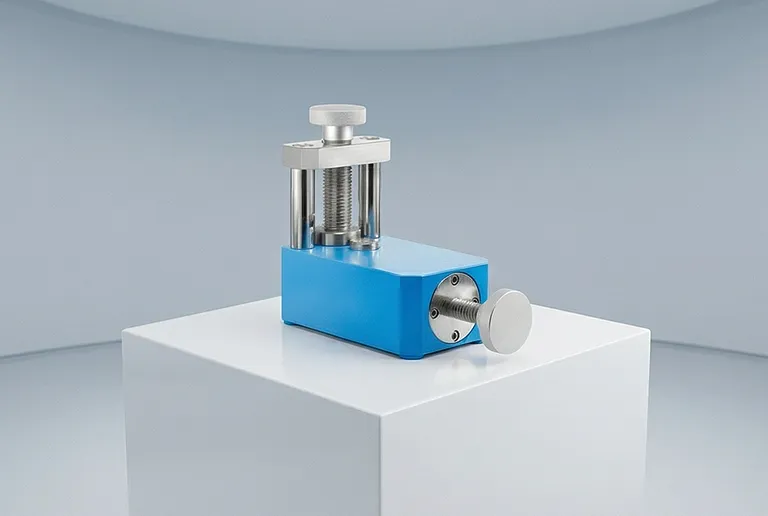
The Invisible Architecture of the Monolith
In the world of Low Temperature Co-fired Ceramics (LTCC), the transition from a stack of individual tapes to a single, functional component is a moment of profound transformation.
On the surface, it looks like a simple mechanical squeeze. In reality, it is a sophisticated thermodynamic event.
Most structural failures in multilayer ceramics don't happen during the final fire; they are born in the lamination phase. If the boundaries between layers do not "vanish" during pressing, the device is doomed before it ever reaches the kiln.
The Mechanics of the "Molecular Handshake"
At room temperature, LTCC green tapes are manageable but distinct. They contain organic binders that provide flexibility, yet these binders act as barriers. To create a monolith, these barriers must be overcome.
Softening the Organic Matrix
The heated platens of a hydraulic press serve a singular purpose: to reach the glass transition temperature of the polymers. Typically set around 70°C, this heat shifts the binders from a rigid state to a state of plastic fluidity.
Without this heat, pressure is just stress. With it, pressure becomes a catalyst for flow.
Driving Molecular Diffusion
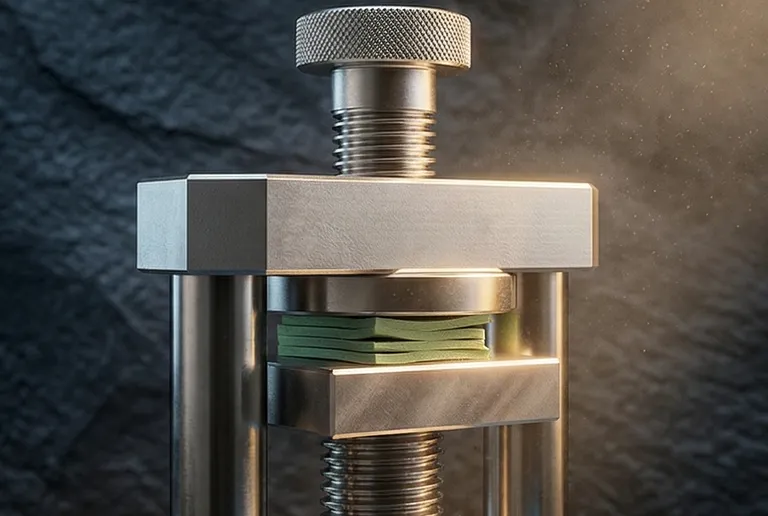
Once the matrix is softened, the hydraulic system applies uniaxial force—often reaching 50 MPa. This pressure does not just push layers together; it forces polymer chains to migrate across the interface.
This is the "molecular handshake." The boundaries effectively disappear as the glass-ceramic components interlock, creating a unified structure that can survive the violent organic burnout of the sintering process.
The Engineering Paradox: Density vs. Geometry
In material science, every gain comes with a cost. The hydraulic press is the tool used to manage this trade-off.
- The Pursuit of Density: Higher pressure eliminates interlaminar voids—tiny pockets of air or solvent that would otherwise expand and cause "blistering" during firing.
- The Preservation of Geometry: Many LTCC designs feature delicate internal flow channels or cavities for microfluidics and RF components. Excessive pressure can collapse these features, turning a high-tech sensor into a solid block of useless ceramic.
The "Engineer's Romance" lies in finding that precise equilibrium—applying enough force to ensure structural integrity without crushing the internal architecture.
Systemic Risks in the Lamination Cycle
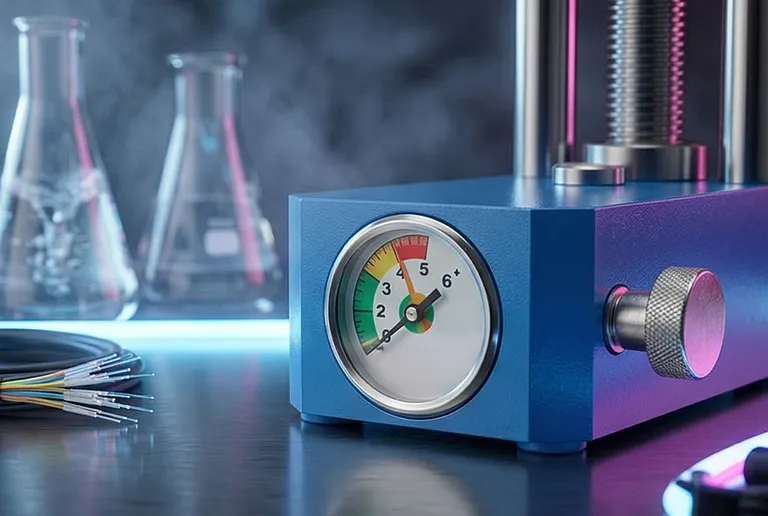
Failure in lamination is rarely about a single mistake; it is usually a systemic imbalance of variables.
- Thermal Non-Uniformity: If your platens have "cold spots," the thermoplastic flow will be incomplete. You will have a part that is bonded on the left but delaminated on the right.
- Insufficient Dwell Time: Molecular diffusion is not instantaneous. If the pressure is released too early, the polymer chains haven't had time to entangle, leading to elastic "spring-back" and layer separation.
- Pressure Spikes: In manual systems, inconsistent pressure application can disrupt particle orientation, leading to uneven shrinkage during sintering and warped final parts.
Strategic Selection: Matching Press to Purpose
| Objective | Technical Priority | Recommended Press Feature |
|---|---|---|
| Maximizing Bond Strength | Long dwell times & precise heat | Automatic Heated Press |
| Complex Internal Cavities | Low-pressure precision | Sensitive Hydraulic Control |
| High Volume Yield | Thermal consistency | Precision-Ground Heated Platens |
| Isotropic Density | Uniform multi-directional force | Warm Isostatic Press (WIP) |
Precision as a Service
At KINTEK, we understand that a laboratory press is not just a piece of hardware; it is the guardian of your material’s structural integrity.
Whether you are working on next-generation solid-state batteries or complex LTCC circuitry, the margin for error is microscopic. Our range of manual, automatic, and isostatic presses—engineered for glovebox compatibility and thermal precision—is designed to ensure that your "vanishing boundaries" stay vanished.
Master the thermodynamics of your process with equipment built for the rigors of advanced research.
Related Products
- Heated Hydraulic Press Machine with Heated Plates for Vacuum Box Laboratory Hot Press
- Automatic High Temperature Heated Hydraulic Press Machine with Heated Plates for Lab
- Heated Hydraulic Press Machine With Heated Plates For Vacuum Box Laboratory Hot Press
- 24T 30T 60T Heated Hydraulic Lab Press Machine with Hot Plates for Laboratory
- Automatic Heated Hydraulic Press Machine with Hot Plates for Laboratory
Related Articles
- The Architecture of Slow: Why Physical Precision Dictates Chemical Destiny
- The Architecture of Certainty: Why the Laboratory Press is the Anchor of Material Science
- The Alchemy of 160°C: Why Precision Pressing is the Silent Backbone of Rubber Science
- The Invisible Forge: Why the Laboratory Press is the Soul of Nano-Composites
- Beyond Tonnage: A First-Principles Guide to Selecting a Laboratory Hot Press



















