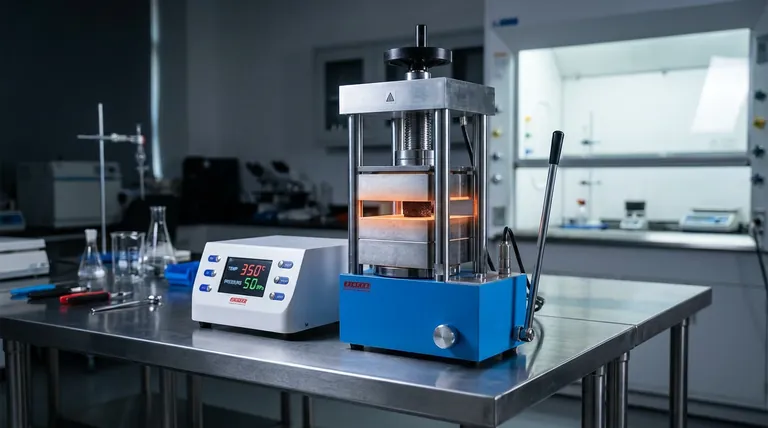
The Illusion of Brute Force
At first glance, a laboratory hot press seems simple. It heats things up and squeezes them. A child could grasp the concept.
But this simplicity is a beautiful illusion. The true purpose of a hot press isn't brute force; it's profound control. It’s an instrument designed to persuade atoms to rearrange themselves, to forge new bonds, and to create materials that nature never intended.
Every researcher who has watched a sample crack during cooling or emerge porous and weak understands this. The challenge isn’t just applying force; it’s applying the exact recipe of heat, pressure, and time in a perfectly controlled environment.
The Anatomy of Transformation
To master a material, you must first master the machine. A hot press orchestrates a delicate dance between three fundamental forces.
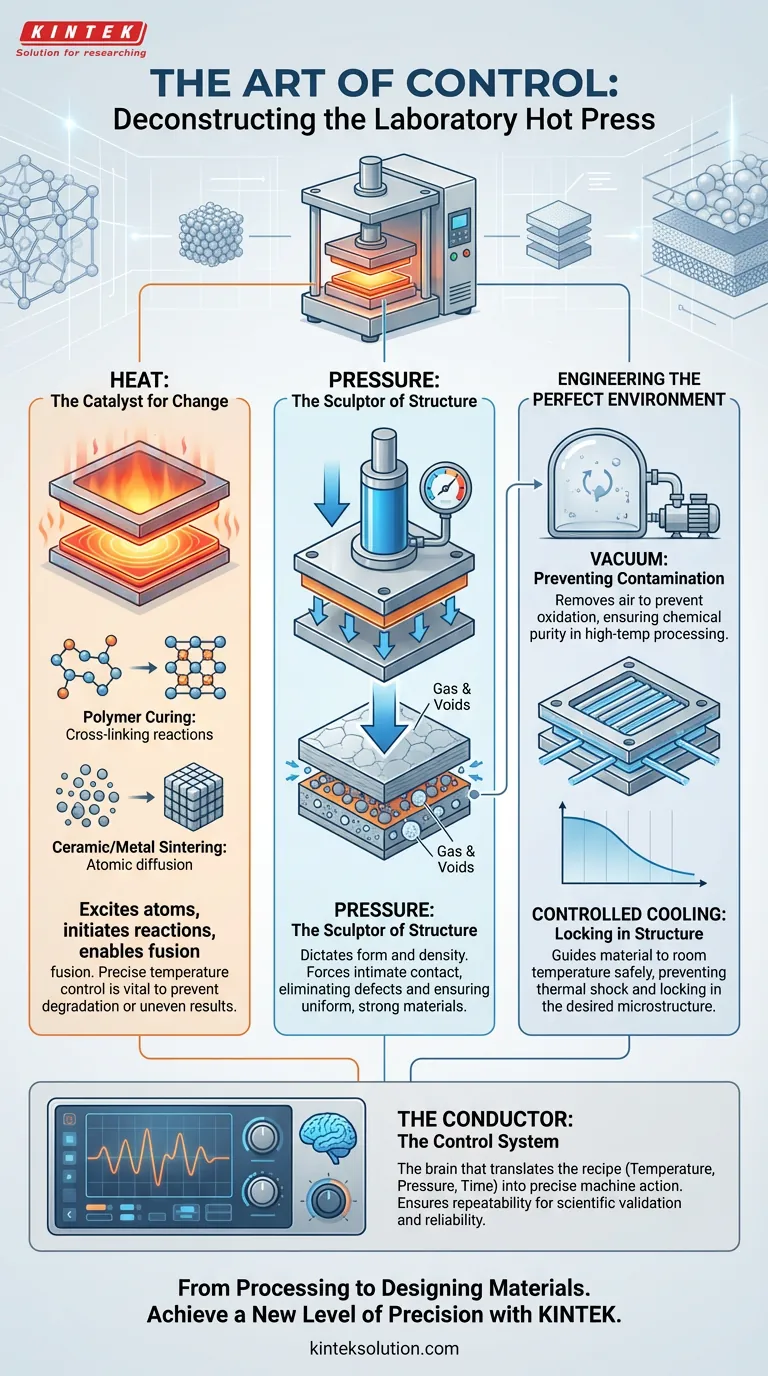
Heat: The Catalyst for Change
Heat is the invitation. It provides the thermal energy that makes a material's internal structure receptive to change.
- In polymers, it initiates the cross-linking reactions that cure the material, transforming it from a pliable resin into a rigid, durable solid.
- In ceramics and metals, it excites atoms, allowing them to diffuse across particle boundaries. This is the heart of sintering—closing the voids and fusing individual grains into a dense, monolithic block.
Without precise temperature control, a polymer degrades. Without uniform heat across the platen, one part of a sample sinters while another remains powder.
Pressure: The Sculptor of Structure
If heat is the invitation, pressure is the instruction. It dictates the final form and density of the material.
Pressure forces intimate contact between layers or particles, ensuring that the bonds initiated by heat can actually form. It squeezes out trapped gasses and volatile byproducts that would otherwise become structural defects—the starting points for catastrophic failure.
A hydraulic system doesn't just push; it applies a measured, uniform force across the entire surface, ensuring the final product is homogenous, not a chaotic mix of dense and porous regions.
Engineering the Perfect Environment
The most common source of failure in materials processing isn't a flaw in the recipe; it's contamination from the environment. Advanced presses are designed to solve this systemic problem.
The Problem of Air: Why Vacuum Matters
Air is an enemy at high temperatures. Oxygen is aggressive, eagerly reacting with hot metals and ceramics to form brittle, unwanted oxide layers.
This is why high-fidelity hot presses, like those from KINTEK, are often equipped with a vacuum chamber. By removing the air, the process occurs in an inert environment. It ensures the material you put in is the material you get out, chemically pure and structurally sound.
The Cool-Down: As Critical as the Heat-Up
The journey isn't over when the target temperature is reached. The cooling phase is where the material's final microstructure is locked in.
- Too fast, and thermal shock can introduce a network of micro-cracks, fatally compromising the sample's integrity.
- Too slow, and you might not achieve the desired crystalline phase.
Controlled cooling systems, often using water channels within the platens, provide the final, crucial step of control, guiding the material safely back to room temperature.
The Conductor of the Orchestra: The Control System
The frame, platens, and hydraulics are the orchestra. The control system is the conductor.
This is the brain where the researcher's recipe—the precise curve of temperature over time, the exact pressure ramp, the hold duration—is translated into machine action. The difference between a failed experiment and a breakthrough often comes down to repeatability.
A robust control system ensures that the hundredth sample is identical to the first. It provides the consistency needed for scientific validation and the reliability needed for developing new technologies. That's why KINTEK’s range of automatic and heated lab presses focuses on intuitive, precise controls—to put the power of creation directly into the researcher's hands.
Choosing Your Instrument
The right tool depends on the art you wish to create.
| Objective | Critical Feature |
|---|---|
| Polymer & Composite Curing | Precise temperature/time control, platen parallelism |
| Ceramic & Metal Sintering | High-temperature capability, integrated vacuum system |
| Sample Prep for Analysis | High repeatability, user-friendly control interface |
| Bonding Dissimilar Layers | Uniform pressure distribution, controlled cooling rates |
Ultimately, the lab press is more than a machine. It's a fundamental tool that grants you direct command over the very properties of matter. By understanding its systems not as separate parts but as an integrated instrument of control, you can move from merely processing materials to truly designing them.
Ready to achieve a new level of precision in your materials research? Contact Our Experts
Visual Guide
Related Products
- 24T 30T 60T Heated Hydraulic Lab Press Machine with Hot Plates for Laboratory
- Laboratory Split Manual Heated Hydraulic Press Machine with Hot Plates
- Heated Hydraulic Press Machine with Heated Plates for Vacuum Box Laboratory Hot Press
- Automatic Heated Hydraulic Press Machine with Hot Plates for Laboratory
- Laboratory Manual Heated Hydraulic Press Machine with Hot Plates
Related Articles
- The Invisible Forge: Why the Laboratory Press is the Soul of Nano-Composites
- The Architecture of Slow: Why Physical Precision Dictates Chemical Destiny
- The Architecture of Density: Why Pressure is the Silent Architect of Solid-State Batteries
- The Physics of Transparency: Why Pressure is the Silent Architect of Spectroscopic Clarity
- The Architecture of Certainty: Why the Laboratory Press is the Anchor of Material Science



















